Drill the real task types · Target 120 · Stay calm, never stop
How the test works
About one hour, taken at home, and adaptive — it gets harder when you do well. It scores you 10–160. 120 is roughly IELTS 6.5.
Four scores make up your result: Production — how well you speak and write · Conversation — understanding and replying · Comprehension — reading and listening · Literacy — reading and writing.
The tasks are short and mixed: reading, listening, speaking to your webcam, writing, and typing what you hear.
The golden rule: NEVER STOP. Keep speaking, keep writing, fill the whole time. If a word won't come, say the idea another way. Silence and blank space score nothing.
Nerves plan: you already know more English than the test will show if you freeze. So we build habits you can fall back on when your mind goes blank — a simple structure for every speaking and writing task, so you are never staring at nothing.
Warm up (60 seconds)
Talk about your day so far. Don't stop, don't correct yourself — just keep the words coming until the timer ends. This is the single most important habit for the test.
01:00
Read Aloud
A sentence appears; you read it to the microphone. It scores your pronunciation and fluency. The trick is not speed — it's a steady, clear pace with every word finished.
How to win it: read the sentence silently first. Break it into phrases at the commas. Then read at a calm, even speed — pronounce the endings (-s, -ed), and don't trail off at the end. A clear slow reading beats a rushed one.
Read each one aloud — twice
READ ALOUD The library closes early on Sundays, so we should go tomorrow morning instead.
READ ALOUD Although the weather was cold, hundreds of people gathered in the main square.
READ ALOUD She explained that the results would be published at the end of the month.
READ ALOUD Renewable energy has become significantly cheaper over the last decade.
READ ALOUD I would appreciate it if you could send me the details before Friday afternoon.
Watch: the -ed ending (gathered, explained, published) — don't drop it. The -s ending (closes, results, details). The th in although, month, the. And breathe at the comma instead of racing through.
Fluency lap (45 seconds)
Read the five sentences above one after another, smoothly, as if you were reading the news. Aim to sound calm and clear.
00:45
Describe the Photo
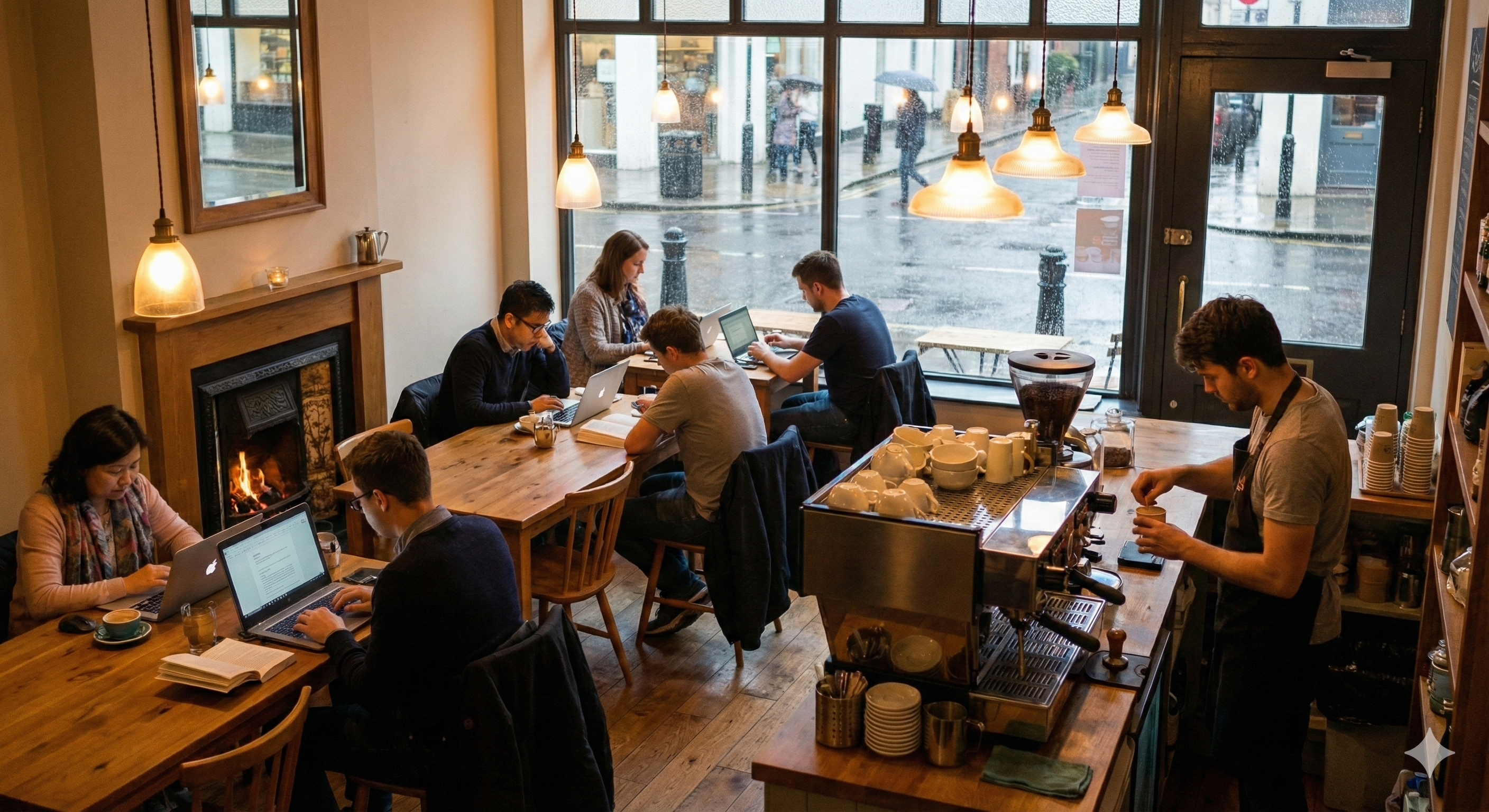
You get a picture and must write about it (one minute) and later speak about it (90 seconds). The secret is a structure so you never run dry: general → details → a guess.
The frame: 1) Say what it is in general (“This is a café…”). 2) Add details — who, what, where, what they are wearing or doing. 3) Make a guess about the situation (“She is probably working, maybe a student…”). Three steps = you always fill the time.
Write about the photo (at least three sentences), then read it back:
One good version: “This is a café or a coffee shop. In the picture, a young woman is sitting at a wooden table, working on a laptop. There is a cup of coffee next to her, and a bright window behind. She is probably a student or someone working remotely, and she looks focused on her task.”
Now speak about it (90 seconds)
Say the same thing out loud, but keep going past your written sentences — add anything: the colours, the mood, what she might do next. Do not stop until the timer ends.
01:30
Speak on a Topic
You read or hear a question, get a few seconds to prepare, then speak. Same rescue structure every time: your answer → two reasons → one example. Then keep talking till it ends.
Use your prep seconds well: don't plan perfect sentences — just pick your position + two reasons + one real example from your life. That is enough to speak for the whole time without freezing.
SPEAK · 90s Describe a place you would like to visit, and explain why you want to go there.
30 seconds to plan, then speak
00:3001:30
SPEAK · 90s Some people prefer to study alone. Others prefer to study in a group. Which do you prefer, and why?
SPEAK · 90s Talk about a skill you would like to learn, and explain how you would learn it.
SPEAK · 90s Do you think it is better to live in a big city or in the countryside? Give your reasons.
Keep these ready: “Personally, I think…” · “There are two main reasons…” · “The first reason is…” · “For example, in my own experience…” · “Another thing is…” · “So overall, I would say…” If a word disappears, say: “in other words…” and explain it differently.
Do all four (90 seconds each)
Pick a card, take your 30 seconds, then speak for the full 90. No stopping.
01:30
Listen & Type — and quick vocabulary
Typing exactly what you hear is worth a lot of marks and is very trainable. In the test you can replay once. Here, your teacher reads each sentence twice — type exactly what you hear, then check.
Dictation
1. Type the sentence you hear:
2. Type the sentence you hear:
3. Type the sentence you hear:
4. Type the sentence you hear:
Real word or not?
The test shows a list of words; you pick the real ones. Speed and instinct.
Which is a real English word?
Which is a real English word?
Complete the word
The experiment was a complete succ___ (result of doing well).
She works as a software engin___ (person who designs systems).
We need to make a final deci___ (a choice) by Friday.
The Writing Sample
A longer piece of writing appears in your score report, so accuracy matters here — especially tenses, articles and agreement. Structure it and leave 30 seconds to check.
The plan: 1) State your opinion in one clear sentence. 2) Reason one + an example. 3) Reason two + an example. 4) One-sentence conclusion. Simple, correct sentences score better than long, broken ones.
WRITE · 5 min Some universities require students to attend classes in person. Others allow online learning. Which do you think is better, and why?
05:00
Check your own writing before you finish
Every verb is in the right tense (past for finished time, present perfect for since/for).
Singular/plural agree: she works, they work.
Articles are there: a, an, the where needed.
I gave an opinion, two reasons, an example each, and a conclusion.
I filled the space — no half-empty box.
One month plan: a full mini-mock of these six tasks every few days, timed, under real conditions — so the real test feels like something you have already done many times.