The map
Hover over any word on the map. Each small box opens that term in its lesson, each heading opens the lesson, and each poet's name opens a real poem to analyse.
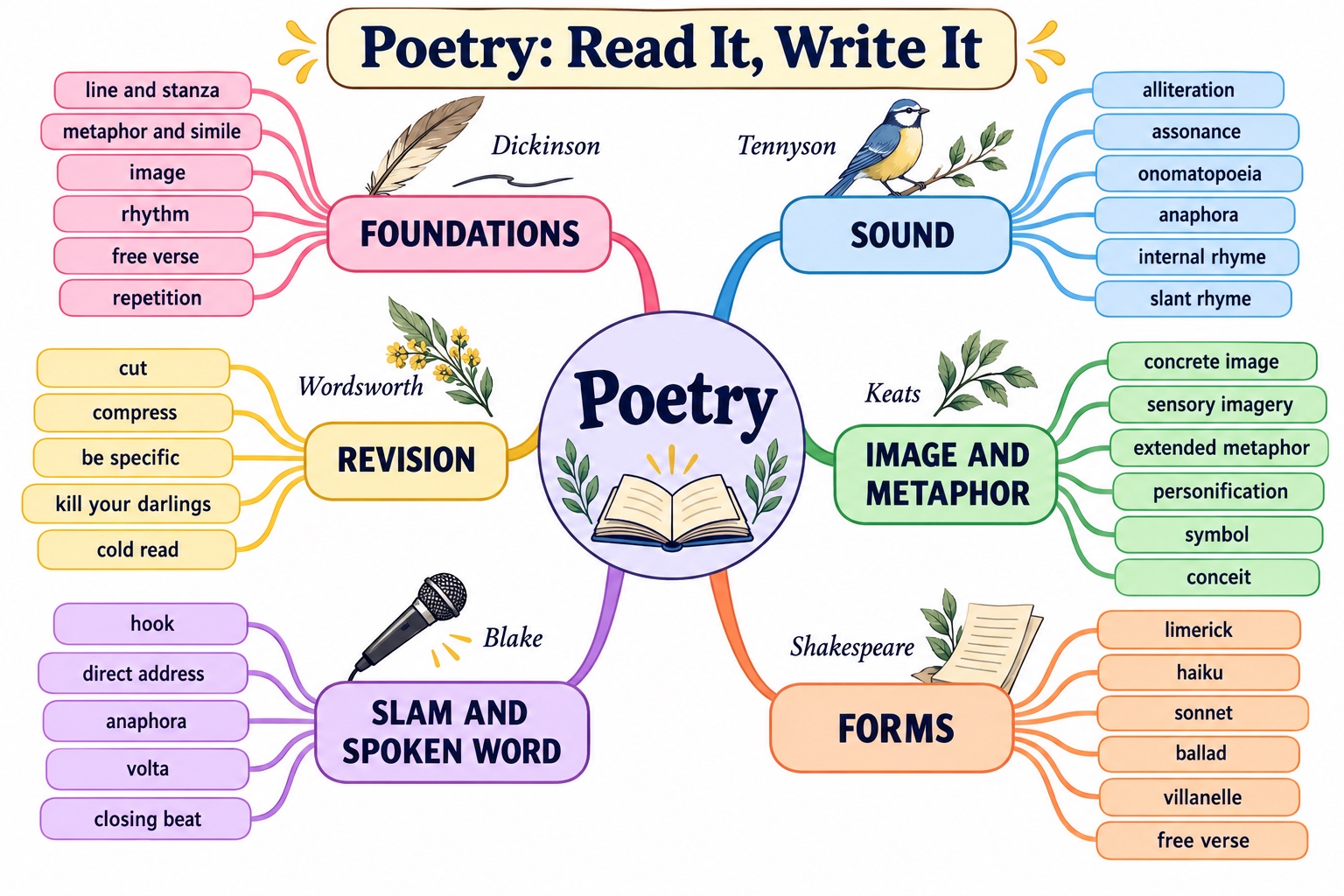
Every word on the map is a link.
The six lessons
Foundations
What makes a poem a poem: line, stanza, metaphor, simile, image, rhythm, free verse, repetition.
Real poem: Emily Dickinson, "Hope" is the thing with feathers
Lesson 2Sound: The Music-Making Toolkit
Alliteration, assonance, consonance, onomatopoeia, anaphora, parallelism, internal and slant rhyme.
Real poem: Tennyson, The Eagle
Lesson 3Image & Metaphor
Show don't tell: concrete and sensory imagery, extended metaphor, personification, symbol, conceit.
Real poem: Keats, To Autumn
Lesson 4Forms
Limerick, haiku, sonnet, ballad, villanelle, ghazal, free verse, blank verse, and when form helps.
Real poem: Shakespeare, Sonnet 18; Bashō's frog haiku
Lesson 5Slam & Spoken Word
Writing for the stage: the hook, personal stakes, direct address, anaphora, the volta, the closing beat.
Real poem: Blake, London
Lesson 6Revision
Turning a draft into a poem: cut, compress, be specific, kill your darlings, cold reading.
Real poem: Wordsworth, two versions of the daffodils poem
- Warm-up: a short idea about poetry
- Vocabulary: eight tools to learn
- Reading: a poem written for the lesson
- Drill: test yourself on new lines
- A Real Poem: read, analyse and discuss a famous poem
- Your Turn: write with a frame to help you
- Free Write: write your own poem with no frame