Major Philosophers & Their Ideas
Memorise 10 philosophical giants and their key concepts
← The course · ← Dewey 000 Computer science · Dewey 200 Religion →
Review: What Do You Know About Philosophy?
Let's activate your prior knowledge about philosophy before learning these 10 major philosophers.
- What is philosophy? (literally "love of wisdom")
- Name any famous philosopher you know
- What's the difference between Eastern and Western philosophy?
- What areas does philosophy study? (ethics, logic, metaphysics...)
- Why is the Socratic Method famous?
Memory Connection
We'll group these 10 philosophers by era and region. This chunking strategy helps your brain organise them into memorable patterns.
10 Major Philosophers
Click each philosopher to reveal their key ideas. Notice the time periods — we'll use these to build a timeline memory.
First Pass Strategy
You've seen all 10 philosophers. Don't worry about memorising yet. Notice patterns: ancient Greece (3 people), early modern and Enlightenment (3 people), Eastern (2 people), 19th century (1 person), 20th century (1 person).
Guided Practice: Memory Palace of Wisdom
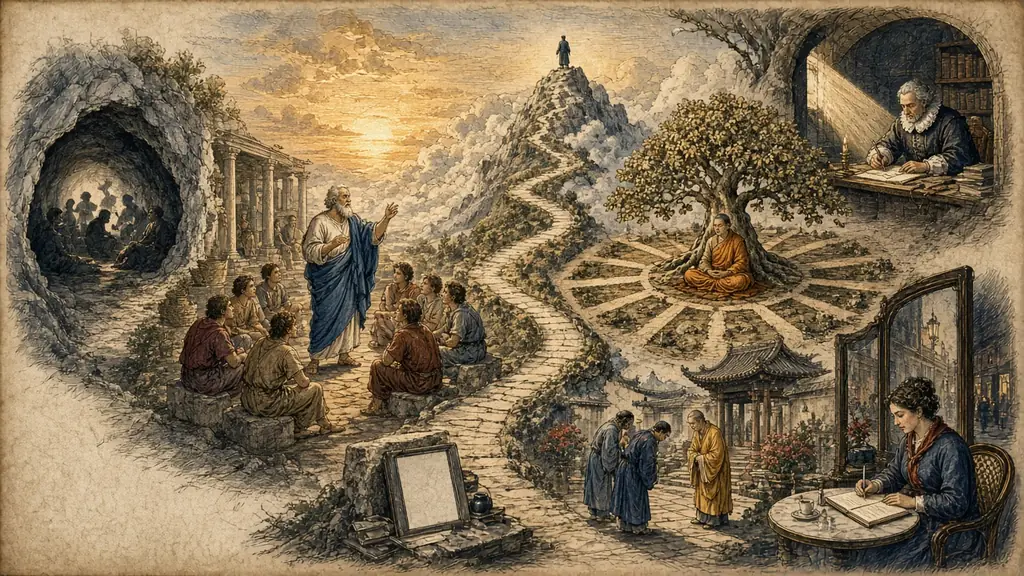
Build a memory palace through famous buildings/locations where these philosophers lived or taught.
1. Athens Agora (Socrates)
Scene: Socrates is surrounded by young students in the marketplace, asking them tricky questions that make their heads explode with confusion and enlightenment.
2. Plato's Academy (Plato)
Scene: Above the Academy entrance: "Let no one ignorant of geometry enter here." Inside, Plato draws perfect FORMS on the wall — ideal shapes that cast shadows like his cave allegory.
3. The Lyceum (Aristotle)
Scene: Aristotle walks in circles (peripatetic school) with students, lecturing about VIRTUE — the golden mean between two extremes on either side of him.
4. René's Study (Descartes)
Scene: Descartes sits in a dark room. He doubts EVERYTHING he sees — maybe it's a demon tricking him. But then he realises: he's THINKING, so he must EXIST. Light floods in.
5. Locke's Library (John Locke)
Scene: Books are being written on blank pages (TABULA RASA) as experiences pour in from windows. Knowledge builds from experience, not innate ideas.
6. Kant's Königsberg (Immanuel Kant)
Scene: Kant walks the same route every day (he was famously predictable). On every street corner: giant stone tablets with the CATEGORICAL IMPERATIVE written in gold.
7. Nietzsche's Mountain (Friedrich Nietzsche)
Scene: Nietzsche stands on a high mountain peak. Below, the world is "beyond good and evil." He's reached the "overman" status. A statue of God shatters at his feet.
8. Confucius's Courtyard (Confucius)
Scene: Five circles intersect in the centre — the FIVE RELATIONSHIPS. Students bow deeply to elders and ancestors. Respect and harmony radiate outward in concentric circles.
9. Buddha's Bodhi Tree (Gautama Buddha)
Scene: Buddha sits under the tree. He nods "yes" four times (FOUR NOBLE TRUTHS), then traces an eight-fold path on the ground with his staff.
10. Simone's Parisian Café (Simone de Beauvoir)
Scene: Simone sits at a café table. A mirror shows her image, but it keeps CHANGING (she's not born, she BECOMES). The words "The Second Sex" float in cigarette smoke.
Memory Anchor Principle
Each location is tied to a real place the philosopher was known for. This uses the Method of Loci combined with spatial memory. The more vivid and strange your mental images, the stronger the memory!
Elaboration: Why Philosophers Matter
Understanding the IMPACT of each philosopher helps your memory stick. These ideas shaped the world.
How They Build on Each Other
- Socrates → Plato → Aristotle = Foundation of Western thought
- Descartes = Shifted from faith to reason (modern philosophy begins)
- Locke = Grounded knowledge in experience, influenced democracy
- Kant = Synthesised Descartes and Locke; revolutionised ethics
- Nietzsche = Rejected ALL previous morality (radical rupture)
- Eastern Philosophers = Different paths to wisdom (not better/worse, just different)
"I'm not afraid of storms, for I'm learning how to sail my ship."
Real-World Impact
Confucius: Shaped Asian governance and family structures for 2,500 years. Confucianism is still taught in schools.
Locke: Inspired the American Declaration of Independence ("life, liberty, and pursuit of happiness").
Kant: His Categorical Imperative is a standard topic in ethics courses. His idea that people must always be treated as ends in themselves, never merely as means, has strongly influenced modern thinking about human dignity and rights.
Buddha: 500 million Buddhists worldwide live by Four Noble Truths. His ideas shaped Eastern psychology and medicine.
Descartes: "Cogito ergo sum" is THE most famous philosophical statement. It anchors modern thought in the individual mind.
Simone de Beauvoir: Inspired second-wave feminism. Women's rights movements worldwide cite her work.
Independent Practice: Timed Recall Challenge
You have 90 seconds to recall all 10 philosophers, their key ideas, and their approximate era.
Select Your Challenge Time
Answer key
The key stays hidden until the timer runs out, so you recall first and check afterwards.
- Socrates | Socratic Method, Know Thyself | Ancient Greece (470-399 BC)
- Plato | Theory of Forms, The Republic | Ancient Greece (428-348 BC)
- Aristotle | Logic, Virtue Ethics | Ancient Greece (384-322 BC)
- Descartes | Cogito Ergo Sum | Early modern rationalism (1596-1650)
- John Locke | Tabula Rasa, Social Contract | Enlightenment (1632-1704)
- Kant | Categorical Imperative | Enlightenment (1724-1804)
- Nietzsche | Will to Power, God is Dead | Modern (1844-1900)
- Confucius | Five Relationships, Filial Piety | Eastern (551-479 BC)
- Buddha | Four Noble Truths, Eightfold Path | Eastern (563-483 BC)
- Simone de Beauvoir | Existentialism, The Second Sex | 20th Century (1908-1986)
Final Review: The Ultimate Recall Test
10 questions. Each reveals one philosopher when you're ready. Try to answer BEFORE revealing.
Q1: Who created the Socratic Method and taught Plato?
Q2: Who believed in the Theory of Forms and founded the Academy?
Q3: Who taught virtue ethics and founded the Lyceum?
Q4: Who said "Cogito, Ergo Sum"?
Q5: Who believed people are born as "blank slates"?
Q6: Who created the Categorical Imperative?
Q7: Who said "God is Dead" and taught Will to Power?
Q8: Who taught the Five Relationships and Filial Piety?
Q9: Who taught the Four Noble Truths and the Eightfold Path?
Q10: Who wrote "The Second Sex" and championed existentialism?
Lesson Complete!
You've learned the 10 greatest philosophers in Western and Eastern history. These thinkers shaped how we think about ethics, knowledge, meaning, and human nature. Use your memory palace to anchor these ideas, and return to the timeline whenever you need to recall them.