Test yourself on what you've learned from earlier Dewey lessons. Click to reveal answers:
What is the Dewey Decimal range for LANGUAGE (Lesson 400)?
400-499: Covers linguistics, grammar, specific languages, dictionaries
What memory technique did you use to remember the Dewey main classes?
Major System numbers or Story Method linking all 10 main categories (0-100, 200, etc.)
What is the range immediately BEFORE 500 (Natural Sciences)?
400-499: Language & Linguistics
Name two memory palace locations you've used so far from your previous Dewey lessons.
Examples: Your home's rooms, a journey through campus, familiar landmarks on your street
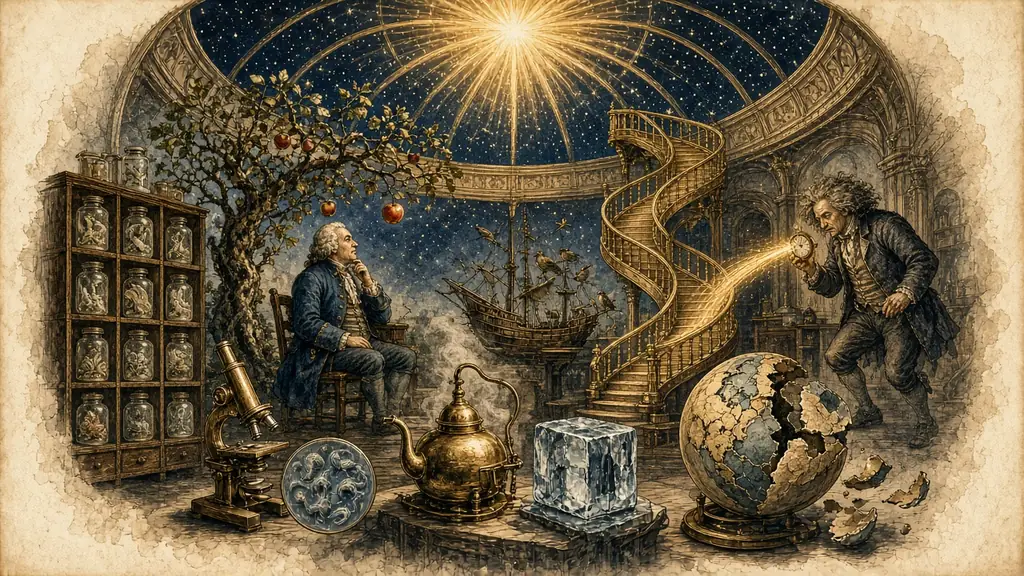
Ready? You're about to memorise 10 scientific breakthroughs that shaped modern science. Let's go to the New Content tab!
New Content: 10 Scientific Laws & Discoveries
Click each fact to reveal the date, formula, and a memory tip. Try to internalise the core discovery first!
Fact 1
Newton's Laws of Motion
Click to reveal details...
Year: 1687
Key Formula: F = ma (Force equals mass times acceleration)
Impact: Foundation of classical mechanics
Memory Anchor: NEWTON'S APPLE (1687) - Imagine Newton being struck by 1,687 apples falling with increasing speed. Each apple = force. His mass × motion = F=ma!
Fact 2
Theory of Relativity
Click to reveal details...
Year: 1905
Key Formula: E = mc² (Energy equals mass times the speed of light squared)
Discoverer: Albert Einstein
Memory Anchor: EINSTEIN'S BEARD ON FIRE (1905) - Visualise Einstein's wild hair catching fire as E=mc² energy. Major System: 19=TAPE + 05=SAIL → Picture Einstein with TAPE on his beard, sailing through space on a SAIL!
Fact 3
Evolution by Natural Selection
Click to reveal details...
Year: 1859
Discoverer: Charles Darwin
Key Idea: Species adapt and change over time through survival of the fittest
Memory Anchor: DARWIN'S BEAGLE TRANSFORMATION (1859) - Imagine Darwin's ship's beagle evolving into different animals before his eyes. Major System: 18=DOVE + 59=LIP → Picture a DOVE with giant LIPS evolving on Darwin's ship!
Fact 4
The Periodic Table
Click to reveal details...
Year: 1869
Creator: Dmitri Mendeleev
Key Data: 118 chemical elements organised by atomic weight and properties
Memory Anchor: MENDELEEV'S WALL OF 118 TILES (1869) - Picture a giant periodic table wall in Mendeleev's lab with 118 glowing tiles. Major System: 18=DOVE + 69=SHIP → Picture a DOVE flying around a SHIP filled with periodic table elements!
Fact 5
DNA Structure (Double Helix)
Click to reveal details...
Year: 1953
Discoverers: Watson & Crick (with Photo 51 by Franklin)
Memory Anchor: TWO TWISTED DANCERS (1953) - Imagine Watson and Crick as two dancers spiraling around each other in a double helix. Major System: 19=TAPE + 53=LAMB → Picture DNA strands made of TAPE twisted around a LAMB!
Fact 6
Germ Theory
Click to reveal details...
Year: 1861
Founder: Louis Pasteur
Key Idea: Diseases caused by microscopic organisms (germs), not bad air
Memory Anchor: PASTEUR'S MICROSCOPE ARMY (1861) - Visualise Pasteur discovering an army of tiny germs marching under his microscope. Major System: 18=DOVE + 61=JET → Picture a DOVE flying on a JET spraying germs!
Fact 7
Laws of Thermodynamics
Click to reveal details...
Year: 1850s-1870s (developed over time)
Core Concept: Energy cannot be created or destroyed, only transformed (conservation of energy)
Key Law: First Law: Energy is conserved; Second Law: Entropy always increases
Memory Anchor: ENERGY NEVER DIES, JUST GETS MESSY - Imagine a phoenix burning (energy transferred) but the ashes never disappear (entropy). Energy transformation = thermodynamic laws.
Fact 8
Quantum Mechanics
Click to reveal details...
Year: 1900 (Planck's quantum hypothesis)
Founder: Max Planck
Key Idea: Energy comes in discrete packets called "quanta," not continuous waves
Memory Anchor: PLANCK'S PIXEL WORLD (1900) - Imagine reality as a pixelated video game where energy jumps from pixel to pixel. No smooth transitions, just discrete quantum jumps. 1900 = easy to remember!
Key Idea: Earth's continents move slowly on tectonic plates
Memory Anchor: PUZZLE PIECES SLIDING ON ICE (1912) - Visualise Earth's continents as puzzle pieces slowly sliding across the planet's surface. South America and Africa fitting together like a puzzle.
Fact 10
Big Bang Theory
Click to reveal details...
Year: 1927 (proposed by Lemaître)
Theorist: Georges Lemaître
Key Data: Universe began ~13.8 billion years ago from a single point of infinite density
Memory Anchor: THE COSMIC EXPLOSION BIRTH (1927) - Imagine a massive explosion creating all of existence at once. Lemaître's "cosmic egg" cracking open. 13.8 billion years = "1-3-8-B" encode as Major System.
Guided Practice: Build Your Memory Palace
Let's place these 10 scientific discoveries in a memory palace. Click each location and assign a fact to it. Visualise the image vividly!
Your Memory Palace: A Science Museum
Journey through 10 rooms in a grand science museum. Place one fact in each location.
Entrance
Newton's apple falls infinitely: F=ma
Newton's Laws
Main Hall
Einstein's hair on FIRE with E=mc² energy
Relativity
Evolution Room
Darwin's beagle transforms into all creatures
Natural Selection
Periodic Wall
118 glowing tiles of elements line the wall
Periodic Table
DNA Gallery
Two dancers spiraling as a double helix
DNA Structure
Microscope Lab
Pasteur's army of tiny germs marching
Germ Theory
Engine Room
Phoenix burning and transforming energy
Thermodynamics
Quantum Chamber
Reality as pixelated video game with quantum jumps
Quantum Mechanics
Tectonic Vault
Puzzle pieces (continents) sliding on ice
Plate Tectonics
Cosmic Chamber
Universe explodes into existence from cosmic egg
Big Bang
Memory Task
Close your eyes and mentally walk through your science museum. Visit each room and see the vivid image in that location. Spend 30 seconds per room, engaging all 5 senses.
Elaboration: Why These Discoveries Matter
Understanding the connections between these discoveries helps deepen memory. Here's how they relate:
The Story of Modern Science
1687: Newton's Laws - The foundation of physics. Everything that moves follows these rules. Without Newton, we couldn't predict planetary motion or build machines.
1859: Darwin's Evolution - Explains how life on Earth diversified. Bridges physics and biology by showing life adapts to environmental laws.
1861: Germ Theory (Pasteur) - Revolutionised medicine and public health. Showed diseases aren't magic, but caused by microscopic life following biological laws.
1869: Periodic Table (Mendeleev) - Organised all matter into predictable patterns. Showed that atoms follow mathematical rules, bridging Newton's physics and chemistry.
1905: Relativity (Einstein) - Revealed that Newton's laws only work at normal speeds. At extreme speeds/gravity, spacetime bends. Energy and matter are interchangeable (E=mc²).
1900-1927: Quantum Mechanics & Thermodynamics - At tiny scales (atoms), energy behaves as particles, not waves. At large scales, energy always increases in disorder (entropy). These describe the hidden rules of the universe.
1912: Plate Tectonics (Wegener) - Applied physics to Earth itself. Continents move due to internal heat and pressure—proving physics operates even on planetary scales.
1927: Big Bang (Lemaître) - Combined relativity, thermodynamics, and observations to explain the universe's beginning. The ultimate application of physical laws to all of existence.
1953: DNA Structure (Watson & Crick) - Shows how life encodes information at the molecular level. Combines chemistry, physics, and biology. Explains how evolution works at the atomic scale.
The Web of Connections
Why memorise these together? Each discovery is a building block. Newton gave us mechanics. Darwin showed life changes. Chemistry (Periodic Table) revealed matter's nature. Einstein showed matter and energy are one. Quantum mechanics explained atoms. DNA connected chemistry to life. Big Bang connected physics to the universe. This isn't random facts—it's the story of how humans understood reality.
You have 90 seconds to memorise as many facts as possible. Use your memory palace technique. Go as fast as you can!
Memorisation Timer
1:30
Rapid-Fire Facts (Reveal and Memorise)
Click each fact quickly. Your mind will link it to the palace location.
Newton's Laws of Motion
1687 | F = ma
Einstein's Theory of Relativity
1905 | E = mc²
Darwin's Natural Selection
1859 | Survival of the Fittest
Mendeleev's Periodic Table
1869 | 118 Elements
Watson & Crick's DNA Structure
1953 | Double Helix
Pasteur's Germ Theory
1861 | Microscopic Organisms
Laws of Thermodynamics
1850s-1870s | Energy Conservation
Planck's Quantum Mechanics
1900 | Energy Quanta
Wegener's Plate Tectonics
1912 | Continental Drift
Lemaître's Big Bang Theory
1927 | Universe ~13.8B Years Old
Challenge Complete!
0
Facts Memorised
Great effort! Now move to the Final Review tab to test your recall without looking at these cards.
Final Review: Recall All 10 Facts
Test yourself! How many can you recall from memory? Click each to reveal the answer.
1. What is Newton's fundamental law of motion formula from 1687?
F = ma (Force = mass × acceleration) | Memory: Newton's apple strikes 1,687 times, each adding speed
2. What is Einstein's famous equation from 1905, and what does it mean?
E = mc² (Energy = mass × speed of light squared) | Shows matter and energy are interchangeable
3. Who discovered evolution by natural selection in 1859, and what was his ship called?
Charles Darwin on the HMS Beagle (1859) | Memory: Beagle transforms into many creatures
4. Who organised the periodic table in 1869, and how many elements does it contain?
Dmitri Mendeleev discovered 118 chemical elements (1869) | Memory: 118 glowing tiles on a wall
5. In 1953, who discovered DNA's structure, and what is its shape?
Watson & Crick (Photo 51 by Franklin) | Double Helix (1953) | Memory: Two dancers spiraling together
6. What major theory did Louis Pasteur prove in 1861?
Germ Theory (1861) | Diseases are caused by microscopic organisms, not bad air | Memory: Army of germs under microscope
7. What is the first law of thermodynamics, and when was it formulated?
Energy cannot be created or destroyed, only transformed (1850s-1870s) | Memory: Phoenix burning but never dying, just changing form
8. Who developed the concept of quantum mechanics in 1900, and what did he discover?
Max Planck (1900) | Energy comes in discrete packets called "quanta," not continuous waves | Memory: Pixelated video game where energy jumps between pixels
9. Who proposed plate tectonics in 1912, and what does the theory explain?
Alfred Wegener (1912) | Earth's continents move slowly on tectonic plates | Memory: Puzzle pieces sliding on ice
10. Who proposed the Big Bang Theory in 1927, and how old is the universe?
Georges Lemaître (1927) | Universe is approximately 13.8 billion years old | Memory: Cosmic explosion from infinite point creating all existence
I CAN Statement
I can recall 10 major scientific discoveries and their dates using memory palace techniques.