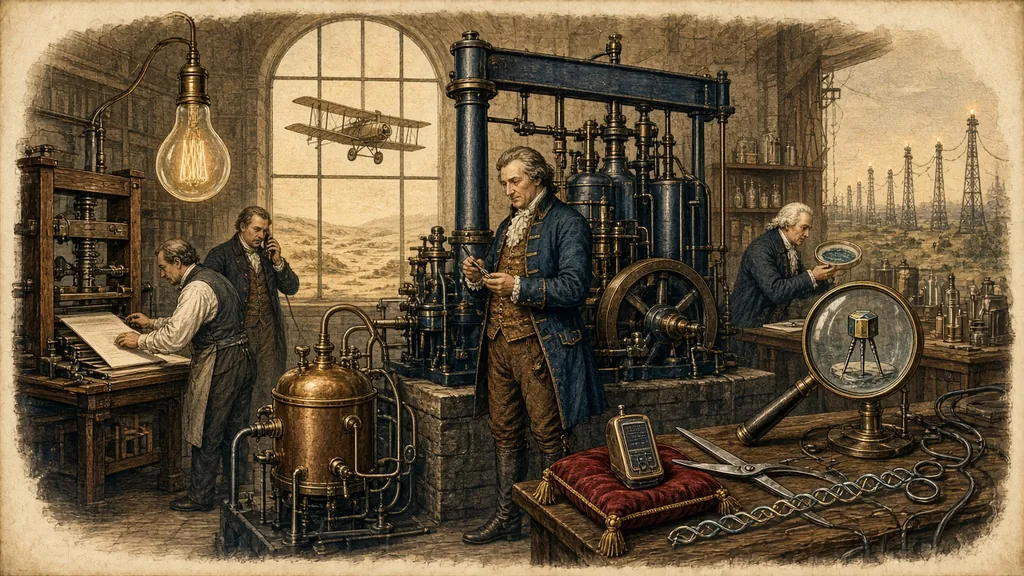
Before memorising technology breakthroughs, recall these science facts that made them possible:
From Dewey 500: Who discovered E=mc² and in what year?
Albert Einstein in 1905 | This equation enables nuclear technology!
From Dewey 500: What did Pasteur prove about disease in 1861?
Germ Theory | Diseases are caused by microscopic organisms | Foundation for medical technology
From Dewey 500: What discovery did Watson & Crick make in 1953?
DNA's double helix structure | This led to biotechnology and genetic engineering
How does Newton's Laws (1687) apply to engineering and flight?
F=ma governs all mechanical motion, essential for designing engines, planes, and machines
Connection: Dewey 500 (Science) describes WHAT happens in nature. Dewey 600 (Technology) describes HOW we USE that knowledge to build things. Ready to memorise 10 world-changing inventions?
New Content: 10 Revolutionary Inventions
Click each invention to reveal the date, inventor, and a vivid memory image. Try to see the story!
Invention 1
Printing Press
Click to reveal details...
Year: 1440
Inventor: Johannes Gutenberg
Impact: Made books cheap and accessible. Enabled mass communication and literacy.
Memory Anchor: GUTENBERG'S MOVING TYPE STAMPEDE (1440) - Imagine thousands of metal letters dancing and jumping like stampeding animals, each stamping itself onto pages. 1440 = "1-4-4-0" = Major System image.
Invention 2
Steam Engine
Click to reveal details...
Year: 1769
Inventor: James Watt (improved Thomas Newcomen's earlier engine)
Impact: Powered the Industrial Revolution. Moved from human/animal power to machine power.
Memory Anchor: WATT'S SECOND CHAMBER (1765/1769) - Picture Watt repairing a model of Newcomen's engine in Glasgow in 1765 and bolting on a separate cold chamber where the steam condenses, so the main cylinder stays hot and the engine burns far less coal. He patented the separate condenser in 1769. (The famous story of young Watt watching a kettle is a family legend, not how the idea came.) 1769 = place in your memory palace.
Invention 3
Telephone
Click to reveal details...
Year: 1876
Inventor: Alexander Graham Bell
Impact: Enabled instant voice communication across distances.
Memory Anchor: BELL'S RINGING VOICES (1876) - Visualise a giant bell (BELL's name!) ringing with human voices flowing through the ringing sound. Voices travel through vibrations. 1876 = "1-8-7-6" = Major System.
Invention 4
Light Bulb
Click to reveal details...
Year: 1879
Inventor: Thomas Edison
Impact: Practical electric lighting transformed daily life, extended work hours, improved safety.
Memory Anchor: EDISON'S 1000 GLOWING BULBS (1879) - Imagine Edison's lab exploding with 1,000 light bulbs suddenly blazing with golden light. Each bulb a failed attempt before the final success. 1879 = place in your memory palace.
Invention 5
Airplane
Click to reveal details...
Year: 1903
Inventors: Wright Brothers (Orville & Wilbur)
Impact: First powered, heavier-than-air flight. Opened age of aviation and global travel.
Memory Anchor: TWO BROTHERS SOARING OVER MOUNTAINS (1903) - Picture Orville and Wilbur Wright sitting on their wooden plane, flying over the landscape. 12-second flight at Kitty Hawk. Major System: 19=TAPE + 03=SAM → Imagine TAPE wrapped around SAM (Uncle Sam) flying with the Wrights!
Invention 6
Penicillin
Click to reveal details...
Year: 1928
Discoverer: Alexander Fleming
Impact: First antibiotic medicine. Transformed medicine from death sentences to curable infections.
Memory Anchor: FLEMING'S MOULDY PETRI DISH MIRACLE (1928) - Visualise Fleming in his lab, noticing a forgotten petri dish growing blue-green mould, suddenly realising it kills bacteria. Major System: 19=TAPE + 28=KNIFE → Picture Fleming cutting mould with a KNIFE wrapped in TAPE!
Invention 7
Transistor
Click to reveal details...
Year: 1947
Inventors: Bell Labs scientists (Bardeen, Brattain, Shockley)
Impact: Replaced vacuum tubes. Made electronics smaller, faster, cheaper. Foundation of all modern computers.
Memory Anchor: TRANSISTOR TINY GATES CONTROLLING ELECTRICITY (1947) - Picture microscopic gates controlling rivers of electricity, each gate opening/closing at light speed. Major System: 19=TAPE + 47=ROCK → Imagine a tiny transistor carved from a ROCK, wrapped in TAPE!
Invention 8
Internet (ARPANET)
Click to reveal details...
Year: 1969
Founder: U.S. Department of Defense (ARPA) - Vint Cerf & Bob Kahn developed TCP/IP
Impact: First packet-switched network. Became foundation for the World Wide Web and global information exchange.
Memory Anchor: ARPANET CONNECTS FOUR COMPUTERS ACROSS AMERICA (1969) - Imagine four glowing computers in different cities suddenly connected by beams of light. Major System: 19=TAPE + 69=SHIP → Picture a SHIP made of TAPE carrying data packets across the ocean of the internet!
Invention 9
Smartphone (iPhone)
Click to reveal details...
Year: 2007
Inventor: Apple (Steve Jobs, team)
Impact: Combined phone, computer, and internet in one device. Transformed communication, work, and daily life globally.
Memory Anchor: JOBS MAGICALLY SHRINKS COMPUTER INTO PHONE (2007) - Picture Steve Jobs pulling a touchscreen phone from his pocket that contains the power of a full computer. Magic rectangle. 2007 = very recent, easy to remember!
Invention 10
CRISPR Gene Editing
Click to reveal details...
Year: 2012
Developers: Jennifer Doudna & Emmanuelle Charpentier (adapted from bacterial immune system)
Impact: Precise tool for editing DNA. Revolutionary for medicine, agriculture, and fighting genetic diseases.
Memory Anchor: GENETIC SCISSORS CUTTING AND PASTING DNA (2012) - Imagine scissors cutting DNA like string, removing disease genes, pasting healthy ones. Simple, precise, powerful tool. 2012 = place in your memory palace "T-N" or remember "recent breakthrough."
Guided Practice: Build Your Innovation Timeline
Create a timeline by clicking each innovation node. Visualise the inventor and the moment of breakthrough. See the progression from print to digital!
Technology Innovation Path: 1440 → 2012
Follow humanity's path from the printing press to genetic scissors. Notice how each invention builds on previous discoveries.
1440
Printing Press
Gutenberg
1769
Steam Engine
James Watt
1876
Telephone
Alexander Graham Bell
1879
Light Bulb
Thomas Edison
1903
Airplane
Wright Brothers
1928
Penicillin
Alexander Fleming
1947
Transistor
Bell Labs
1969
Internet/ARPANET
DARPA
2007
Smartphone
Apple
2012
CRISPR
Doudna & Charpentier
Memory Story Challenge
Walk through the timeline mentally. For each invention, ask yourself: "What problem did this solve? What new problems did it create? How does it connect to the next invention?"
Each invention is built on discoveries from Dewey 500 (Science). See the connections:
1440: Printing Press - Used principles of mechanics (Archimedes screws, levers). Made communication technology accessible.
1769: Steam Engine (James Watt) - Applied Newton's Laws of Motion. Converted heat energy into mechanical work. Built on thermodynamics knowledge.
1876: Telephone (Bell) - Used principles of electricity and wave physics. Sound converted to electrical signals, transmitted, reconverted to sound.
1879: Light Bulb (Edison) - Applied electromagnetic principles. Used resistance heating and vacuum properties. Built practical application of electrical theory.
1903: Airplane (Wright Brothers) - Applied aerodynamics (Newton's Laws of Motion). Understood lift, drag, thrust. Experimental approach to physics.
1928: Penicillin (Fleming) - Based on Germ Theory (Pasteur, 1861). Accidental discovery of antibiotic showing how bacteria can kill bacteria. Applied microbiology.
1947: Transistor (Bell Labs) - Based on quantum mechanics and semiconductor physics. Applied Planck's quantum theory to practical computing devices. Made electronics miniaturisation possible.
1969: Internet/ARPANET - Applied information theory, electrical engineering, Boolean logic. Built on transistor and computing advances. Connected distributed systems via packet switching.
2012: CRISPR Gene Editing - Based on DNA structure (Watson & Crick, 1953) and bacterial genetics. Applied molecular biology. Uses precise cutting/editing mechanism. Ultimate precision technology for life itself.
The Great Chain of Technology
Why are these inventions connected? Each solved problems created by the previous generation. Printing press needed distribution → Steam engine provided power → Telephone needed wiring → Light bulb enabled evening work → Airplane enabled travel → Penicillin healed injuries → Transistor enabled computation → Internet connected computers → Smartphone made it portable → CRISPR makes us masters of genetics. This isn't a random list—it's the story of civilisation.
How many inventions can you memorise in 60 seconds? Click each card as you memorise it. Use the timeline in your mind!
Speed Challenge Timer
1:00
Rapid-Fire Inventions (Click to Memorise)
Go down the list. Visualise each inventor and the year. Build the timeline in your mind!
Printing Press
1440 | Gutenberg
Steam Engine
1769 | James Watt
Telephone
1876 | Alexander Graham Bell
Light Bulb
1879 | Thomas Edison
Airplane
1903 | Wright Brothers
Penicillin
1928 | Alexander Fleming
Transistor
1947 | Bell Labs
Internet/ARPANET
1969 | DARPA
Smartphone
2007 | Apple
CRISPR Gene Editing
2012 | Doudna & Charpentier
Challenge Complete!
0
Inventions Memorised in 60 Seconds
Excellent! Now test your recall in the Final Review tab.
Final Review: Recall All 10 Inventions
Test your memory! How many can you recall with dates and inventors? Click to reveal answers.
1. What invention did Gutenberg create in 1440, and why was it revolutionary?
Printing Press (1440) | Gutenberg's metal movable type | Made books cheap and accessible | Spread literacy and communication | Memory: Letters dancing and stamping on pages
2. Who invented the steam engine in 1769, and how did it transform society?
James Watt (1769) | Improved Newcomen's engine | Powered the Industrial Revolution | Replaced human/animal labour with machine power | Memory: a separate cold chamber bolted onto Newcomen's hot cylinder (condenser idea 1765, patent 1769)
3. What did Alexander Graham Bell invent in 1876, and how did it work?
Telephone (1876) | Converted voice to electrical signals | Transmitted through wires | Reconverted to sound | Enabled instant voice communication | Memory: Bell's ringing with human voices flowing through
4. When did Thomas Edison invent the practical light bulb, and what made it practical?
Light Bulb (1879) | Used carbonised cotton filament | Lasted long enough to be useful | Used vacuum to prevent oxidation | Memory: 1,000 glowing bulbs in Edison's lab
5. In what year did the Wright Brothers achieve powered flight, and where?
Airplane (1903) | Orville & Wilbur Wright | First flight at Kitty Hawk, North Carolina | 12-second flight | Applied aerodynamics principles | Memory: Two brothers soaring over mountains
6. Who discovered penicillin in 1928, and how did it change medicine?
Penicillin (1928) | Alexander Fleming (accidental discovery) | First antibiotic antibiotic medicine | Transformed incurable infections into treatable diseases | Saved millions of lives | Memory: Mouldy petri dish creates miracle drug
7. When was the transistor invented at Bell Labs, and why was it so important?
Transistor (1947) | Bardeen, Brattain, Shockley at Bell Labs | Replaced vacuum tubes | Smaller, faster, cheaper, reliable | Foundation of all modern electronics and computers | Memory: Microscopic gates controlling electricity
8. What network did ARPA create in 1969, and what was its purpose?
Internet/ARPANET (1969) | U.S. Department of Defense | First packet-switched computer network | Connected research institutions | Became foundation for World Wide Web | Memory: Four computers connecting across America with beams of light
9. In what year did Apple release the iPhone, and what did it integrate?
iPhone (2007) | Steve Jobs & Apple team | Combined phone, computer, internet in one device | Touchscreen interface | Transformed global communication and work | Memory: Shrinking entire computer into a handheld phone
10. Who developed CRISPR gene editing in 2012, and what does it do?
CRISPR (2012) | Jennifer Doudna & Emmanuelle Charpentier (adapted from bacterial immune system) | Precise tool for editing DNA | Cuts and pastes genetic code | Revolutionary for medicine and fighting genetic diseases | Memory: Genetic scissors cutting and pasting DNA
I CAN Statement
I can recall 10 revolutionary inventions, their dates, inventors, and how they transformed society using memory palace techniques.