Literature is the art of language. Let's recall some artistic connections:
From Dewey 700: Which artist's works were surrealist and dream-like?
Salvador Dalí | His melting clocks and dreamscapes explore consciousness | Literature does the same through narrative.
From Dewey 700: What did Frida Kahlo express through her self-portraits?
Personal pain, disability, suffering, identity | Writers do this through autobiographical novels and confessional poetry
From Dewey 700: Which playwright wrote about 37 plays exploring every human emotion?
Shakespeare | He's the bridge between art and literature | Now we memorise the classic books that shaped civilisation.
Now: Literature (Dewey 800) is where language becomes immortal. These books contain humanity's greatest stories, philosophies, and dreams.
New Content: 10 Classic Books & Authors
Click each book to reveal author, date, and a memory image that captures the story's essence:
Book 1
Homer (Ancient Greece)
Iliad & Odyssey
Click to reveal details...
Date: ~750 BC (oral tradition, written down later)
Type: Epic poems
Iliad: Trojan War, Achilles, Hector (10-year conflict over Helen)
Odyssey: Odysseus's 10-year journey home after Troy
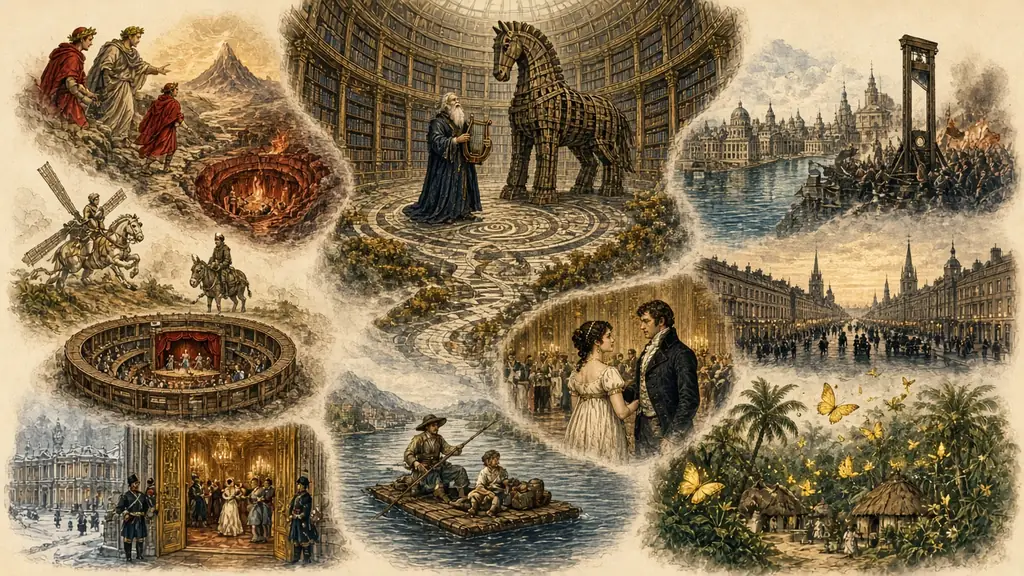
Memory Anchor: HOMER'S WOODEN HORSE JOURNEY (~750 BC) - Picture blind Homer singing epics to crowds. Trojans wheeling in a giant wooden horse. Ten years of war. A hero Odysseus struggling against gods to return home. These are humanity's first great stories.
Journey: Dante guided by Virgil through Hell and Purgatory, then by Beatrice through Heaven
Memory Anchor: DANTE'S DESCENT INTO HELL (1320) - Picture Dante descending through 9 circles of Hell: gluttons drowning in filth, traitors frozen in ice, sinners burning in flames. Guided by poet Virgil. Then climbing Purgatory, finally reaching Heaven guided by beloved Beatrice. Journey through human consciousness.
Book 3
Miguel de Cervantes (Spain)
Don Quixote
Click to reveal details...
Date: 1605 (Part 1), 1615 (Part 2)
Type: Novel (first modern novel)
Hero: Don Quixote—delusional knight tilting at windmills, thinking they're giants
Theme: Reality vs. imagination, idealism vs. pragmatism
Memory Anchor: QUIXOTE CHARGING WINDMILLS AS GIANTS (1605) - Picture an aging knight on a scrawny horse, lance raised, charging windmills. They appear to him as giants. His loyal squire Sancho Panza warns him. Madness or noble idealism? The first great novel of delusion and reality.
Book 4
William Shakespeare (England)
Complete Works (37 Plays)
Click to reveal details...
Date: 1590-1613
Major Plays: Hamlet, Romeo & Juliet, Macbeth, A Midsummer Night's Dream, The Tempest
Types: Tragedies, comedies, histories
Legacy: The earliest recorded user of around 1,700 words (first recorded uses, not proof he invented them all); universal human themes
Memory Anchor: SHAKESPEARE'S GLOBE THEATRE MAGIC (1600s) - Picture the Globe Theatre overflowing with common people and nobility. Shakespeare's characters walk the stage: Hamlet questioning existence, Romeo and Juliet dying for love, Macbeth betrayed by witches. Every human emotion contained in 37 plays.
Book 5
Jane Austen (England)
Pride and Prejudice
Click to reveal details...
Date: 1813
Type: Novel of manners / Romance
Protagonist: Elizabeth Bennet—witty, independent woman resisting social expectations
Themes: Female independence, overcoming first impressions, love and marriage
Memory Anchor: ELIZABETH CHALLENGING MR. DARCY'S PRIDE (1813) - Picture spirited Elizabeth Bennet in Regency gown, refusing to be impressed by wealthy, proud Mr. Darcy. She insists on marrying for love, not money. A revolutionary idea for 1813. Their wit sparks electricity. "It is a truth universally acknowledged..."
Book 6
Charles Dickens (England)
A Tale of Two Cities
Click to reveal details...
Date: 1859
Type: Historical novel
Setting: London and Paris during French Revolution
Famous Line: "It was the best of times, it was the worst of times"
Theme: Resurrection, sacrifice, love transcending revolution
Memory Anchor: CARTON'S SACRIFICE ON THE GUILLOTINE (1859) - Picture the chaos of French Revolution. Sydney Carton, dissolute but noble, sacrifices himself for love, going to the guillotine with the words "It is a far, far better thing that I do..." Resurrection through death. Love through sacrifice.
Book 7
Leo Tolstoy (Russia)
War and Peace
Click to reveal details...
Date: 1869
Type: Epic novel (1,200+ pages)
Setting: Russia, 1805-1812, during the Napoleonic Wars (1803-1815), with an epilogue set in 1820
Themes: History as force beyond individual control, love, family, mortality
Memory Anchor: TOLSTOY'S EPIC RUSSIAN BATTLES (1869) - Picture vast armies clashing across Russian winter. Intimate moments of aristocratic families amid war's chaos. Pierre seeking spiritual truth. Natasha dancing at ball. Andrei dying philosophically. Individual lives caught in history's hurricane. 1,200 pages of human experience.
Book 8
Mark Twain (America)
Adventures of Huckleberry Finn
Click to reveal details...
Date: 1884
Type: Novel / Adventure
Setting: Mississippi River during American slavery era
Hero: Huckleberry Finn—runaway boy helping enslaved Jim escape to freedom
Themes: Morality, friendship, racism, freedom, American innocence
Memory Anchor: HUCK AND JIM FLOATING DOWN MISSISSIPPI (1884) - Picture Huckleberry Finn on a raft floating down the Mississippi River with Jim, an enslaved man escaping. Adventure, danger, and the moral awakening of a boy realising slavery's evil. Twain's satire exposes racism. American classic.
Book 9
James Joyce (Ireland)
Ulysses
Click to reveal details...
Date: 1922
Type: Modernist novel
Setting: Dublin, Ireland, single day (June 16, 1904)
Stream of Consciousness: Interior monologues of Leopold Bloom and Stephen Dedalus
Parallels: Homer's Odyssey reimagined in modern Dublin
Memory Anchor: JOYCE'S STREAM OF CONSCIOUSNESS ODYSSEY (1922) - Picture Dublin ordinary citizen Leopold Bloom navigating one day like Odysseus's 10-year journey. Joyce's interior monologue technique revolutionises literature. One day becomes epic. Consciousness itself becomes the hero. Modernism's masterpiece.
Book 10
Gabriel García Márquez (Colombia)
One Hundred Years of Solitude
Click to reveal details...
Date: 1967
Type: Magical realism novel
Setting: Fictitious town of Macondo
Structure: Multi-generational saga; cyclical time; magical + realistic elements intertwined
Themes: Solitude, love, destiny, time, family cycles
Memory Anchor: GARCÍA MÁRQUEZ'S MAGICAL MACONDO (1967) - Picture a fictional Colombian town where rain lasts 4 years, ghosts visit, and magic is ordinary. Seven generations of Buendía family repeating similar fates. Time moves in circles. Love and solitude intertwine. Reality and magic seamlessly blend. Latin American literature's masterpiece.
Guided Practice: Organise Your Literary Library
Arrange these 10 great books on your mental library shelves. Click each to place the book. Visualise opening each one!
Your Memory Palace: The Great Library
Place each classic book on its shelf across the ages. Journey from ancient epics to modern magical realism.
Ancient
Homer's Epics
Iliad & Odyssey (~750 BC)
Medieval
Dante's Comedy
Divine Comedy (1320)
Renaissance
Cervantes
Don Quixote (1605)
Elizabethan
Shakespeare
37 Plays (1590-1613)
Romantic
Jane Austen
Pride & Prejudice (1813)
Victorian
Dickens
Tale of Two Cities (1859)
19th Century
Tolstoy
War and Peace (1869)
American
Mark Twain
Huckleberry Finn (1884)
Modernist
James Joyce
Ulysses (1922)
Contemporary
García Márquez
One Hundred Years (1967)
Literary Journey
Mentally walk through your library shelves chronologically. Notice how literature evolves: from epics celebrating heroes → to philosophical journeys → to realistic novels → to modernist experiments → to magical realism. Each shelf represents an era and a new way of telling stories.
Elaboration: Literature's Evolution
These 10 books represent literature's greatest achievements. Understanding the progression helps memory:
Ancient Epics (~750 BC)
Homer: Iliad & Odyssey - Humanity's first great written stories. Established the hero's journey. Explored war, honour, fate, and homecoming. Foundation of Western literature.
Medieval Allegory (1320)
Dante: Divine Comedy - Journey through spiritual realms. Blended theology, philosophy, and personal experience. Invented terza rima verse form. Showed literature could explore inner consciousness.
Early Novel (1605)
Cervantes: Don Quixote - First modern novel. Explored reality vs. imagination. Satirised chivalry while celebrating human idealism. Showed characters could be psychologically complex.
Renaissance Theatre (1590-1613)
Shakespeare: Complete Works - The greatest writer in English. Created archetypes: tragic hero (Hamlet), star-crossed lovers (Romeo), tyrant (Macbeth). Demonstrated that popular entertainment could be high art.
Romantic Era (1813)
Jane Austen: Pride & Prejudice - Novel of manners with wit and irony. Gave voice to female perspective. Showed women could be intelligent agents of their own destiny. Invented modern romance genre.
Victorian Era (1859)
Charles Dickens: Tale of Two Cities - Social realism. Showed literature could critique injustice. Memorable characters, dramatic plot. Made literature popular entertainment for masses.
Russian Literature (1869)
Leo Tolstoy: War and Peace - Epic scope. Explored how history shapes individuals. Philosophical depth. Showed novel could rival philosophy in exploring human existence.
American Literature (1884)
Mark Twain: Huckleberry Finn - American vernacular. First person voice as literary technique. Moral awakening of innocent. Exposed racism's evil. Created distinctly American literature.
Modernism (1922)
James Joyce: Ulysses - Stream of consciousness revolutionises technique. Interior monologue captures actual thought. Experimental structure. One day becomes epic. Literature becomes formally innovative.
Magical Realism (1967)
Gabriel García Márquez: One Hundred Years of Solitude - Blends magical and realistic. Non-linear time. Cyclical structure. Gives voice to non-Western perspectives. Shows literature can transcend rational realism.
The Greater Picture
Why memorise these books? They represent humanity's conversation with itself across 2,700 years. Each book solves problems the previous one couldn't answer. Homer asked: how do heroes behave? Dante asked: what is destiny? Cervantes asked: is idealism madness? Shakespeare asked: what are we? Austen asked: how do women survive? Dickens asked: is society just? Tolstoy asked: is history meaningful? Twain asked: what's right? Joyce asked: how do we experience reality? García Márquez asked: what is time? These are the books that defined human consciousness.
Speed memorise all 10 books and authors. Click each as you commit author-book pairs to memory!
Literary Sprint Timer
1:20
Memorise These Author-Book Pairs!
Click each book as you link author to masterpiece to memory palace location.
Homer
Iliad & Odyssey | ~750 BC
Dante Alighieri
Divine Comedy | 1320
Miguel de Cervantes
Don Quixote | 1605
William Shakespeare
Complete Works | 1590-1613
Jane Austen
Pride and Prejudice | 1813
Charles Dickens
Tale of Two Cities | 1859
Leo Tolstoy
War and Peace | 1869
Mark Twain
Huckleberry Finn | 1884
James Joyce
Ulysses | 1922
Gabriel García Márquez
One Hundred Years | 1967
Challenge Complete!
0
Books & Authors Memorised in 80 Seconds
Excellent literary sprint! Now test your full recall in Final Review.
Final Review: Test Complete Literary Knowledge
Complete your mastery. Recall authors, titles, dates, and significance:
1. Who wrote the Iliad and Odyssey, and approximately when were they composed?
Homer (~750 BC) | Epic poems about Trojan War and Odysseus's journey home | Foundation of Western literature | Memory: Wooden horse and 10-year voyage
2. What are the three sections of Dante's Divine Comedy, and when was it completed?
Divine Comedy (1320) | Inferno (Hell), Purgatorio (Purgatory), Paradiso (Heaven) | Dante guided by Virgil through Hell/Purgatory, by Beatrice through Heaven | Memory: Journey through spiritual realms, 9 circles of Hell
3. What is Don Quixote's most famous action, and why is Cervantes' novel considered important?
Don Quixote (1605) | Charges windmills thinking they're giants | First modern novel | Explores reality vs. imagination | Memory: Delusional knight on scrawny horse tilting at windmills
4. Name five of Shakespeare's most famous plays and their general time period.
Shakespeare (1590-1613) | Hamlet (tragedy/revenge), Romeo & Juliet (tragedy/romance), Macbeth (tragedy/ambition), A Midsummer Night's Dream (comedy), The Tempest (romance/magic) | Memory: Globe Theatre magic—every human emotion
5. Who is the protagonist of Pride and Prejudice (1813), and what is revolutionary about her character?
Jane Austen: Pride & Prejudice (1813) | Elizabeth Bennet refuses to be impressed by wealth | Insists on marrying for love, not money | Witty, independent, challenges social expectations | Memory: Woman defying Regency society for love
6. What is the opening line of A Tale of Two Cities, and what year was it published?
Charles Dickens: Tale of Two Cities (1859) | Opening: "It was the best of times, it was the worst of times" | Set during French Revolution | Sydney Carton's sacrifice: "It is a far, far better thing..." | Memory: Guillotine, resurrection through death
7. What is War and Peace about, and why is Tolstoy's novel considered one of the greatest?
Leo Tolstoy: War and Peace (1869) | Epic novel (~1,200 pages) | Napoleonic Wars setting | Explores how history shapes individuals | Pierre, Natasha, Andrei intertwined fates | Philosophy of history and love | Memory: Vast battles interwoven with intimate moments
8. What is the plot of Huckleberry Finn (1884), and what major themes does it explore?
Mark Twain: Huckleberry Finn (1884) | Boy Huck helps enslaved Jim escape down Mississippi River | Adventure, moral awakening, friendship, racism, freedom | American vernacular style | Memory: Raft floating down river, boy learns racism is evil
9. What literary technique did James Joyce pioneer in Ulysses (1922), and what is its setting?
James Joyce: Ulysses (1922) | Stream of consciousness technique | Interior monologues of Leopold Bloom and Stephen Dedalus | Set in Dublin, single day: June 16, 1904 | Parallels Homer's Odyssey | Memory: One day becomes epic journey through consciousness
10. What literary style is One Hundred Years of Solitude, and what is the setting?
Gabriel García Márquez: One Hundred Years of Solitude (1967) | Magical realism | Fictional Colombian town Macondo | Multi-generational saga of Buendía family | Cyclical time structure | Blends magical and realistic elements | Memory: 100 years in fictional town where reality and magic blend
I CAN Statement
I can recall 10 classic books and authors, explain their historical context, and articulate why they matter to human civilisation.