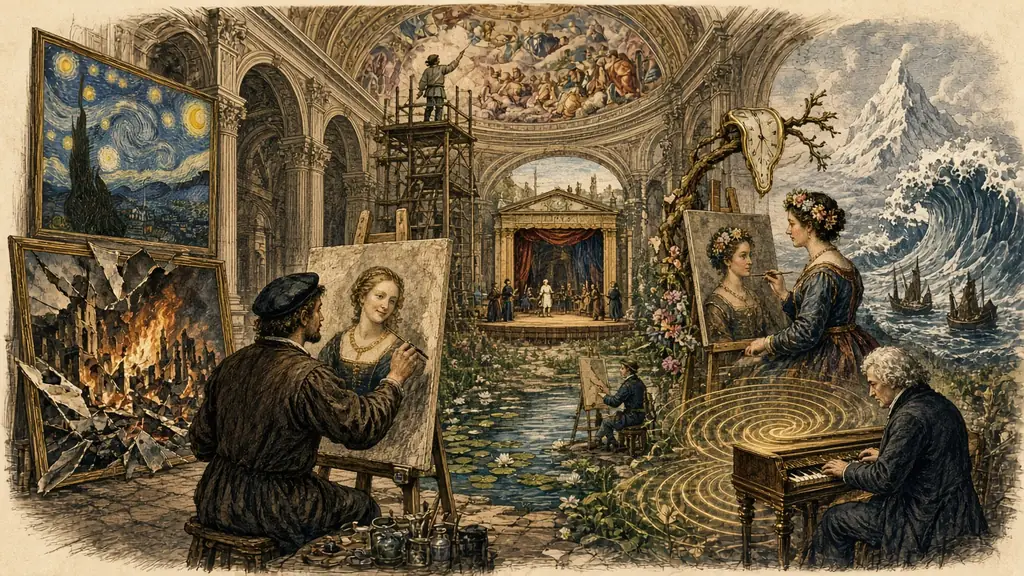
Memory Anchor: DA VINCI'S MYSTERIOUS SMILE (1503) - Picture Leonardo painting a woman with the most enigmatic smile in history. Her eyes seem to follow you. Golden light surrounds her face. The smile haunts viewers 500 years later.
Artist 2
Michelangelo Buonarroti
Click to reveal masterpiece...
Masterpiece: Sistine Chapel Ceiling
Year: 1508-1512
Medium: Fresco (paint on wet plaster)
Size: 36.5 m × 13.7 m ceiling
Famous Scene: Creation of Adam (God's finger touching Adam's finger)
Memory Anchor: GOD AND ADAM'S FINGERS TOUCH (1508) - Imagine lying on your back painting a massive ceiling. God's hand reaching down, Adam's hand reaching up, their fingers almost touching. The moment of creation captured in one gesture. Michelangelo on a scaffolding for four years.
Artist 3
Vincent van Gogh
Click to reveal masterpiece...
Masterpiece: The Starry Night
Year: 1889
Medium: Oil on canvas
Size: 73.7 cm × 92.1 cm
Features: Swirling sky, cypress tree, sleeping village, 11 stars and crescent moon
Memory Anchor: VAN GOGH'S SWIRLING STARS AND MADNESS (1889) - Picture the night sky dancing and swirling. Stars blazing like fireworks. A lonely cypress tree reaching up. Below, a peaceful village sleeps. Van Gogh in his asylum room, painting the night from memory. Raw emotion in every brushstroke.
Artist 4
Pablo Picasso
Click to reveal masterpiece...
Masterpiece: Guernica
Year: 1937
Medium: Oil on canvas
Size: 3.49 m × 7.76 m (monumental)
Subject: Bombing of Basque town during Spanish Civil War | Distorted human and animal figures expressing horror
Memory Anchor: PICASSO'S FRAGMENTED CHAOS OF WAR (1937) - Picture a massive black-and-white painting exploding with twisted bodies. Faces broken into geometric pieces. A bull, a horse, women screaming. Picasso showed the true horror of bombing. Bodies deconstructed like his Cubist style.
Artist 5
Claude Monet
Click to reveal masterpiece...
Masterpiece: Water Lilies Series (Late Period)
Years: 1890s-1920s
Medium: Oil on canvas | Various sizes, up to 2m × 2m
Subject: His Japanese garden pond at Giverny | Impressionist technique capturing light and reflection
Memory Anchor: MONET'S POND OF REFLECTIONS (1890s) - Picture a peaceful pond with floating lily pads. Monet painted the same scene 200+ times, chasing light at different hours. Water reflecting sky, plants, clouds. Pure colour and light, not form. Water Lilies = meditation on beauty and transience.
Features: Unibrow, monochromatic facial hair, unflinching gaze, surrealist elements, pain transformed into art
Memory Anchor: KAHLO'S UNFLINCHING SELF-MIRRORS (1930s) - Picture a woman staring directly at you with an unibrow. Her face mirrors her inner pain—broken spine, miscarriage, betrayal—all painted with raw honesty. Small canvases, huge emotional power. She said "I paint myself because I am my own subject."
Artist 7
Salvador Dalí
Click to reveal masterpiece...
Masterpiece: The Persistence of Memory
Year: 1931
Medium: Oil on canvas
Size: 24 × 33 cm (small but iconic)
Features: Melting clocks, surrealist landscape, distorted time, dreamscape
Memory Anchor: DALÍ'S MELTING CLOCKS OF TIME (1931) - Picture Salvador Dalí painting a desert landscape where clocks aren't hard metal but soft, melting like cheese. Time is malleable. A distorted face sleeps on the ground. Ants crawl over one pocket watch. Surrealism at its dreamiest.
Artist 8
Katsushika Hokusai
Click to reveal masterpiece...
Masterpiece: The Great Wave off Kanagawa
Year: 1830-1832
Medium: Woodblock print (ukiyo-e)
Size: 25.2 × 37.1 cm
Features: Giant wave threatening boats, Mount Fuji tiny in background, Japanese perspective
Memory Anchor: HOKUSAI'S TSUNAMI POWER (1831) - Picture a colossal ocean wave with foam-white fingers reaching up like claws. Tiny boats and fishermen about to be swallowed. Mount Fuji sits peacefully in the distance—eternal and unmoved. Nature's power vs. human fragility in one image. Japanese art meets global recognition.
Artist 9
Ludwig van Beethoven
Click to reveal masterpiece...
Masterpiece: Symphony No. 9 in D minor
Year: 1824
Final Movement: "Ode to Joy" with choir singing
Length: ~65 minutes | Composed while completely deaf
Legacy: One of most celebrated compositions ever; its "Ode to Joy" was adopted as the European Anthem (Council of Europe, 1972)
Memory Anchor: BEETHOVEN'S DEAFNESS TRANSCENDED (1824) - Picture Beethoven, completely deaf, hearing a symphony in his mind. No sound reaches his ears, yet he composes the 9th Symphony. Final movement: "Ode to Joy"—human voice and orchestra uniting. He conducts it deaf, unable to hear audience applause. Art transcends limitation.
Artist 10
William Shakespeare (theatre)
Click to reveal masterpiece...
Masterpieces: Complete Works (37 plays, 154 sonnets)
Years: 1590-1613 (23-year career)
Major Works: Hamlet, Romeo & Juliet, Macbeth, A Midsummer Night's Dream, The Tempest, King Lear
Legacy: The earliest recorded user of around 1,700 words (first recorded uses, not proof he invented them all) | Explored every human emotion and conflict
Cross-reference: Here Shakespeare stands for theatre as a performing art (Dewey 792). His plays as literature are shelved at Dewey 822.33, and he appears again in the Dewey 800 lesson.
Memory Anchor: SHAKESPEARE'S UNIVERSAL MIRROR (1600s) - Picture Shakespeare at the Globe Theatre, quill in hand, writing stories about every human emotion: love (Romeo & Juliet), betrayal (Macbeth), madness (Hamlet), magic (The Tempest). His words become the language we still speak. Every human story compressed into 37 plays.
Guided Practice: Build Your Art Gallery Memory Palace
Place these 10 masterpieces in a grand art museum. Click each gallery to assign an artwork. Visualise standing before each masterpiece!
Your Memory Palace: The Grand Art Museum
Walk through 10 rooms of the world's greatest art. Place one masterpiece in each gallery room.
Room 1
Mona Lisa's Smile
Leonardo da Vinci
Room 2
Creation of Adam
Michelangelo
Room 3
Starry Night
Van Gogh
Room 4
Guernica
Picasso
Room 5
Water Lilies
Monet
Room 6
Self-Portrait
Frida Kahlo
Room 7
Persistence of Memory
Dalí
Room 8
Great Wave
Hokusai
Room 9
Symphony No. 9
Beethoven
Room 10
Complete Works
Shakespeare
Visualisation Challenge
Close your eyes and mentally walk through your art museum. Visit each room. Stand before each masterpiece. Feel the emotions each artwork creates. What colours dominate? What's the mood? Spend 1-2 minutes fully immersed in each gallery.
Elaboration: The Evolution of Artistic Expression
These artists represent different movements and periods. Understanding connections helps memory:
Renaissance Humanists (1400s-1500s)
Leonardo da Vinci & Michelangelo - Rediscovered classical beauty and human anatomy. Blended art with science. Initiated Renaissance.
Impressionism & Post-Impressionism (1870s-1890s)
Claude Monet & Vincent van Gogh - Broke from traditional rules. Captured light, colour, emotion over realism. Monet repeated the same scene; Van Gogh showed inner emotion through distorted forms.
Modernism & Cubism (1900s-1930s)
Pablo Picasso - Fragmented reality into geometric pieces. Showed multiple perspectives at once. Guernica transformed art into political statement.
Surrealism (1920s-1930s)
Salvador Dalí - Explored dreams and the unconscious. Painted irrational scenes with technical precision. Melting clocks symbolised time's relativity (inspired by Einstein's physics!).
Mexican Modernism (1930s-1950s)
Frida Kahlo - Personal subject matter. Self-portraiture as political act. Transformed pain into beauty. Rejected European traditions, embraced Mexican identity.
Japanese Woodblock Prints (1700s-1800s)
Katsushika Hokusai - "The Great Wave" represented Japanese perspective and technique. Influenced European artists. Proved non-Western art was equally powerful.
Music: Beethoven's Revolution (1800s)
Ludwig van Beethoven - Expanded what symphony could express. Composed while deaf (ultimate isolation, ultimate creation). 9th Symphony united humanity with "Ode to Joy." Music became political and philosophical.
Theatre: Shakespeare's Universality (1600s)
William Shakespeare - Created plays exploring every human emotion. Characters transcend time and culture. Language so powerful it changed English itself. Democratic art (performed for common people in Globe Theatre).
The Bigger Picture
What connects all these artists? They all challenged conventions. Da Vinci broke boundaries between art and science. Van Gogh painted emotion, not just objects. Picasso deconstructed perspective. Kahlo made pain universal. Each pushed humanity's understanding of what art could express. When you memorise these masterpieces, you're memorising the evolution of human consciousness—how we learn to see ourselves and our world more deeply.
Speed memorisation of all 10 artists and their masterpieces. Click each as you memorise. Link the artist to their most famous work!
Artistic Memorisation Timer
1:15
Memorise These Masterpieces!
Click each artwork as you encode the artist-masterpiece connection into memory.
Leonardo da Vinci
Mona Lisa | 1503
Michelangelo
Sistine Chapel | 1512
Vincent van Gogh
Starry Night | 1889
Pablo Picasso
Guernica | 1937
Claude Monet
Water Lilies | 1890s
Frida Kahlo
Self-Portraits | 1930s-1950s
Salvador Dalí
Persistence of Memory | 1931
Katsushika Hokusai
Great Wave | 1831
Ludwig van Beethoven
Symphony No. 9 | 1824
William Shakespeare
Complete Works | 1590-1613
Challenge Complete!
0
Masterpieces Memorised in 75 Seconds
Wonderful! Test your complete recall in the Final Review tab.
Final Review: Complete Artistic Mastery
Demonstrate your knowledge of all 10 artists and their greatest works. Click to test yourself:
1. What is Leonardo da Vinci's most famous painting, and what makes its subject's expression so memorable?
Mona Lisa (1503) | Her mysterious smile has captivated viewers for 500+ years | Sfumato technique creates soft, subtle shadows | Psychological depth and enigmatic quality | Memory: Mysterious smile that haunts viewers
2. What is Michelangelo's most iconic work, and what is its most famous scene?
Sistine Chapel Ceiling (1508-1512) | Most famous scene: Creation of Adam | God's finger reaches down, Adam's finger reaches up, almost touching | Symbolises the moment of creation | Memory: Two fingers almost touching—the spark of life
3. What is the name of Van Gogh's masterpiece featuring a swirling night sky, and when did he paint it?
The Starry Night (1889) | Painted from memory in an asylum | Swirling stars, cypress tree, sleeping village | Raw emotion in every brushstroke | Depicts village of Saint-Rémy-de-Provence | Memory: Swirling sky and madness transformed into beauty
4. What event inspired Picasso's massive painting Guernica in 1937?
Guernica (1937) | Bombing of Basque town during Spanish Civil War | Monumental painting (3.49m × 7.76m) | Black and white | Distorted human and animal figures express horror and suffering | Cubist style fragments reality | Memory: Fragmented chaos showing war's true horror
5. What technique did Claude Monet pioneer, and what subject did he paint repeatedly?
Water Lilies Series (1890s-1920s) | Monet painted his Japanese garden pond 200+ times | Impressionist technique capturing changing light and colour | Different times of day, seasons, weather | Focused on colour and light, not form | Memory: Same pond, infinite variations—meditation on beauty
6. What does Frida Kahlo primarily paint about, and what is distinctive about her self-portraits?
Frida Kahlo Self-Portraits (1930s-1950s) | Painted 55 self-portraits (of about 143 known paintings) | Unflinching honesty about pain, disability, suffering | Characteristic unibrow and monochromatic facial hair left visible | Used surrealist elements | Mexican identity and indigenous symbolism | Memory: Woman staring directly, refusing to hide pain
7. What is Salvador Dalí's most famous surrealist painting, and what does it symbolise?
The Persistence of Memory (1931) | Features melting clocks in a dreamscape | Small canvas (24 × 33 cm) but iconic | Symbolises time's malleability and relativity | Influenced by Einstein's physics | Features distorted landscape and sleeping figure | Memory: Time melts like cheese—relativity made visual
8. What is Hokusai's most famous work, and what does it depict?
The Great Wave off Kanagawa (1830-1832) | Woodblock print (ukiyo-e style) | Giant wave threatens tiny boats | Mount Fuji sits peacefully in far background | Japanese perspective on nature and human fragility | Became globally iconic | Memory: Tsunami with claws about to swallow boats—nature's power
9. What makes Beethoven's 9th Symphony unique, and what is its famous final movement?
Symphony No. 9 (1824) | Composed entirely while Beethoven was completely deaf | Final movement: "Ode to Joy" includes a choir singing (unprecedented) | ~65 minutes long | Explores universal themes of joy and brotherhood | Beethoven conducted premiere unable to hear it | Memory: Deaf composer transcending silence to create joy
10. How many plays and sonnets did Shakespeare write, and what are some of his most famous works?
William Shakespeare (1590-1613) | 37 plays + 154 sonnets | Most famous: Hamlet, Romeo & Juliet, Macbeth, A Midsummer Night's Dream, The Tempest | Earliest recorded user of around 1,700 words | Explored every human emotion and conflict | Performed at Globe Theatre for common people | Memory: Universal stories in every human language
I CAN Statement
I can identify 10 greatest artists, recall their masterpieces, and explain their artistic significance and historical context.