THE ART OF MEMORY · LESSON 1 OF 30 · PART I: FOUNDATIONS

How Memory Works

A man who could not forget anything shows us how memory really works, and why most of us forget so much.
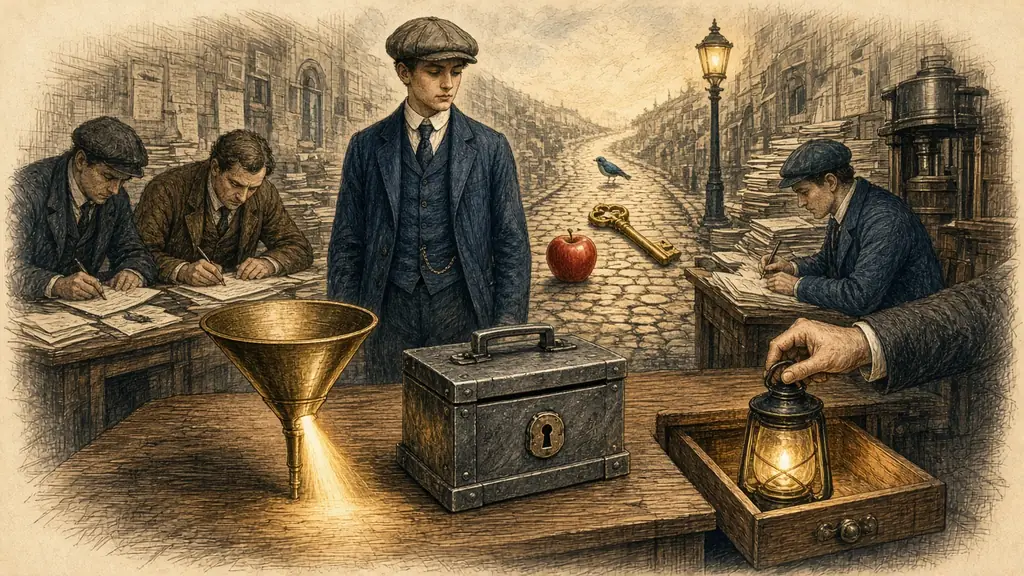
Memory hook: a 1920s reporter with no notebook, a street of vivid objects behind him, and a funnel, strongbox and lantern for encoding, storage and retrieval.

The whole course  ·  Pictures That Stick →

In this lesson: you will learn the three stages of memory, why we forget, and how chunking and spaced review work against forgetting. You will also meet the idea that runs through the whole course: pictures hold better than words.
Before we begin
How do you remember a phone number, or a shopping list, at the moment? Say what you actually do.
Most people repeat it to themselves, or write it down. Repeating works for about a minute and then fades. Keep your answer in mind: by the end of this lesson you will have something stronger to compare it with.
Think of something you remember perfectly from years ago. Why do you think that one stayed?
Memories that last usually had something extra: strong feeling, surprise, a picture, a place, a story. Almost never just repetition. That is the pattern this whole course uses on purpose.

The reporter who never wrote anything down

Moscow, in the 1920s. Every morning a newspaper editor gave his reporters their jobs for the day: a long list of addresses, names, and instructions about whom to see and what to ask. The reporters scribbled it all down. All except one.

The young man in the corner sat with his hands folded. He did not write a single word. The editor, annoyed, stopped in the middle of the list and told him to pay attention. The reporter stood up, and repeated the whole list back, in order, word for word, including the editor's own jokes.

What did the reporter do that surprised the editor?
He wrote nothing down, yet he repeated the whole list perfectly, in order.
Talk about it. If you were the editor, what would you ask him first? What would you want to know about how he did it?

The editor sent him to a psychologist, Alexander Luria, who studied him for about thirty years and later wrote a famous book about him. In the laboratory the reporter, known in the book only as S., was given long tables of numbers, lists of words, even strings of nonsense. He read them once or twice, and then repeated them forwards, backwards, and in any order Luria asked for. Years later he could still do it.

Luria could not find the limit. How did S. do it? He did not repeat the numbers over and over. He saw them. Numbers had colours and shapes. A voice could look like a cloud of yellow or smell like smoke. Everything he heard turned into a vivid picture, and he placed those pictures along a street he knew, so he could walk past them again.

What was S.'s secret, according to the story?
He turned everything into vivid pictures (he often saw numbers and sounds as colours and shapes) and placed them along a street he knew.
Talk about it. Do you ever see colours or shapes when you hear a word or a number? What would happen to your memory if every word came with a picture?

A perfect memory sounds like a gift. For S. it was also a burden. His pictures never faded, so old ones piled up and got in the way of new ones. A line of poetry could call up a crowd of images and make it hard to follow the meaning. He even tried to forget numbers by writing them down, hoping that once the paper held them his mind could let go.

He found it hard to recognise faces, because a face changes every second and each change looked like a new picture. And abstract ideas gave him real trouble, because they could not easily be turned into a picture. So S. teaches us two things at once. First: memory is mostly a matter of how you take in what you want to keep. Second: you do not need a gift to do it. You can learn to turn things into pictures, on purpose, and put them in places you know. That is this whole course.

Why was S.'s memory sometimes a problem?
He could not forget. Old pictures piled up and interfered with new ones, and he found abstract ideas and changing faces hard.
Talk about it. Would you want a memory that never forgot anything? What would you like to be able to forget, and what would you never want to lose?

Words worth knowing

Say what you think each one means, then open it.

to change information into a form your brain can store. She encoded the number as a picture.
to bring something back out of memory. I could not retrieve his name.
a small group of things treated as one unit. Phone numbers are easier in chunks.
very clear and strong, like a picture you can almost see. a vivid dream
to become weaker and less clear over time. The memory has faded.
a person who uses memory techniques, or has an unusual memory. From the Greek word for memory.

The case of S. is told in A. R. Luria, The Mind of a Mnemonist (1968). Retold here in our own words.

Three stages, one limit, one curve

Memory is not one thing. It is a chain of three jobs, and a memory can fail at any link.

1Encodingtaking it in2Storagekeeping it3Retrievalfinding it
If any link is weak, the memory is lost.
StageWhat happensHow it failsWhat helps
EncodingYou turn what you see or hear into something the brain can hold.You were not really paying attention, or you only repeated words.Attention, meaning, and a vivid picture.
StorageThe memory is kept over time.It fades because you never came back to it.Review at growing intervals.
RetrievalYou bring it back out.It is in there but you cannot find the way to it.A place or a link to start from: a cue.

One limit: working memory

When you hold a number in your head for a moment while you dial it, you are using working memory. It is small. In 1956 the psychologist George Miller famously suggested about seven items, plus or minus two. More recent work puts it nearer four. Either way, it is a small desk, not a warehouse.

The way round it: chunking

The limit is about chunks, not letters. FBICIANASA is ten letters, but FBI, CIA, NASA is three chunks you already know. A chunk is anything you can treat as one unit. You make chunks by grouping, and you make them stronger by giving them meaning.

Chunking in action
Remember: 1 9 6 6 1 0 6 6 2 0 0 0
RawTwelve digits. Far too many for working memory.
Group1966 · 1066 · 2000. Three years you may know: England win the World Cup, the Norman conquest, the year 2000.
ResultThree chunks instead of twelve digits.
The picture: Footballers in a boat, with a Norman soldier, going into the year 2000 as fireworks go off.

Why we forget: the curve

In the 1880s Hermann Ebbinghaus tested himself on lists of nonsense syllables and found a pattern that has been confirmed many times since: forgetting is fastest at the start and then slows down. If you review the memory just as it begins to fade, it fades more slowly the next time.

how much you keepdays1371430with reviewsno review
A picture of the idea, not measured data.
  1. Review soon. Go back to it within a day.
  2. Then wait a little longer each time. A few days, a week, a month.
  3. Test yourself instead of re-reading. Pulling the memory out is what strengthens it.
pictures + places + review
= the whole course.
Say it aloud. Explain the three stages of memory in your own words, with an example from your own life of a time one of them failed.

Now you build

Have a go before you open any answer. A rough attempt teaches you more than a perfect model you only read.

The three stages

Fill each gap with one of the stage names.
Getting information in, in a form the brain can use, is called .
Keeping it over time is called .
Bringing it back out when you need it is called .

Which stage went wrong?

Match each situation to the stage that failed.
You were on your phone when the person told you their name.
You learned a poem at school and have not thought of it for twenty years.
The name is on the tip of your tongue, but you cannot get it out.

Make chunks

Here are twelve digits: 4 9 1 7 3 8 2 0 6 5 1 9. Write them in chunks that mean something to you (years, ages, a date, a phone-style grouping). How many chunks did you make?
There is no single answer. For example: 49 · 1738 · 2065 · 19 is four chunks, or 491 · 738 · 206 · 519 is four chunks of three digits. The best chunks are the ones that already mean something to you.

Sort a list into chunks

Here are eight items: hammer, saw, rose, drill, football, tennis ball, sunflower, basketball. Group them into the fewest sensible chunks and give each chunk a name.
Three chunks: tools (hammer, saw, drill), flowers (rose, sunflower) and balls (football, tennis ball, basketball). Eight items become three. Name the chunks and you only have to remember the names.

Your first picture

The word hippocampus names the part of the brain that helps to form new memories. It sounds like hippo + campus. Make one vivid picture: a hippo on a university campus. Add what you see, hear and feel. Write it down.
A huge purple hippo is blocking the main gate of a university campus. Students are trying to squeeze past; the hippo is yawning loudly and the smell of wet grass is everywhere. Its mouth is full of books. The hippo (hippo) is on the campus (campus) and it is where new memories are being made.
Which of these is the best use of a spare minute to remember a name you just heard?

A time you forgot

Tell a partner, or say it aloud to yourself, about a time you forgot something important. Which stage do you think failed? What could you have done differently?
1:30

Drill

Flash cards

Say the answer first, then tap the card.

tap to turn over

Quick quiz

Which stage is about keeping a memory over time?
What is a chunk?
According to the forgetting curve, when is forgetting fastest?
Which method of review is usually strongest?

The memory challenge

Memory challenge: lock in the key words

Eight terms from this lesson. They are not random: they fall into three groups (the process, the limit, the cure). Find the groups first, and they will be much easier.

Make three groups, give each a name and a picture. Do not just read the list.

0:00

The list has gone. Type what you remember, one item per line.

Look back

These reach back to earlier rooms. Answer in your head or out loud, then check.

Lesson 1 · How Memory Works. Name the three stages of memory in order.
Encoding, storage, retrieval.
Lesson 1 · How Memory Works. Why does chunking help with a long number?
Working memory holds only a few units. Chunks let one unit stand for several digits.
Lesson 1 · How Memory Works. What did S. do that made his memory so strong?
He turned everything into vivid pictures and placed them along a street he knew.
Lesson 1 · How Memory Works. When is the best time to review something new?
Soon after learning, then again after growing gaps.

What I can do now

A thought to keep

Think about one thing you want to remember this month. Which of the three stages is most likely to go wrong for it, and what will you do about that?

Saved on this device as you type.