Pictures That Stick
A Roman handbook, a man with a goat on his head, and twelve ways to make any picture impossible to forget.
← How Memory Works · The whole course · The Body as a Memory Board →
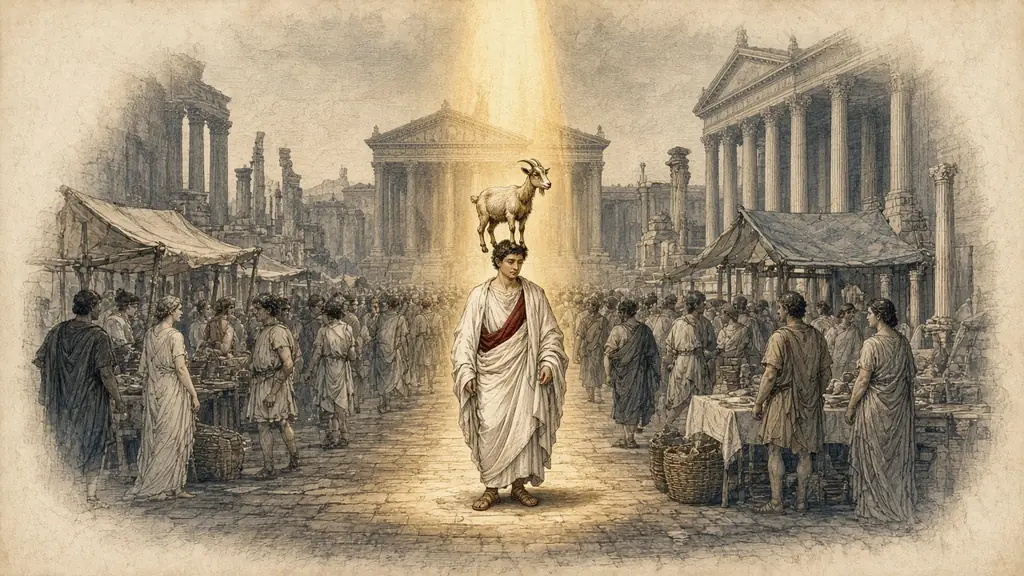
The man with the goat on his head
Imagine a morning in Rome, two thousand years ago. You cross the Forum on your way to a lesson. You pass a hundred things: stalls of olives, a woman arguing about the price of cloth, a boy with a basket, the same stone steps you climb every day. At the end of the day someone asks you what you saw. You can hardly say. It was all ordinary, and ordinary things slip straight through the mind.
Now imagine that halfway across the square a man comes towards you wearing a bright red wig, leading an elephant by a string, with a live goat balanced on his head. The goat is chewing a letter. You would remember him for years. You might not even need to try.
The Roman author who made this point in a handbook on public speaking, written around 85 BC, is unknown. For centuries people thought it was Cicero. The handbook is called Rhetorica ad Herennium, and it says something very close to the Forum story. We remember little things, ordinary things, everyday things, it says, because nothing about them surprises us. But anything shocking, ugly, beautiful, funny, huge or unbelievable stays with us a long time.
So the advice for anyone who wants to remember is make the picture unusual. Do not hold a polite, realistic picture in your mind. Give it colour, make it move, make it louder and bigger than life, make it a little silly or a little shocking. The handbook adds that the pictures should be active: people doing things, not still lifes.
People have been rediscovering this ever since. Modern memory trainers have turned the advice into a checklist you can use to build a picture on purpose. One popular version is a twelve-letter word, SMASHIN' SCOPE, and you will learn it in the next tab. Each letter is a way to make a picture richer: add a sense, add movement, add a joke, add a number.
There is a catch, and it is a good one. The picture has to be yours. A picture borrowed from someone else, however wild, does not hold as well as one you made, because making it is the work that fixes it in the mind. This lesson is where you start making them.
Words worth knowing
Say what you think each one means, then open it.
The handbook is the Rhetorica ad Herennium (c. 85 BC), Book III. Our own paraphrase.
Twelve ways to make a picture stick
A good memory picture is not a photograph. It is a small film with something happening in it, and it breaks the rules of real life.
| Letter | Idea | What to do |
|---|---|---|
| S | Synaesthesia and senses | Mix the senses. Taste a colour, hear a shape, smell the scene. |
| M | Movement | Make it move: fly, spin, crash, run. |
| A | Association | Connect it to something you already know well. |
| S | Sensuality | Add strong feeling: touch, taste, delight or disgust. |
| H | Humour | Make it funny or silly. |
| I | Imagination | Break the rules of the real world. |
| N | Number | Count it: three hundred ducks, one giant. |
| S | Symbolism | Use a symbol: a crown for a king, a heart for love. |
| C | Colour | Make it bright, or the wrong colour. |
| O | Order | Put things in a clear order or pattern, or stack them in an odd one. |
| P | Positivity | Pleasant pictures are easier to return to than horrid ones. |
| E | Exaggeration | Make it enormous or tiny. Overdo everything. |
three or more
= unforgettable.
When the word is not a thing
You can picture an orange. You cannot picture justice or Brazil or lecture. For those you substitute: find something you can see that sounds like the word, or means something close to it, and picture that. Brazil sounds like bra; Russia sounds like rushing; lecture can be a person talking at a lectern. You will do a great deal of this in the rooms to come.
- Find the thing. A word you can see, or a substitute for it.
- Make it do something. Movement, a crash, an action.
- Add three tools from the checklist. Size, colour, sound, humour, a number.
- See it for a few seconds. Close your eyes. It is a picture only if you can see it.
Now you build
Have a go before you open any answer. A rough attempt teaches you more than a perfect model you only read.
Which tool is this?
Build it together
Your turn: PENCIL
Your turn: HAMMER
Fill the gaps
Describe it aloud
Drill
Flash cards
Say the answer first, then tap the card.
Quick quiz
The memory challenge
Memory challenge: eight words in ninety seconds
Make a vivid picture for each word, using at least three tools. Study, then type what you remember.
Do not repeat the words. Build one wild picture for each, a few seconds each.
The list has gone. Type what you remember, one item per line.
Look back
These reach back to earlier rooms. Answer in your head or out loud, then check.
What I can do now
A thought to keep
Pick a word from today you found hard to picture. What did you substitute, and why did that work?