The Memory Palace
A banquet, a falling roof and the poet who remembered where everyone sat. The oldest method of all, and the one that holds a hundred things.
← The Body as a Memory Board · The whole course · Links and Stories →
The banquet and the falling roof
Greece, over two thousand years ago. A rich nobleman named Scopas gave a great banquet in his house in Thessaly. Among the guests was the poet Simonides of Ceos, who had been paid to perform a poem in honour of his host. The poem, as poets did in those days, also praised the twin gods Castor and Pollux.
Scopas was not pleased. He said, in front of his guests, that he would pay only half the fee for the poem about himself. The rest, he said, could be collected from the twins. And he turned back to his wine.
A little later a servant came to the poet and said that two young men were waiting outside and wanted to see him urgently. Simonides went to the door. There was no one there.
At that very moment the roof of the banqueting hall fell in. Scopas and the guests were crushed. When the families arrived they could not recognise their dead: the bodies were beyond identifying. And so Simonides was asked, 'Who was sitting where?'
Simonides closed his eyes, and he could see the hall again. He could see where each guest had been sitting: the old man by the window, the merchant on the left of the host, the pair of brothers near the door. He walked from place to place in his mind and named the people one by one, and the families could bury their own.
The story comes to us from the Roman writer Cicero, who tells it as the origin of the art of memory. We cannot know if it happened. But the lesson Cicero draws is clear and true: order is what makes a memory, and the best order is a place. If you can walk through a place, you can walk through a list.
Words worth knowing
Say what you think each one means, then open it.
The story is told by Cicero in De Oratore II. It is a famous founding legend, not a verified event. Retold in our own words.
Building a palace, step by step
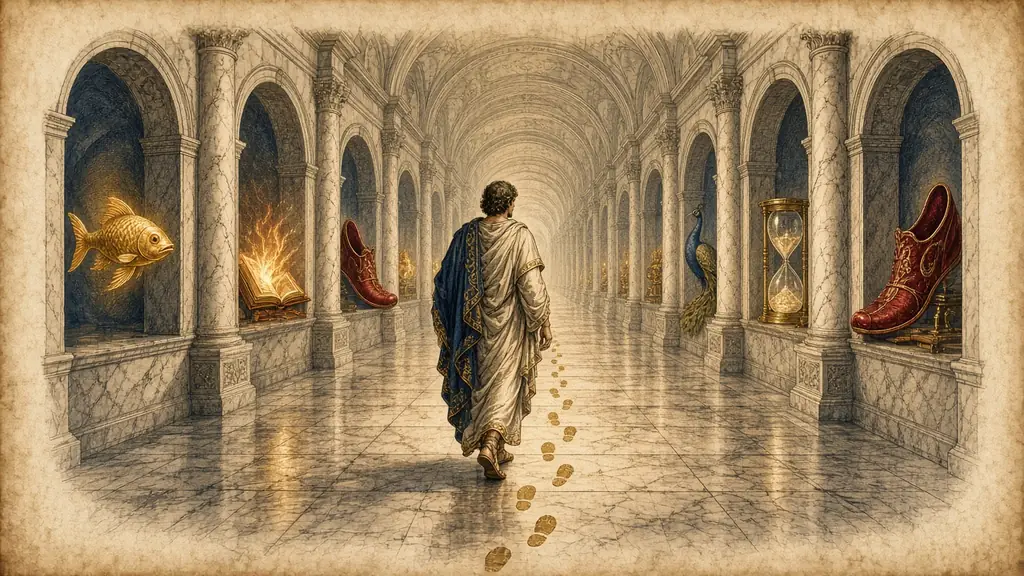
A memory palace is a real place you know very well, with a fixed route through it. Along the route you choose places, and in each place you put one vivid picture. This is the method of loci.
- Choose a place you know very well. Your home, a house you grew up in, your school, a street you walk every day. Real beats invented, because you already know it.
- Fix a route and never change it. Start at a door and walk through the rooms in a single direction. The route gives the list its order.
- Pick distinct places along it. A door, a sofa, a window, a stove. Each should be clearly different from its neighbours and not too close to them. Five to ten in a room is plenty.
- Put one vivid picture at each place. On it, in it or through it. Use what you learned in lessons 2 and 3: movement, size, senses.
- Walk the route to recall. Go through the places in order and look at each one. The picture will be there.
What the old teachers advised
- Choose places that are well lit and not crowded.
- Keep the places a moderate distance apart. Too close and they blur; too far and the walk is long.
- Make each place distinct. Two identical armchairs are a trap.
- Real is better than invented, because you do not have to learn the building as well as the list.
+ the same route
= recall.
How big can it get?
A house with ten rooms and five places in each holds fifty items. A second house gives you fifty more. Memory champions use many palaces. In lesson 24 you will learn how to link several together. For now, one house and about ten places is plenty.
Now you build
Have a go before you open any answer. A rough attempt teaches you more than a perfect model you only read.
Choose your first palace
Put one item in your first place
Three items in three places
The method in words
The walk, aloud
Drill
Flash cards
Say the answer first, then tap the card.
Quick quiz
The memory challenge
Memory challenge: the first ten Roman emperors
Put the first ten emperors of Rome into the first ten places of your palace, in order. Hint: use sound-alikes. Augustus = August sun; Tiberius = tyre; Caligula = call a goalie; Claudius = clouds; Nero = near-O (or Nero fiddling); Galba = gal with a bar; Otho = other; Vitellius = vital; Vespasian = a Vespa scooter; Titus = tight.
Walk your route in your head. One picture per place, in order.
The list has gone. Type what you remember, one item per line.
Look back
These reach back to earlier rooms. Answer in your head or out loud, then check.
What I can do now
A thought to keep
Which building do you know best? Walk through it in your head for a minute: where would your route begin, and which three places would you use first?