Links and Stories
Singers who knew songs of thousands of lines, and the method that needs no building at all: just a chain of pictures that tells a story.
← The Memory Palace · The whole course · Numbers Become Pictures →
The singers who never learned their songs
In the 1930s a young American scholar of Greek, Milman Parry, travelled through the villages and coffee-houses of what was then Yugoslavia, with his assistant Albert Lord and a recording machine. He was looking for something he could not find in a library. He wanted to hear how an epic poem is actually performed by someone who cannot read.
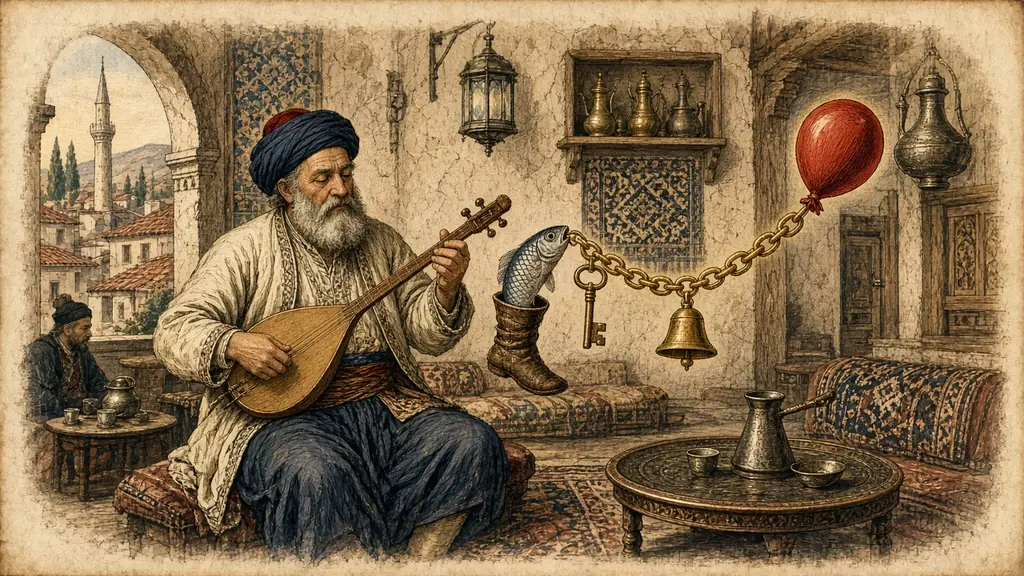
Wherever they went, they found singers, usually men, who sat with a one-stringed instrument called a gusle and sang stories of battles and heroes. Some of these songs were thousands of lines long, and they went on for hours.
Parry and Lord asked the same question again and again: how do you remember so much? The answers surprised them. The singers did not learn the songs word for word. They did not even think they sang the same song twice. Each time, they built the song again as they sang, using a store of stock phrases, familiar scenes (the hero arming himself, the messenger riding out, the feast) and, above all, a strong sense of the story's shape.
The story was the memory. If you know what happens next, you can find the words. If a singer lost his place, he did not stop: he knew the next event and moved on to it.
Parry and Lord's work changed how scholars think about the poems of Homer, which may have been made in a similar way. For us the lesson is practical. You can use the same power for any list. When you have no palace, or no time, or only a few things to remember, make the items into a story in which each one leads to the next.
This is the link method. It is not as strong as a palace, because if one link breaks the chain can break, but it is quick, it needs no building, and it works anywhere. It is the second great tool in your kit, and in the next lessons you will start to combine it with the others.
Words worth knowing
Say what you think each one means, then open it.
Milman Parry and Albert Lord's field recordings of South Slavic singers were made in the 1930s; Lord's The Singer of Tales (1960) sets out the findings. Retold here in our own words.
Chains and stories
A link is a picture in which two items act on each other. A chain is a row of links. A story is a chain that makes sense of itself.
- Make a picture for each item. Use what you learned in lesson 2. Substitute if it is not a thing.
- Link item 1 to item 2. Let them act on each other: the first one hits, rides, eats, drowns or melts the second.
- Link item 2 to item 3. Now item 2 is the active one. Keep the action visible.
- Go on to the end. Each link only has to hold two pictures. Never try to link item 1 to item 5.
- Retell it. Start with the first picture. It will bring the second, and so on.
Link or palace?
| Link / story | Palace | |
|---|---|---|
| Needs a place | No | Yes, a building you know |
| Best for | Short lists, quick jobs, a sequence of events | Long lists, anything you need to jump around in |
| Weakness | A forgotten link can break the chain | Takes a few minutes to set up |
| Strength | Instant, anywhere | Any item can be reached directly |
The two combine well. For a long list, put a short chain of four or five items at each place of your palace. The palace keeps the order; the chain holds the detail.
always leads
to the next.
Now you build
Have a go before you open any answer. A rough attempt teaches you more than a perfect model you only read.
Two links
A story of four
Fill the gaps
Palace or story?
Tell it
Drill
Flash cards
Say the answer first, then tap the card.
Quick quiz
The memory challenge
Memory challenge: twelve gods in a story
Link twelve Greek gods into a single story, in this order: Zeus, Hera, Poseidon, Demeter, Athena, Apollo, Artemis, Ares, Aphrodite, Hephaestus, Hermes, Dionysus. (Some lists put Hestia instead of Dionysus.) Make the silliest story you can.
Zeus (zoo) hits Hera (a hairy) ... Make each god act on the next one.
The list has gone. Type what you remember, one item per line.
Look back
These reach back to earlier rooms. Answer in your head or out loud, then check.
What I can do now
A thought to keep
Think of a sequence you often forget (the steps of something you do rarely). How would you turn it into a story?