People With Numbers
A British champion saw a man learn a pack of cards on television and went on to win the world title eight times. His system turns every pair of digits into a famous person.
← The Major System · The whole course · Person, Action, Object →
The man who learned a pack of cards on television
In 1987 a young Englishman called Dominic O'Brien was watching television when a man appeared who could memorise the order of a shuffled pack of cards. The presenter shuffled, the man looked at each card once, and then he named the whole pack in order, without a mistake.
O'Brien did not think of himself as someone with a special memory. That evening he did something unusual. He picked up a pack of cards and tried to find out how the trick was done.
He read about the old methods: the places, the pictures, the stories. He trained, and he made up his own ways of speeding it up. In 1991 he won the first World Memory Championship, in London. He went on to win it eight times in all.
In 2002 he memorised fifty-four decks of cards, in a single viewing of each, a record that made the newspapers: 2,808 cards in total. He did it with the same two tools you have already learned, a long route of places and strong pictures. He also built a way of turning numbers into people.
His idea is that a person is the best picture there is. A word like toes is a picture, but you meet it and forget it. A person has a face, a voice, a way of moving, and things they do. If every pair of digits is a famous person doing something, then a long number becomes a short film, and a film is far easier to remember than a row of digits.
This system is named for him. It is the system behind the PAO method of the next lesson, and it is the link between the simple systems of lesson 6 and the champion's methods of lessons 21 and 23.
Words worth knowing
Say what you think each one means, then open it.
O'Brien's career and records are summarised from public accounts. The Dominic System is his own invention; the details below are told in our own words.
Digits to letters, letters to people
Every digit becomes a letter. A pair of digits becomes a pair of initials. The initials belong to a person you can see, and that person has one famous action.
| Digit | Letter | Digit | Letter |
|---|---|---|---|
| 1 | A | 6 | S |
| 2 | B | 7 | G |
| 3 | C | 8 | H |
| 4 | D | 9 | N |
| 5 | E | 0 | O |
Why these letters? 1 to 5 simply follow the alphabet. After that: an S looks like a 6, a G looks a little like a 7, the letter H says aitch, which sounds like eight, N is the first letter of nine, and O looks like a zero.
- Split the number into pairs. 1066 → 10 and 66.
- Turn each digit into a letter. 10 → A, O. 66 → S, S.
- Find a person with those initials. A. O. = Al Oerter (an Olympic discus champion). S. S. = Steven Spielberg.
- Give each person one action. Oerter: throwing a discus. Spielberg: directing a film.
- Four digits = one person + another's action. Take the person of the first pair and the action of the second pair.
A starter list
The best list is yours: use people you know and can see doing things. Here are some to start from.
| Pair | Initials | Person | Action |
|---|---|---|---|
| 10 | A O | Al Oerter | throwing a discus |
| 12 | A B | Alec Baldwin | acting in a film |
| 13 | A C | Al Capone | counting money |
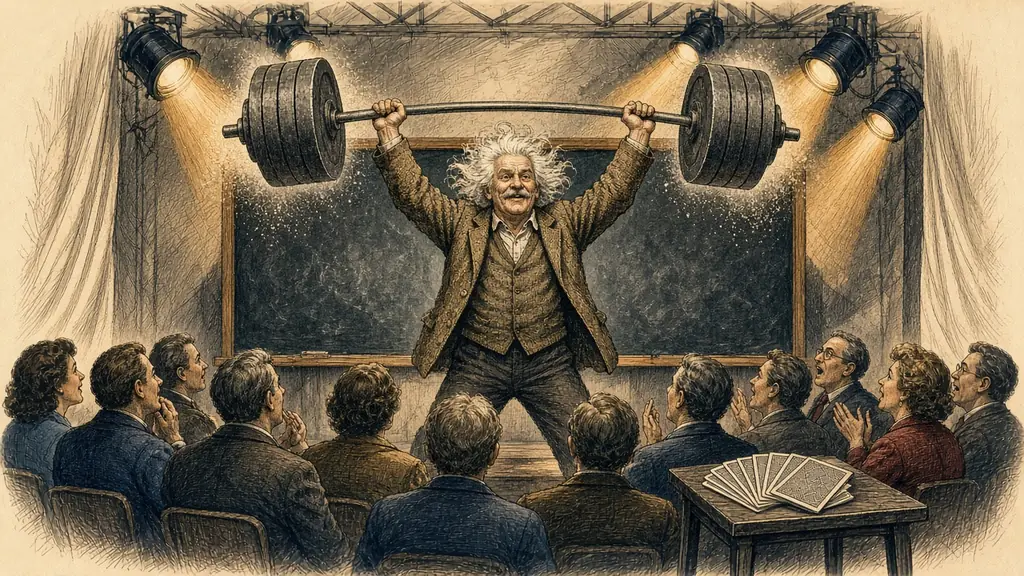
| 15 | A E | Albert Einstein | writing on a blackboard |
| 16 | A S | Arnold Schwarzenegger | lifting weights |
| 17 | A G | Al Gore | giving a lecture |
| 18 | A H | Alfred Hitchcock | filming a shower scene |
| 23 | B C | Bill Clinton | playing the saxophone |
| 24 | B D | Bob Dylan | singing with a guitar and a harmonica |
| 26 | B S | Bruce Springsteen | singing with a guitar |
| 27 | B G | Bill Gates | typing on a computer |
| 33 | C C | Charlie Chaplin | walking with a cane |
| 34 | C D | Charles Darwin | looking through a magnifying glass |
| 36 | C S | Carl Sagan | looking at the stars |
| 66 | S S | Steven Spielberg | directing a film |
| 68 | S H | Stephen Hawking | speaking through a machine |
| 77 | G G | Greta Garbo | wearing a hat and sunglasses |
| 78 | G H | George Harrison | playing a sitar |
| 91 | N A | Neil Armstrong | walking on the moon |
Compare with the Major System
| Major System | Dominic System | |
|---|---|---|
| Unit | A word with the right sounds | A person with the right initials |
| Strength | Easy to build from scratch, works in many languages | People are very memorable and carry an action |
| Cost | Words can be flat | You must build and learn a list of 100 people |
| Best for | Starting out; other languages | Four or more digits, long numbers |
action from the second.
four digits, one picture.
Now you build
Have a go before you open any answer. A rough attempt teaches you more than a perfect model you only read.
The letter code
Pair to initials
Encode 1776
Encode 1945
Choose your own
Say it aloud
Drill
Flash cards
Say the answer first, then tap the card.
Quick quiz
The memory challenge
Memory challenge: seven people
These seven people stand for the pairs 10, 12, 13, 15, 16, 17 and 18. Learn them in order. Say the pair and the initials as you see each person.
Place each person in a place along your palace route, doing their action.
The list has gone. Type what you remember, one item per line.
Look back
These reach back to earlier rooms. Answer in your head or out loud, then check.
What I can do now
A thought to keep
Which ten famous people could you use for the pairs from 10 to 19? Write down the first few that come to mind.