Person, Action, Object
A film director with a cast of a hundred and a million possible scenes. Six digits become one picture.
← People With Numbers · The whole course · Choosing Your System →
The film set
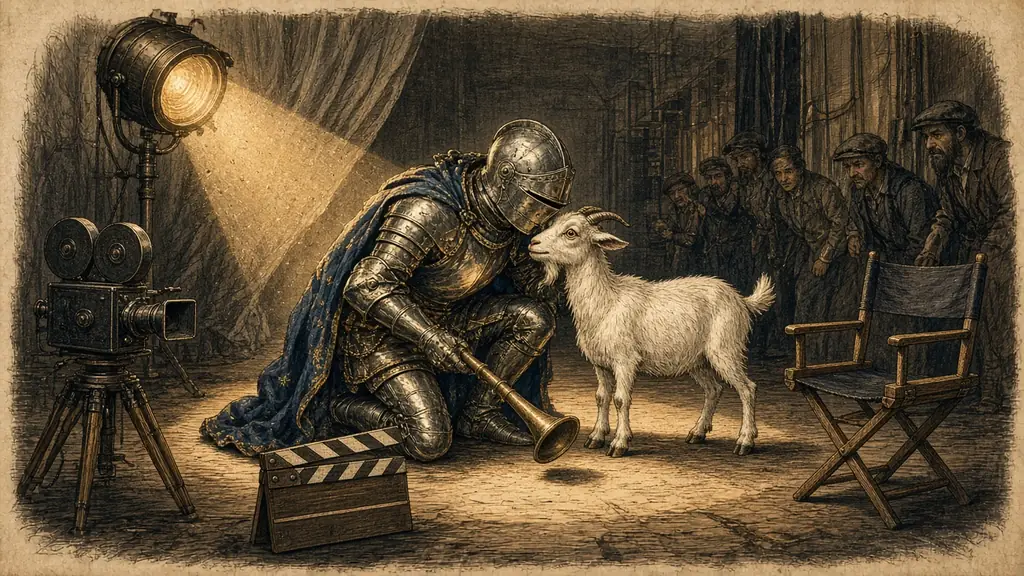
Imagine you are the assistant director on a film set, and the director has a strange rule. Every scene must contain exactly three things: a person, something that person does, and something they do it with. A woman paints a wall with a feather. A knight kisses a goat with a trumpet. A soldier cooks a pie in a bathtub.
The director shouts a number at the start of each scene, and your job is to remember all the scenes in order. The first number is 341526. Without thinking, the cast takes its places.
The reason the film works is that a scene has just three ingredients, but there are so many possible combinations. If there are a hundred people on the cast list, a hundred actions and a hundred objects, then the director can make a million different scenes, and no two are alike.
In this story every scene corresponds to six digits. The first two digits choose the person, the next two choose the action, and the last two choose the object. 34 is Charles Darwin. 15 is a certain action, 26 is a certain object. And so the scene for 341526 is Darwin, doing the action that belongs to 15, with the object that belongs to 26.
That is the idea of the PAO system: Person, Action, Object. It grew out of the Dominic System of the last lesson, which used person and action only, and it is used by many memory champions in competitions. One scene holds six digits, so a twelve-digit number needs just two pictures.
You will need to build the cast list yourself: a hundred people, each with one action and one object. It takes some work. But once it is built, you have a piece of equipment you can use all your life.
Words worth knowing
Say what you think each one means, then open it.
PAO is a standard technique in memory sport. Our own explanation.
Three entries for every pair
Every two-digit pair, 00 to 99, has three entries: a person, an action and an object. You learn them once. Then any six digits become one scene.
- Split the number into pairs of digits. 341526 → 34 | 15 | 26.
- Take the PERSON of the first pair. 34 → Charles Darwin.
- Take the ACTION of the second pair. 15 → the action of Albert Einstein: writing on a blackboard.
- Take the OBJECT of the third pair. 26 → the object of Bruce Springsteen: a guitar.
- Put them in one scene. Darwin is writing on a blackboard, with a guitar for a piece of chalk.
A model list to start from
Use these to begin, then replace them with people and things that are vivid for you.
| Pair | Person | Action | Object |
|---|---|---|---|
| 10 | Al Oerter | throwing | discus |
| 13 | Al Capone | counting money | briefcase |
| 15 | Albert Einstein | writing on a blackboard | chalk |
| 16 | Arnold Schwarzenegger | lifting | barbell |
| 17 | Al Gore | giving a lecture | globe |
| 18 | Alfred Hitchcock | filming | bird |
| 23 | Bill Clinton | playing | saxophone |
| 24 | Bob Dylan | writing songs | harmonica |
| 26 | Bruce Springsteen | singing | guitar |
| 27 | Bill Gates | typing | computer |
| 34 | Charles Darwin | sailing | finch |
| 66 | Steven Spielberg | directing | clapperboard |
Building your own list
- Person: use the Dominic initials (digits to letters). Choose people who are easy to see: film stars, sports people, family, friends.
- Action: choose the thing they are best known for. Make it big and physical.
- Object: choose something you can see them holding. Try not to use the same object twice.
- Keep entries different. If two people use a guitar, one of them will leak into the other.
- Start with a few. Build ten pairs a day and test yourself.
A from the second.
O from the third.
six digits, one scene.
Decoding works the other way. You see Darwin writing on a blackboard with a guitar: Darwin is 34, the action is Einstein's (15), the object is Springsteen's (26). So 341526.
Odd lengths. If the number does not divide by six, finish with a smaller scene: two digits = a person, four digits = person + action.
Now you build
Have a go before you open any answer. A rough attempt teaches you more than a perfect model you only read.
PAO in words
Assemble 241813
Assemble 162734
Decode a scene
Make your own entry
Tell the scene
Drill
Flash cards
Say the answer first, then tap the card.
Quick quiz
The memory challenge
Memory challenge: ten objects
These are the objects of the pairs 10, 13, 15, 16, 17, 18, 23, 24, 26 and 27 in the model list. Learn them in order and say the pair as you place each one in your palace.
One object at each place of your palace, doing something to the place.
The list has gone. Type what you remember, one item per line.
Look back
These reach back to earlier rooms. Answer in your head or out loud, then check.
What I can do now
A thought to keep
Which ten people would you start your PAO list with, and what would each of them be doing?