THE ART OF MEMORY · LESSON 14 OF 30 · PART III: MEMORY IN DAILY LIFE

Drawing Your Thinking

A naturalist's notebook and a branching drawing: how to see the shape of a subject on one page, and then walk through it.
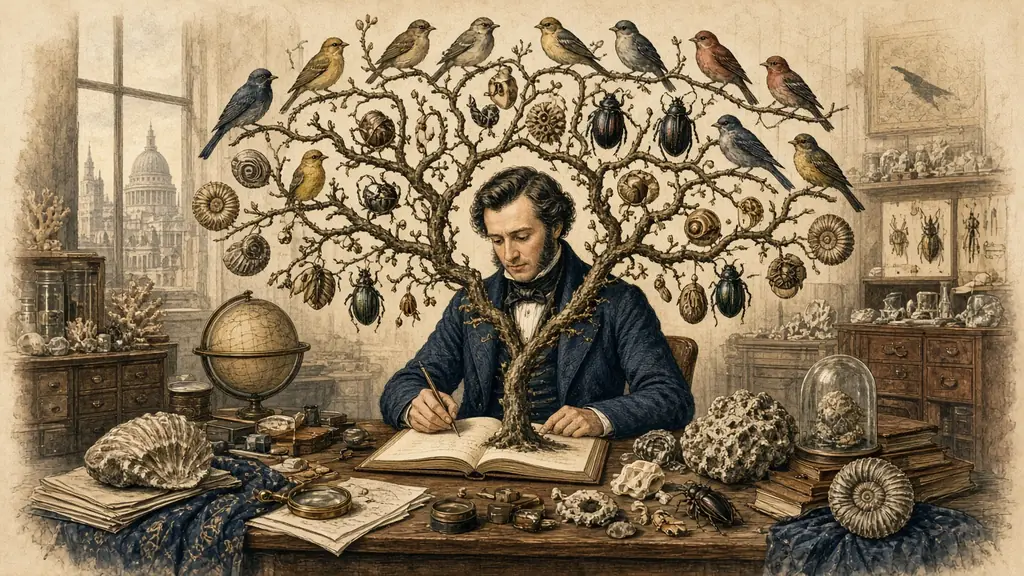
Memory hook: a Victorian naturalist at his desk as a tree grows out of his notebook, its branches ending in finches, shells, beetles and fossils.

← Speaking Without Notes  ·  The whole course  ·  Market Day →

In this lesson: you will learn the rules of a good mind map, draw the branches of a subject on one page, and turn the map into a palace with a room for each branch.
Where we left off
What are the five canons of rhetoric?
Invention, arrangement, style, memory and delivery.
What do you memorise for a talk, in the palace method?
A picture for each main point, placed along a route; not the script.
What is a 'spare place' for?
A picture that tells you where to restart if your mind goes blank.

A tree in a notebook

London, July 1837. A young naturalist, Charles Darwin, has been back from his long voyage on the Beagle for less than a year. His head is full of facts: finches from one island and mockingbirds from another, fossils, shells, bones, and a question he is not sure he dares to ask. His notebooks are full of lists.

On one page of a small notebook he stops listing. He writes two words at the top, I think, and underneath he draws something that is not a list at all.

What did Darwin do differently on that page?
He stopped writing a list and drew a branching shape.
Talk about it. When you think hard about something, do you write lists, draw pictures, or talk? Which helps you most?

It is a small, rough drawing: a single line that splits, and splits again, like the branches of a tree. Some of the branches end. Some keep going. It shows his idea that all living things are related, descending from common ancestors, with new kinds branching off over time.

The drawing is famous today. It shows the thing a list cannot show: how ideas connect. A list puts every item in a row, and every item looks the same size. A branching drawing shows which things belong together, which come first, and which are the trunk and which only twigs.

What does a branching drawing show that a list cannot?
How things connect: which belong together, which come first, and which are main branches and which twigs.
Talk about it. Think of a subject you know well. How would it look as a tree, with the trunk, the big branches and the twigs?

In the 1970s the writer and educator Tony Buzan popularised a way of taking notes in this branching form, which he called mind mapping. He explained it in a BBC series, Use Your Head, and in a book of the same name. A mind map starts from one central idea and spreads out in all directions, with a key word on every line.

A map is a good memory tool for another reason. It is a picture of a subject, and you already know what to do with pictures. In this lesson you will draw one and then turn it into a house.

Who popularised mind mapping, and where did he explain it?
Tony Buzan, in the 1970s, in a BBC series and a book called Use Your Head.
Talk about it. Have you ever used a mind map for study or work? What was it like?

Words worth knowing

Say what you think each one means, then open it.

a part that grows out of a main stem. The map has five main branches.
a system in which things are arranged by importance, from top to bottom.
in the middle; most important.
one important word that carries the meaning of a longer idea.
spreading out from a centre like the spokes of a wheel.
to come from an earlier source. Species descend from common ancestors.

Darwin's 1837 'I think' tree is in his Notebook B. Tony Buzan's Use Your Head series was broadcast by the BBC in 1974. Retold here in our own words.

The rules of a good map

A mind map is a single page with a central image in the middle and branches spreading out from it. Each branch carries one idea; smaller branches carry details.

Metaphysicswhat is real?Epistemologywhat can we know?Ethicshow to liveLogicgood reasoningAestheticswhat is beauty?Philosophy
A subject on one page: centre, five main branches, and one detail on each.
  1. Start in the middle. Draw the main idea as a picture or a word in a shape. Use the whole page.
  2. Give each main idea its own branch. Three to seven main branches is a good number.
  3. Use one key word per line. Not sentences. Keep the words short and write them on the branch.
  4. Add detail on smaller branches. Each sub-branch comes from a main branch.
  5. Use colour and small pictures. A different colour for each main branch.

From map to palace

A map shows you the structure. A palace lets you keep it. The two fit together because both are made of places.

  1. Choose a palace with a room for each main branch. Five branches, five rooms.
  2. Turn each branch into a picture and put it in its room. Metaphysics could be a huge glowing question mark floating over the hall.
  3. Turn each sub-branch into a picture in a place within the room. Detail goes on furniture and walls.
  4. Walk it. From room to room, branch by branch.
Philosophy in five rooms
A flat with five rooms.
Hall: MetaphysicsA glowing question mark floats in the hall, and the floor keeps turning transparent so you see what is real underneath.
Study: EpistemologyA giant eye on a desk is reading a book and peeping through a magnifying glass.
Kitchen: EthicsA tray of food is being shared out fairly, with a pair of scales on the table.
Bedroom: LogicA neat chain of train carriages runs under the bed, each linked to the next with a ticket.
Garden: AestheticsA beautiful painting of a sunset is hanging from a tree.
The picture: One page, five rooms: you can look at a subject, and then walk through it.
map it to see it.
palace it to keep it.
Say it aloud. Say aloud the five branches of philosophy, one question for each, and the room you would put each in.

Now you build

Have a go before you open any answer. A rough attempt teaches you more than a perfect model you only read.

Branches and questions

Match each branch of philosophy to its main question.
Metaphysics
Epistemology
Ethics
Logic
Aesthetics

Make your own map

Choose a subject you know well (a hobby, a job, a place). On paper, draw a central image and at least four main branches, each with one key word and two details. Then write the branches here.
Centre: Cooking. Branches: Equipment (knives, pans), Methods (roast, boil, fry), Ingredients (veg, meat, spices), Meals (breakfast, lunch, dinner). Colour-code each branch.

Turn it into a palace

Take your map. Choose a palace with the same number of rooms, and write a picture for each branch, placed in its room.
Hall: Equipment, a knife the size of a car on the doormat. Kitchen: Methods, a pan dancing on the stove. Pantry: Ingredients, a pile of vegetables with sunglasses. Dining room: Meals, a table laid for the whole street.

The rules

A mind map starts with a image in the middle of the page.
Write one on each line.
To turn a map into a palace, give each main branch its own .
Why is a mind map better than a list for seeing a subject?

Explain your map

Describe your map aloud: the centre, each branch, and why you put the branches where you did.
1:30

Drill

Flash cards

Say the answer first, then tap the card.

tap to turn over

Quick quiz

How many main branches does a map usually have?
What goes on a branch?
In a palace conversion, what does a main branch become?
What does a branching drawing show that a list does not?

The memory challenge

Memory challenge: the five branches

Learn the five branches of philosophy in order, one in each of five rooms. Metaphysics, epistemology, ethics, logic, aesthetics.

Use the five rooms from the example, or your own. A picture for each, and one question for each.

0:00

The list has gone. Type what you remember, one item per line.

Look back

These reach back to earlier rooms. Answer in your head or out loud, then check.

Lesson 13 · Speaking Without Notes. Name the five canons of rhetoric.
Invention, arrangement, style, memory, delivery.
Lesson 12 · A Pack of Cards. What is the King of Clubs in the card system?
Amsterdam.
Lesson 11 · Names and Faces. How do you make a name picture for 'Carmen'?
Car + men: a car full of men.
Lesson 4 · The Memory Palace. What is a locus?
A place on the palace route where a picture sits.

What I can do now

A thought to keep

Which subject on your desk right now would be best seen as a map? What would be its centre?

Saved on this device as you type.