Speaking Without Notes
A Roman lawyer who could repeat a whole day's auction from memory, and a way to give a talk with a house instead of a script.
← A Pack of Cards · The whole course · Drawing Your Thinking →
The auction
Rome, about a hundred years before the birth of Christ. Quintus Hortensius Hortalus, a famous lawyer, was known for a memory that his friends found hard to believe. He could listen to a long argument in court, and then stand up and answer every point in turn, without a note.
According to the writer Seneca the Elder, who tells the story a century later, his friends once made a bet. Hortensius sat through a whole day at an auction, listening to the sales. In the evening he stood up and recited, in order, everything that had been sold, who bought it and for how much. The auctioneer's clerk checked the records. Hortensius did not make a single mistake.
To Hortensius and the men he competed with, this was not a party trick. A Roman orator had to speak for hours in public with no screen, no cards, and no microphone. The ancient teachers of public speaking, whose books we still have, divided their art into five parts, and memory was one of them.
The five were: finding what to say, putting it in order, choosing the words, keeping it in mind, and delivering it with voice and gesture. A speaker who forgot his place lost the case. So memory was taught as carefully as grammar.
Today we give talks with slides, and most of us still read from them, which is why so many talks are dull. A speaker who reads loses the audience. A speaker who looks up, who has the talk in their head and the audience in their eyes, is a different person.
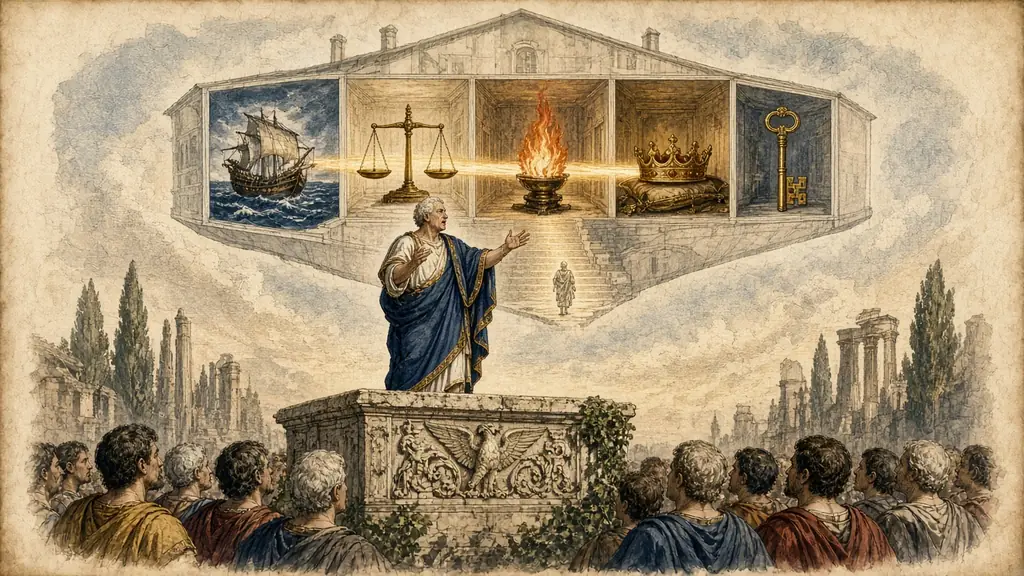
This is exactly what the palace method makes possible. You do not memorise a script word for word. You memorise five or six pictures in five or six places, and the words come as you walk. The Romans did it that way, and you can too.
Words worth knowing
Say what you think each one means, then open it.
Hortensius's feat is reported by Seneca the Elder, Controversiae, preface to Book 1. The five parts of rhetoric are set out in Cicero and the Rhetorica ad Herennium. Told here in our own words.
A talk in five or six rooms
The ancient teachers named five parts of rhetoric. The fourth one, memory, is the part you are learning here, and the other four tell you what to put in your palace.
| Canon | Meaning | Picture it as |
|---|---|---|
| Invention | Finding what to say | A lightbulb |
| Arrangement | Putting it in order | A row of boxes |
| Style | Choosing words | A paintbrush |
| Memory | Keeping it in mind | A treasure chest |
| Delivery | Voice and gesture | A trumpet |
- Write the talk as five or six points. An opening hook, three main points and a closing. One line each.
- Turn each point into one vivid picture. Not the words: the idea. A sad moon for 'sleep problems'.
- Choose a palace with the same number of places. A short route you know well: door, hall, kitchen, stairs, bedroom.
- Place the pictures along the route. In the order of the talk. The walk is the structure.
- Rehearse by walking. Say the talk aloud as you move through the palace, ten minutes at a time.
- Add a calming ritual for the moment before you speak. A slow breath, a hand on the table, and a picture of the first place.
Four tips from the old teachers
- Remember ideas, not sentences. The words will come, and fresh words sound alive.
- Keep a spare place for the moment your mind goes blank: a picture that says 'start the next point'.
- Rehearse out loud. Practise the sound of speaking, not only the thought.
- Practise on a walk. Moving helps your mind link the words to places.
not the words.
Now you build
Have a go before you open any answer. A rough attempt teaches you more than a perfect model you only read.
The five canons
Plan a short talk
Place it
Fill the gaps
Give the talk
Drill
Flash cards
Say the answer first, then tap the card.
Quick quiz
The memory challenge
Memory challenge: the five canons
Learn the five canons in order, with a picture for each. A lightbulb, a row of boxes, a paintbrush, a treasure chest, a trumpet.
Place the five pictures in five places. Invention at the door, then onwards.
The list has gone. Type what you remember, one item per line.
Look back
These reach back to earlier rooms. Answer in your head or out loud, then check.
What I can do now
A thought to keep
What is the next talk you have to give? How many points does it have, and what are your first two pictures?