Verbs That Misbehave
Why English verbs have such strange pasts, and how to learn them in families with a story each, not one by one.
← Words in a New Language · The whole course · Twenty-Six Pegs →
The verb that borrowed a past
Every learner of English eventually asks the same question: why? Why is the past of walk simply walked, but the past of go is went, which has nothing to do with go? Why is it sing, sang, sung but bring, brought, brought? It looks like chaos, and a learner who tries to memorise each verb separately may feel it is.
The answer is old, and it is interesting. Long before English was English, the Germanic languages made the past tense of many verbs by changing the vowel: sing, sang. That was the normal way. Later a new, simpler way arrived: just add -ed. It spread to almost every new verb, and the old vowel-changing verbs became the exceptions we call irregular.
A few verbs have an even stranger history. Go once had its own past, but it was lost, and English borrowed the past of another verb, wend, which meant 'to travel'. Wend got a new regular past, wended, and its old past, went, was left over. So the past of go is the past of a different verb.
And be is made up of at least three different old verbs wearing one coat: be, been come from one; am, is, are from another; was, were from a third. That is why they look nothing like each other.
The good news is that the chaos has a pattern. Most irregular verbs fall into small families that share a sound. Sing, ring, drink, swim, begin all change their vowel in the same way. Bring, buy, think, teach, catch all end their past in -ought or -aught. If you learn the families, you learn dozens of verbs at once.
And a family is exactly the kind of thing a memory method likes: a small group, with a shared sound, that can be held in one picture or one room. That is what you will do in this lesson.
Words worth knowing
Say what you think each one means, then open it.
The history of went (from wend) and of the verb be is standard in dictionaries of English. Told here in our own words.
Five families, five stories
Do not learn twenty verbs. Learn five families and a story for each.
| Family | Pattern | Verbs (infinitive, past, past participle) |
|---|---|---|
| 1 I-A-U | i → a → u | sing, sang, sung · ring, rang, rung · drink, drank, drunk · swim, swam, swum · begin, began, begun · sink, sank, sunk |
| 2 -ought / -aught | the past ends in -ought or -aught, same as the participle | bring, brought · buy, bought · think, thought · seek, sought · fight, fought · catch, caught · teach, taught |
| 3 Come | the infinitive and participle are the same | come, came, come · become, became, become · overcome, overcame, overcome |
| 4 -ow / -ew / -own | ow → ew → own | know, knew, known · grow, grew, grown · throw, threw, thrown · fly, flew, flown · draw, drew, drawn |
| 5 The odd ones | individual history | go, went, gone · be, was/were, been · do, did, done · see, saw, seen · take, took, taken |
One story per family
For the other three families, make your own stories. Or give each family a room: the I-A-U verbs in the kitchen, the -ought verbs in the hall. The method is the same as for any list: a picture or a story, and a place.
not the verb.
Now you build
Have a go before you open any answer. A rough attempt teaches you more than a perfect model you only read.
Family 1
Family 2
Which family?
A story for family 4
Tell the family
Drill
Flash cards
Say the answer first, then tap the card.
Quick quiz
The memory challenge
Memory challenge: twelve past forms
Learn these twelve past forms in order, in two stories (I-A-U, then -ought/-aught). Type them back, one per line.
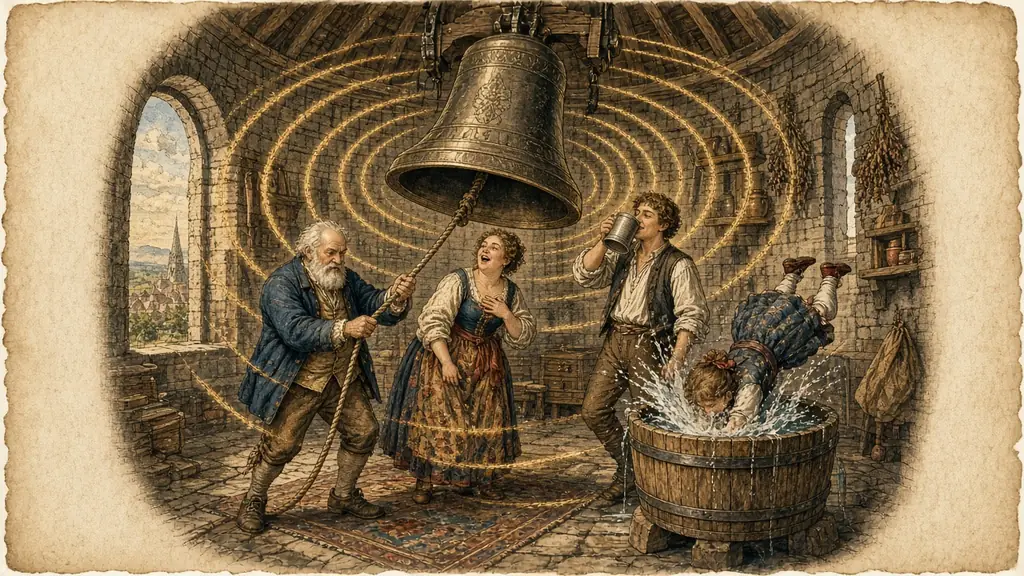
A swimmer, a bell, a drunk fish... then a fisherman who bought, brought, thought, sought, fought and caught.
The list has gone. Type what you remember, one item per line.
Look back
These reach back to earlier rooms. Answer in your head or out loud, then check.
What I can do now
A thought to keep
Which three irregular verbs do you most often get wrong? Which family do they belong to, and what is your story for it?