Twenty-Six Pegs
How pilots, police and call centres learned to spell without mistakes, and how the same twenty-six words can hold a list or a procedure.
← Verbs That Misbehave · The whole course · Formulas as Characters →
B, D, E, P, T and V sound the same
Picture a pilot over the sea, a controller on the ground, and a crackling radio. The pilot needs to spell the name of an airfield. She says the letters. The controller hears B, D, E, G, P, T and V, and cannot tell which is which. They all sound like the same short noise, bee, dee, ee, gee, pee, tee, vee, and an error here could be dangerous.
Radio operators had faced this since the early days of wireless. In the Second World War the Allies used a word for each letter: Able, Baker, Charlie, Dog, Easy. It worked for English speakers. But after the war, aviation became international, and a code that only works in English is not enough.
In the early 1950s the aviation authorities began to design a new alphabet. They asked linguists to help; among them was a Canadian, Jean-Paul Vinay. The new words had to be easy to say and to recognise for speakers of English, French and Spanish, with a clear and different sound for each.
They tested many words. Some were dropped because speakers of one language mispronounced them. In 1956 the final list was adopted, and it is still used today by pilots, ships, police, armies and call-centre workers: Alfa, Bravo, Charlie, Delta, Echo, Foxtrot, and on through Zulu. Two of the spellings, Alfa and Juliett, are unusual on purpose, to show French and other speakers how to say them.
Look at the list again. It is twenty-six fixed words in a fixed order, which everyone knows, each with a picture or a sound that is easy to see. That is exactly what a memory peg is. If A is Alfa, B is Bravo, C is Charlie, you have twenty-six places in order, and you can hang any list or any set of steps on them.
So: you already know the order. All you need is a picture for each word. Then you have a second, longer set of pegs, to go with the ten body pegs, and with no building.
Words worth knowing
Say what you think each one means, then open it.
The international spelling alphabet was finalised by the International Civil Aviation Organization in 1956. Our own account.
A picture for every letter
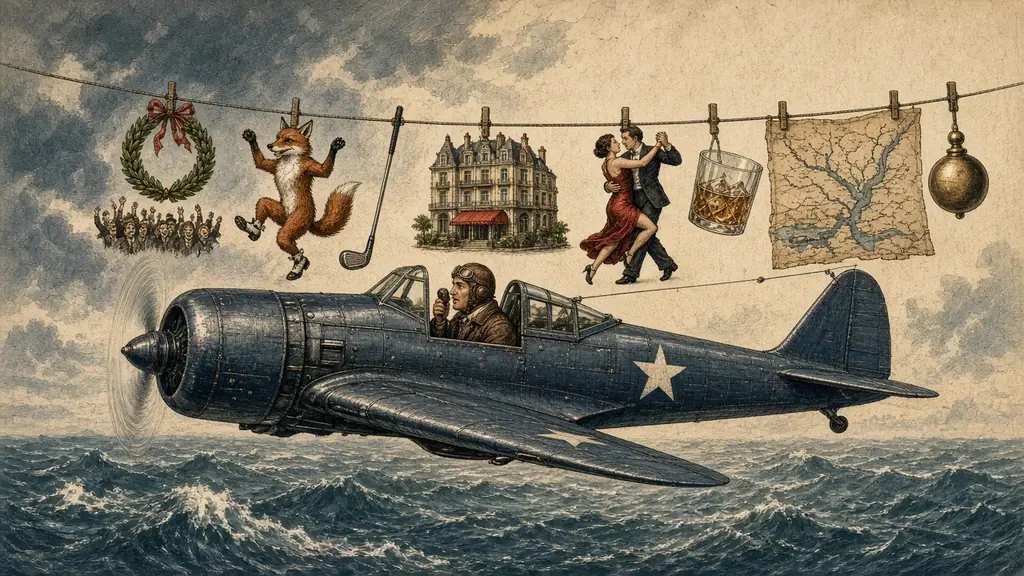
The code words are the pegs. Give each one a clear picture, always the same, and you can hang twenty-six things on them.
| Letter | Word | Picture | Letter | Word | Picture |
|---|---|---|---|---|---|
| A | Alfa | an alpha-wolf | N | November | a foggy night |
| B | Bravo | a crowd shouting 'Bravo!' | O | Oscar | a golden statue |
| C | Charlie | Charlie Chaplin's cane | P | Papa | a bearded father |
| D | Delta | a river delta | Q | Quebec | a maple leaf |
| E | Echo | a voice in a canyon | R | Romeo | a lover under a balcony |
| F | Foxtrot | a fox dancing | S | Sierra | mountains |
| G | Golf | a golf club | T | Tango | dancers |
| H | Hotel | a bell on a desk | U | Uniform | a smart uniform |
| I | India | an elephant | V | Victor | a trophy |
| J | Juliett | a girl on a balcony | W | Whiskey | a glass |
| K | Kilo | a heavy weight | X | X-ray | a skeleton picture |
| L | Lima | a llama | Y | Yankee | a baseball cap |
| M | Mike | a microphone | Z | Zulu | a zoo with a loo |
- Learn the order first. Say the code words from Alfa to Zulu until it is automatic. Singing the list can help.
- Give each word one fixed picture. Use the table, or your own: whatever you can see at once.
- Turn each item you want to remember into a picture too. Then make the item and the peg act on each other.
- Recall by running through the alphabet. Alfa, Bravo, Charlie... and see what is there.
A procedure: mending a puncture
Eight steps on eight pegs: A: take the wheel off. B: take out the inner tube. C: find the hole. D: dry the tube. E: put on the patch. F: check the tyre for sharp things. G: put the tube back. H: pump the tyre up. Each step is an action on its peg: an alpha-wolf removes a huge wheel; a crowd shouts 'Bravo!' at an inner tube pulled from the tyre like a snake.
| Alphabet pegs | Body pegs | Palace | |
|---|---|---|---|
| Number | 26 | 10 | As many as you build |
| Needs | The 26 code words | Your body | A building |
| Best for | Medium lists, steps | Short lists | Long lists |
= 26 pegs, ready.
Now you build
Have a go before you open any answer. A rough attempt teaches you more than a perfect model you only read.
The first ten
Letters and words
A list on the pegs
A procedure
Spell it
Drill
Flash cards
Say the answer first, then tap the card.
Quick quiz
The memory challenge
Memory challenge: Alfa to Mike
Learn the first thirteen code words in order, with a picture for each. Type them back, one per line.
Say them with their pictures: wolf, crowd, cane, river delta, echo, fox...
The list has gone. Type what you remember, one item per line.
Look back
These reach back to earlier rooms. Answer in your head or out loud, then check.
What I can do now
A thought to keep
What procedure do you do rarely and tend to get wrong? How would you put it on the pegs?