THE ART OF MEMORY · LESSON 21 OF 30 · PART V: ADVANCED TECHNIQUES

Against the Clock

A pack of cards, a clock and a room full of silent competitors. How to get faster without getting sloppy.
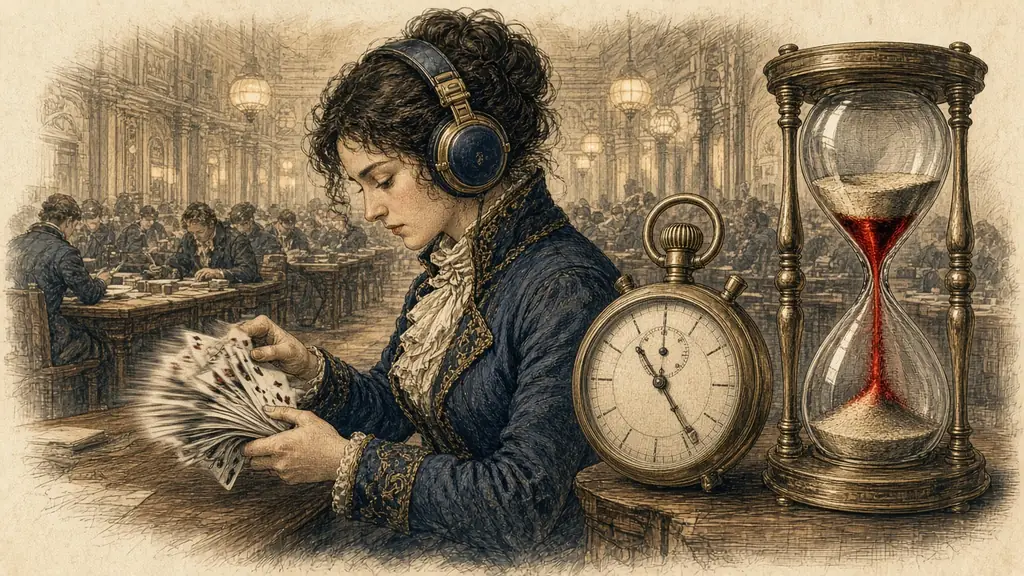
Memory hook: a competitor in ear defenders flicks through cards beside a giant stopwatch and an hourglass whose neck jams in a glowing red bottleneck.

← The Night Before the Exam  ·  The whole course  ·  A Palace of Centuries →

In this lesson: you will find out where your time goes when you memorise, remove the slowest step, and train in short timed rounds that build speed safely.
Where we left off
What is the difference between recognising and recalling?
Recognising is a feeling of familiarity when you see it; recalling is bringing it out with nothing in front of you.
How long of a one-hour study session should be spent testing yourself?
About a third or more.
Name the five steps of the study cycle.
Understand, picture, place, test yourself, come back.

Thirteen seconds

A large hall. Rows of tables. At each table there is a competitor with a pack of cards face down in front of them, a stopwatch, and a pair of ear defenders. The room is silent. When the signal comes, every competitor turns over the pack and begins.

This is the speed cards event, one of the most watched at memory championships. The task: look at a shuffled pack of fifty-two cards and learn the order as fast as you can. When you are ready you stop the clock, hand over the pack, and later you must put a second, new pack into the same order. Both the time and the accuracy count.

What must a speed cards competitor do?
Learn the order of a shuffled pack as fast as possible, stop the clock, and later arrange a fresh pack in the same order.
Talk about it. Would you rather be fast and sometimes wrong, or slow and always right? In which situations?

In recent years the best competitors have got the time for a whole pack below thirteen seconds. That is about a quarter of a second for each card. It sounds impossible, and it would be, if each card needed a new idea. But it does not.

The answer is that nothing new happens at all. Every card is already a fixed picture, and every place is already a fixed place. The competitor is not inventing. They are looking up pictures and putting them in places they have walked a thousand times. The work was done in training, long before the day.

How can a competitor learn a pack in about a quarter of a second per card?
Nothing is invented on the day: each card is already a fixed picture and each place is a fixed place, so it is look-up and placing.
Talk about it. What skill have you practised so much that you now do it without thinking? How long did it take?

The most important lesson of speed is the least obvious. You do not get faster by trying to go faster. You get faster by finding the one step that is slow, and making it automatic, and then finding the next.

In this lesson you will do exactly that, using ordinary words and pictures instead of cards. You will time yourself, find where the seconds go, and train in short rounds that raise your speed in steps.

How do you get faster?
Find the slowest step, make it automatic, then find the next one.
Talk about it. What would you like to be able to do ten times faster?

Words worth knowing

Say what you think each one means, then open it.

done without thinking. An automatic picture.
the narrowest point, where things slow down. The bottleneck is the look-up.
to practise something again and again.
speed. Keep a steady pace.
the quality of being correct. Speed without accuracy is useless.
to measure how long something takes.

The speed cards event is part of the standard World Memory Championship programme. Records change; 'below thirteen seconds' is the order of magnitude. Our own account.

Finding where the seconds go

Memorising an item has four small steps. Speed comes from making each one smaller.

  1. Look-up. Turn the item into its fixed picture.
  2. Build. Make the picture act in a vivid way.
  3. Place. Put it at the next place on the route.
  4. Move on. Step to the next item without checking or going back.
If you are slow atIt is probably becauseFix
Look-upThe fixed pictures are not automatic yetFlash-card the list until each answer takes no time
BuildingYou are trying to make the picture perfectMake it good enough: one action and one sense
PlacingThe route is not automaticWalk the route in your head, fast, without items
Moving onYou go back to checkTrust the picture and go on; check at the end

How to train

  • Accuracy first. Do not time yourself until you can do the task correctly at a slow pace.
  • Short rounds. Thirty to sixty seconds, then stop and rest. Many short rounds beat one long one.
  • Raise the speed by about a tenth each time. If you make errors, go back.
  • Keep a log. Write the time and the number of mistakes. Progress is visible.
  • Rest. Sleep is part of training.
slow is smooth,
smooth is fast.
A timed round with words
Ten words in sixty seconds: tiger, anchor, violin, pepper, rocket, mirror, candle, bridge, lantern, saddle.
Look-upEach is already a picture. No decision.
BuildOne action and one sense: a tiger roaring at a mirror.
PlaceTen places on a route you know by heart.
CheckAt the end, walk the route once and say each word.
The picture: Ten quick scenes, six seconds each, on a route that is already automatic.
Say it aloud. Describe the four steps of memorising an item, and say which of them is slowest for you.

Now you build

Have a go before you open any answer. A rough attempt teaches you more than a perfect model you only read.

Find the bottleneck

Match each symptom to the step that is slow.
You hesitate over which picture a card is
You spend ages making each picture perfect
You get lost in your route
You keep going back to check earlier items

A timed round

Take the ten words from the example. Write one very short scene for each (a few words only). Try to finish in two minutes. Then write your time.
tiger roaring at mirror; anchor in coffee cup; violin sawn in half; pepper sneezing; rocket in a bath; mirror dancing; candle melting on a head; bridge walking; lantern singing; saddle on a giraffe.

The idea

Do not time yourself until you can do it correctly at a slow .
Raise the speed by about a each time.
The slowest step is called the .

Your training log

Design a one-line log for your practice. What will you write each day (date, task, time, mistakes)? Write an example entry.
Monday 18 Oct: 10 words, 52 seconds, 1 mistake (candle). Plan: raise to 10 words in 47 seconds.
A learner is fast but makes many mistakes. What should they do?

Walk the route fast

Walk your palace route in your head as fast as you can, naming each place. Do it three times and see if it gets quicker.
1:00

Drill

Flash cards

Say the answer first, then tap the card.

tap to turn over

Quick quiz

How do you get faster?
What is the best length for a training round?
When should you start timing yourself?
What is a good thing to record?

The memory challenge

Memory challenge: ten words, sixty seconds

Ten words in sixty seconds. Look-up, build, place, move on. Type them in order.

About six seconds for each. Do not go back.

0:00

The list has gone. Type what you remember, one item per line.

Look back

These reach back to earlier rooms. Answer in your head or out loud, then check.

Lesson 20 · The Night Before the Exam. What is the difference between recognising and recalling?
Recognising is a feeling of familiarity; recalling is bringing it out from nothing.
Lesson 19 · Formulas as Characters. What is the first step in memorising a formula?
Say what it means in words.
Lesson 18 · Twenty-Six Pegs. How many pegs does the alphabet system give?
Twenty-six.
Lesson 12 · A Pack of Cards. How does a champion learn a pack faster than 52 scenes?
Three cards at a time as a person-action-object scene.

What I can do now

A thought to keep

Which step is your bottleneck? What small drill will you do this week to fix it?

Saved on this device as you type.