The Night Before the Exam
A student reads her notes three times and feels sure. Then she sits the exam. Why feeling you know is not the same as knowing, and how to study so that it lasts.
← Formulas as Characters · The whole course · Against the Clock →
The night before the exam
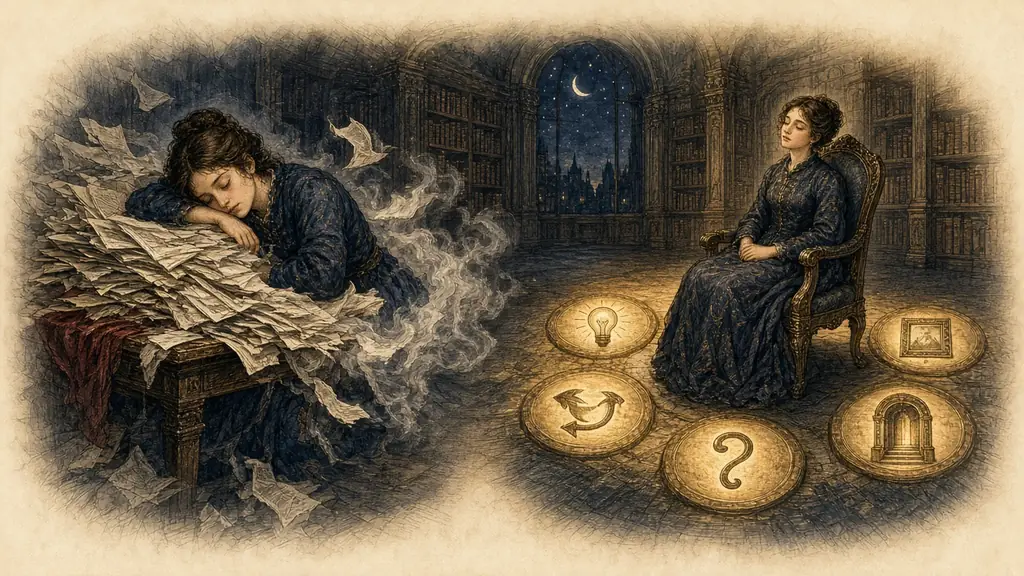
It is eleven at night in a university library, and a student, Lena, has an exam at nine in the morning. She has a stack of notes: forty new words, twenty irregular verbs, a list of ten steps for a procedure, and four formulas. She has three hours before the library closes, and she is calm, because she has a plan. She will read it all again, three times.
She does. She reads the words and each one feels familiar. She reads the verbs and they look right. By one o'clock she has a warm, comfortable feeling that she knows it. She goes to bed pleased with herself.
At nine o'clock the exam begins, and the first question is a blank page. The words are not there. The verbs she thought she knew will not come out. She stares at a formula and cannot remember how it starts. It is the strangest feeling: everything looks familiar, but nothing comes when she asks for it.
What went wrong? Recognising is not recalling. When she read the notes, every word was in front of her, and the feeling of familiarity was strong. In the exam the notes were gone, and the memory had never been trained to come out on its own.
Psychologists have tested this many times. In one well-known series of experiments, students studied a short text and then either read it again or tried to recall it from memory. A week later, the students who had tested themselves remembered clearly more than those who had simply re-read, even though the re-readers felt more confident.
That is the lesson of this lesson, and the lesson of the whole library part. Words, verbs, steps and formulas all need the same treatment: understand, picture, place, test, and come back. You will practise all four kinds at once, as in the exam.
Words worth knowing
Say what you think each one means, then open it.
The testing effect was shown by Henry Roediger and Jeffrey Karpicke (2006) and many others. Lena is invented for this lesson.
A study cycle that lasts
Whatever you are studying, the cycle is the same. The tools change with the material.
- Understand. Say each thing in your own words. If you cannot, you are not ready to memorise.
- Picture. Give each item a vivid picture (lesson 2): a keyword, a character, a scene.
- Place. Put the pictures on pegs, in a palace or in a chain.
- Test yourself. Close the notes. Write or say everything you can. Check, and mark what you missed.
- Come back. Test again tomorrow, then in three days, then in a week.
The tool for each kind of material
| Material | Tool | Lesson |
|---|---|---|
| New words in another language | Keyword method: sound-alike + picture | 16 |
| Hard English words | Latin roots: duc, spec, port, scrib, aud, vid, dict, mit, ject, tract | 16 |
| Irregular verbs | Families with one story each | 17 |
| Lists and procedures | Alphabet pegs, 26 code words | 18 |
| Formulas | Understand, then a character for each symbol | 19 |
is when you learn.
- Mix the kinds. Switching between words, verbs and formulas in one session is harder, and helps more than doing one kind at a time.
- Ask what you missed. The mistakes are the useful part: fix those pictures.
- Stop when you can do it twice. Then leave it, and come back later.
Now you build
Have a go before you open any answer. A rough attempt teaches you more than a perfect model you only read.
Material and tool
Plan your next study session
Four scenes at once
The idea
Test yourself aloud
Drill
Flash cards
Say the answer first, then tap the card.
Quick quiz
The memory challenge
Memory challenge: mixed review
Eight things from the last five rooms, in a mixed order: a foreign word, a root, a verb form, a code word and formulas. Type them back in any order.
Eight scenes: a duck in a pot, a clown throwing a pie, a fisherman who caught, a swimmer who swum, Charlie's cane, an eagle on a cheetah, a fist and a mouse, a tractor pulling.
The list has gone. Type what you remember, one item per line.
Look back
These reach back to earlier rooms. Answer in your head or out loud, then check.
What I can do now
A thought to keep
What will you test yourself on this week? When will you test yourself again?