A Town of Palaces
A Jesuit who taught the memory palace in China, and how to link many palaces into a network that holds a whole subject.
← Three Digits, One Picture · The whole course · Ideas You Cannot See →
The Jesuit and the palace
China, the late sixteenth century. An Italian priest of the Jesuit order, Matteo Ricci, has lived in the country for years. He has learned to speak, read and write Chinese, and dresses as a scholar. He is there to talk about his religion, but he has found that the best door into Chinese society is a surprising one: his memory.
In China, ambitious young men prepared for years for the imperial examinations, which tested their knowledge of an enormous body of classical texts. Memory was a serious matter. When Ricci reportedly showed scholars that he could learn a long list of Chinese characters, read once, and say it back in order, and then backwards, they wanted to know how.
In 1596 he wrote a short book in Chinese to explain the art. In it he taught the memory palace. He told his readers to choose a building, to fix places in it, and to put a picture in each place. He explained that the scholar should fix places in order and walk through them. He did not present it as his own invention; it came from the West.
The scholars who read it faced the same problem as every student with a lot to learn. A single building is not enough. One house with fifty places holds fifty things, and the examination was thousands of lines long. What they needed was more buildings, and a way to move between them.
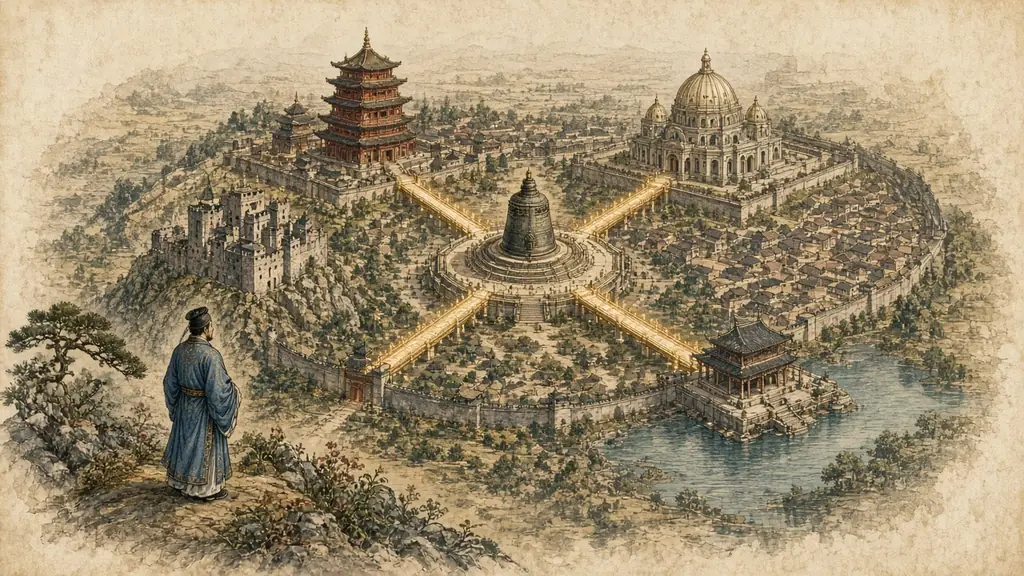
Which is exactly where this lesson begins. A network of palaces is like a town. You do not memorise one house; you memorise streets, and the streets connect houses, and each house is about one subject. A bank of buildings for history, another for languages, another for your job.
The part of the network that matters most is not the houses but the connections. A good connection is a short, vivid step between the last place of one palace and the first of the next. With those, a hundred buildings can be walked in one long journey, and you can enter and leave wherever you want.
Words worth knowing
Say what you think each one means, then open it.
Matteo Ricci (1552 to 1610) wrote a treatise on the art of memory in Chinese in 1596. Retold here in our own words.
Many palaces, one journey
One palace holds as many items as it has places. A network of palaces holds a subject, a course, or a career.
- Choose one building per subject. History in your old school, languages in your grandmother's house, work in your office.
- Make each building distinct. Different styles, colours, sizes: so you never mix a room of one with a room of another.
- Pick a hub. A place you know very well, with doors to the others. Your own home works.
- Build the bridges. A vivid, short link, for example: you open the front door of your home and walk straight into the school playground.
- Keep a plan. A list of palaces, what is in each, and how many places are free.
Practical rules
- Fifty places per palace is a lot. Twenty to thirty is a good size to start with.
- Keep one palace per subject. A subject that overflows gets a second building and a bridge.
- Keep the order fixed in each, and the order of buildings fixed along the journey.
- Reuse after clearing. When a palace is no longer needed, clear it by imagining it empty, clean and bright.
- Review the bridges. The weak point of a network is a connection that has faded.
| Size | Best for | |
|---|---|---|
| One palace | 20 to 50 places | A talk, a list, a lesson |
| A small network | 3 to 6 palaces | A course or a project |
| A large network | A dozen palaces or more | A subject for years |
each bridge vivid.
one plan.
Now you build
Have a go before you open any answer. A rough attempt teaches you more than a perfect model you only read.
Plan a small network
A bridge
The idea
Which size?
Walk the network
Drill
Flash cards
Say the answer first, then tap the card.
Quick quiz
The memory challenge
Memory challenge: the eight planets across two palaces
Put the first four planets in palace A and the next four in palace B, with a bridge between. Mercury, Venus, Earth, Mars | Jupiter, Saturn, Uranus, Neptune. Type them in order.
Four in the first palace; a bridge; four in the second palace.
The list has gone. Type what you remember, one item per line.
Look back
These reach back to earlier rooms. Answer in your head or out loud, then check.
What I can do now
A thought to keep
Which three subjects deserve a palace of their own? What building would you give each?