Ideas You Cannot See
Seven women in a hall, each carrying a symbol. How medieval teachers kept justice, courage and logic in mind, and how you can too.
← A Town of Palaces · The whole course · The Long Speech →
Seven women in a hall
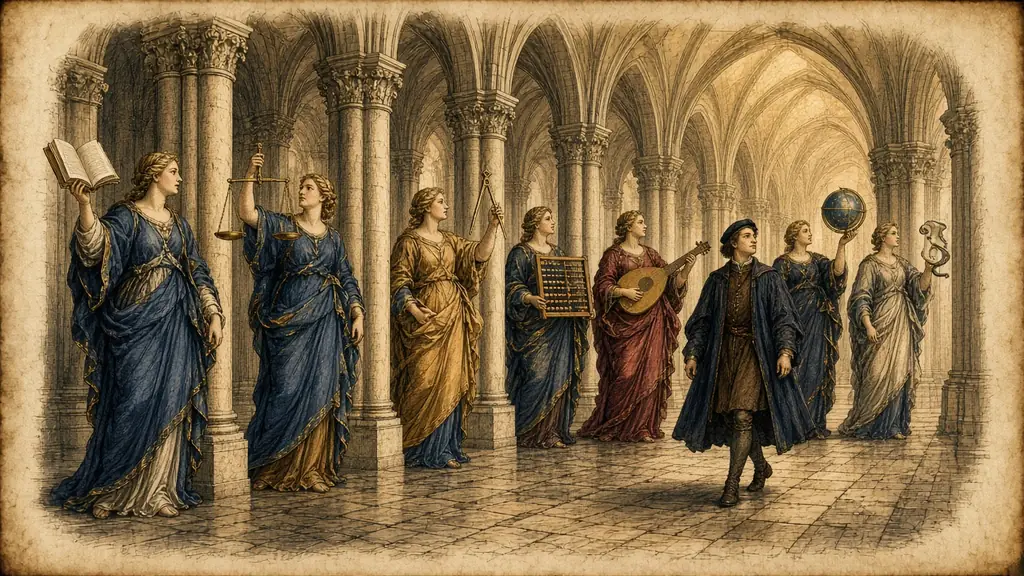
Imagine a long hall in a medieval university. Seven women stand between the columns, each holding something. One has a book, one a pair of scales, one a pair of compasses, one a counting frame, one a lute, one a globe. They are not real women. They are the seven liberal arts, the subjects every student had to study: grammar, rhetoric, logic, arithmetic, geometry, music and astronomy.
Artists painted them again and again. They did it because an idea with no face is hard to hold, and an idea with a face, a costume and something to carry is easy.
The great thirteenth-century thinker Thomas Aquinas wrote about memory, following the old Roman handbooks. He gave advice that sounds modern. Put the things you want to remember in an order. Attach them to striking images, because plain ones slip away. Give them your close attention. And go over them often.
He also noticed the difficulty this lesson is about: the ideas that matter most, such as truth, duty or fairness, are the ones with no picture. His answer was the old one. Use likenesses: a picture that stands for the idea, even if it is not the idea.
Later, in the sixteenth century, the philosopher Giordano Bruno designed enormous systems of images for abstract ideas, with wheels of figures that stood for qualities and concepts. They were too complicated to be useful for most people. But the principle was right: an abstract idea needs a body.
You will not need a wheel. You need four small tools, and a habit of asking, whenever you meet an idea, what could I see that stands for this?
Words worth knowing
Say what you think each one means, then open it.
Aquinas's four pieces of advice follow the Roman handbook tradition. Bruno's memory systems date from the 1580s. Told here in our own words.
Four ways to give an idea a body
To remember an abstract idea, make it concrete: turn it into something you can see, hear and feel.
| Tool | How | Example |
|---|---|---|
| A symbol | Use an object that traditionally stands for it | Justice: scales. Peace: a dove. Time: an hourglass. |
| A person | Make the idea a person doing something, or use a person famous for it | Courage: a firefighter in the flames. Wisdom: an old owl-eyed woman. |
| A scene | Show the idea happening | Inflation: prices on a shop sign rise like a balloon and float away. |
| A feeling | Put in the emotion the idea brings | Freedom: running barefoot down a hill with the wind in your hair. |
- Say what the idea means. In one plain sentence.
- Choose a tool. Symbol, person, scene or feeling. A mix is best.
- Make it vivid and moving. Add action and a sense.
- Place it. On a peg, in a palace place, or in a chain.
- Check that it brings the idea back. Look at the picture, then say what it means. If it does not work, change it.
Other kinds of word
Small grammatical words, such as although or because, have no pictures either. Give each a fixed picture from its sound, as in the keyword method (lesson 16): because as a buzzing bee holding a banner that says CAUSE; although as a giant letter A made of dough.
that stands for this?
Now you build
Have a go before you open any answer. A rough attempt teaches you more than a perfect model you only read.
Symbol or scene?
Freedom
Inflation
Courage and evidence
Explain your pictures
Drill
Flash cards
Say the answer first, then tap the card.
Quick quiz
The memory challenge
Memory challenge: six abstract words
Learn six ideas in order, each with a picture: justice, freedom, democracy, inflation, courage, evidence. Type them back in order.
Scales; a barefoot runner; a box of paper hats; a floating loaf; a child past a dragon; a footprint under a spotlight.
The list has gone. Type what you remember, one item per line.
Look back
These reach back to earlier rooms. Answer in your head or out loud, then check.
What I can do now
A thought to keep
Which abstract words in your own subject keep slipping away? What would their pictures be?