Keeping a Book
Monks who carried a hundred and fifty psalms in their heads, and a way to keep the shape and the key ideas of a book or article.
← The Long Speech · The whole course · A Day at the Championships →
The monk and the psalter
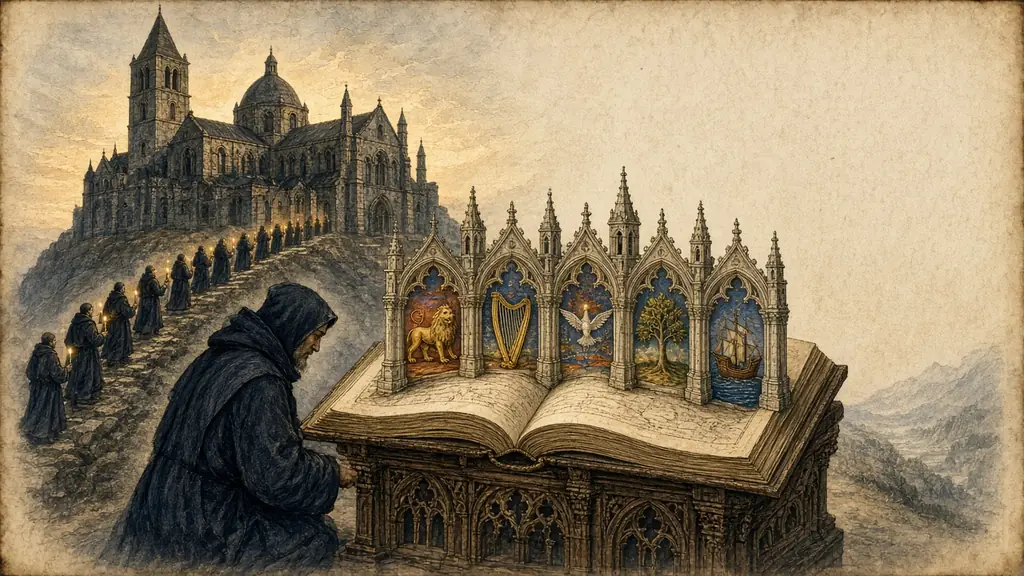
A monastery in medieval Europe, before dawn. A bell rings, and the monks file into the church in the dark. They do not carry books. The service they are about to sing is made of psalms, the 150 ancient poems of the Bible, and many of the monks know them by heart.
The rule that governed monastic life asked monks to sing through the whole set of psalms in the course of a week. Newcomers had to learn them. It was normal to spend years memorising the psalter, and then to keep it all of one's life.
How did they hold so much? Scholars of medieval memory say that the monks did not try to hold each psalm as a block of words. They built a structure: they knew the order of the psalms, divided them into groups, and tied each to a place, a picture, or a tune. A text in their minds was a building with rooms.
Some teachers in the Middle Ages went further. They told students to picture a great diagram, such as a ship or a building, and to hang the parts of a book on it, section by section. The book became a place you could walk through.
Most of us read books and articles very differently. We start at the first word, read to the end, and a week later can say only that we enjoyed it or it was long. Some of this is natural. But if you read for study or work, you want the argument, the key ideas and the evidence to still be there when you need them.
The method in this lesson is built on the monks' insight. First see the shape, then fill it in. You will map the text before you read it, turn the map into a palace, and read with a purpose.
Words worth knowing
Say what you think each one means, then open it.
Scholars of medieval memory, such as Mary Carruthers, describe the monastic memory of the psalter. Told here in our own words.
Five steps for a book or article
Read in two passes: first for the shape, then for the substance.
- Survey. Five minutes: title, contents, headings, first and last paragraph of each chapter. Do not read the body yet.
- Map. Draw a mind map (lesson 14): the main question at the centre, one branch for each chapter or main section.
- Place. Turn the map into a palace: one room per chapter, with a big picture for its main idea.
- Read and add. Read each chapter. Add two or three key details as pictures in its room: a fact, an example, a quotation.
- Test. Close the book. Walk the palace and say what each room holds, in your own words. Then check.
Good habits
- Ask a question first. What do I want from this text? A reader with a question reads better.
- Use your own words. A summary in your own words is a memory; copying is not.
- Keep the argument. What is claimed, what is the evidence, and what follows?
- Review by walking. A short walk through the rooms a day later, a week later, a month later.
- Do not memorise everything. Choose what matters. A palace of the ten key ideas is worth more than a vague memory of the whole.
then fill in the rooms.
Now you build
Have a go before you open any answer. A rough attempt teaches you more than a perfect model you only read.
Map a text
Rooms for the sections
Two details
The steps
Say the article
Drill
Flash cards
Say the answer first, then tap the card.
Quick quiz
The memory challenge
Memory challenge: the five steps
Learn the five steps of the method in order: survey, map, place, read and add, test.
One room for each step: a pair of binoculars, a map, a flag, a book with a plus sign, an exam paper.
The list has gone. Type what you remember, one item per line.
Look back
These reach back to earlier rooms. Answer in your head or out loud, then check.
What I can do now
A thought to keep
Which book on your shelf would you most like to keep? What are its five rooms?