A Day at the Championships
Ten events, one hall and a silence you can hear. What memory sport asks of people, and which tool you would pick for each event.
← Keeping a Book · The whole course · From Seven Digits to Seventy-Nine →
The first championship
London, 1991. A small group of people sit at tables in a hall and wait for a signal. Nobody has done this before. There is no rule book yet worth the name. A writer on mind and learning, Tony Buzan, and a chess master and organiser, Raymond Keene, have invited a few people who claim to have unusual memories to compete in the first World Memory Championship.
The winner is a young Englishman who has trained in secret, using the methods of Roman orators and a system of his own: Dominic O'Brien, whom you met in lesson 8. He will win it eight times. But what is important is not who wins. It is that the old art has become a sport, with scores and a clock.
Since then the championship has grown into an international event, with national contests and young competitors from many countries. The events have settled into a standard programme of ten. Some use words, some use digits, some use cards, faces or images, and a few last an hour while others last seconds.
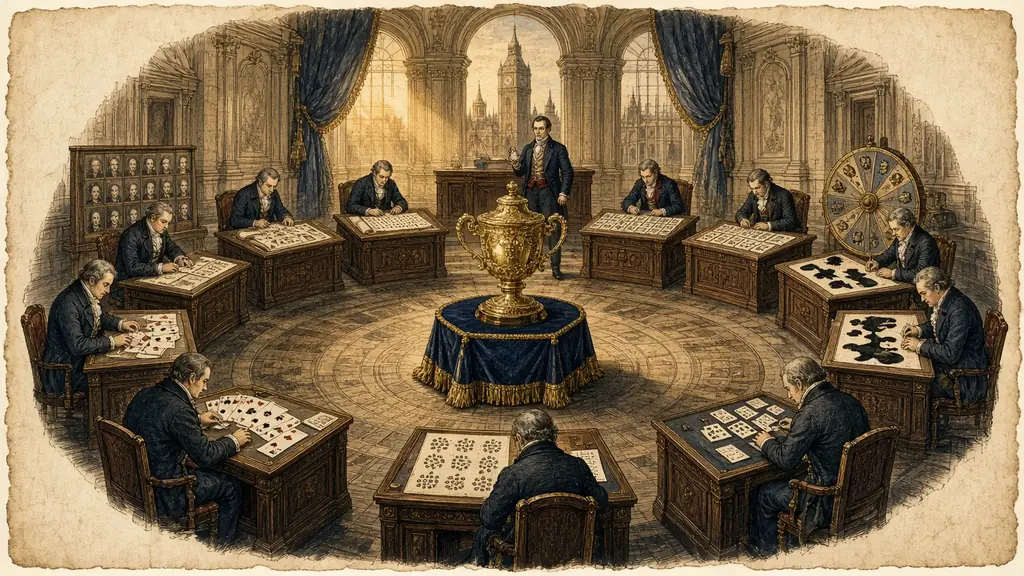
What strikes a visitor is the quiet. Competitors wear ear defenders, or headphones, to block noise. They sit still. When the clock starts, they are not memorising in the old sense of repeating. They are building and placing pictures, at the speed of a person turning pages.
You do not need to compete to learn from them. The ten events are a catalogue of kinds of memory, and each is a practical question. How do you keep a list of words? A sequence of faces? A run of binary digits? A set of dates? Each event was designed to be hard, and each has a method.
In this lesson you will go through all ten, match each to the tool from this course, and set up a small event of your own as a personal test.
Words worth knowing
Say what you think each one means, then open it.
The first World Memory Championship was held in London in 1991, organised by Tony Buzan and Raymond Keene. The event list is the standard programme; rules and timings vary by competition.
Ten events, ten tools
Each event is a different kind of material. For each, you already have a good tool.
| Event | The task | Tool from this course |
|---|---|---|
| Names and faces | Learn many faces with first and last names | Name pictures joined to features (lesson 11) |
| Binary digits | Long rows of 0s and 1s | Group into threes or more: each group is a picture (lesson 6, 23) |
| Random numbers | As many digits as possible in a set time | PAO or a three-digit system (lesson 9, 23) |
| Abstract images | Learn the order of abstract pictures | Give them concrete names or pictures (lesson 25) |
| Speed numbers | Digits in five minutes | PAO or three-digit, fast (lesson 9, 21, 23) |
| Dates | Years with invented events | Timeline palace (lesson 22) |
| Random cards | Several packs in a time limit | Card pictures along a palace (lesson 12) |
| Random words | A long list of unrelated words | Pictures and a palace (lesson 2, 4) |
| Spoken numbers | Digits read aloud, one a second | A system that works by ear: a three-digit or PAO system |
| Speed cards | One pack, as fast as possible | Card system, three cards a scene (lesson 12, 21) |
How events are scored
- A correct answer gets points; for many events, a mistake in a section ends or reduces its score.
- In speed events, the time counts and so does accuracy.
- In long events, the total number of correct items counts.
The exact rules change from year to year, so check the current rules if you want to compete. The point for us is the training idea: every event is a skill that is trained, not a gift.
trained like any other.
Now you build
Have a go before you open any answer. A rough attempt teaches you more than a perfect model you only read.
Event and tool
Design a personal test
Binary digits in threes
The history
Describe a championship
Drill
Flash cards
Say the answer first, then tap the card.
Quick quiz
The memory challenge
Memory challenge: the ten events
Learn the ten events in order, with a picture for each: names and faces, binary digits, random numbers, abstract images, speed numbers, dates, random cards, random words, spoken numbers, speed cards.
Ten places along a route, one event at each.
The list has gone. Type what you remember, one item per line.
Look back
These reach back to earlier rooms. Answer in your head or out loud, then check.
What I can do now
A thought to keep
Which of the ten events would you like to try first, and what tool would you use?