The House
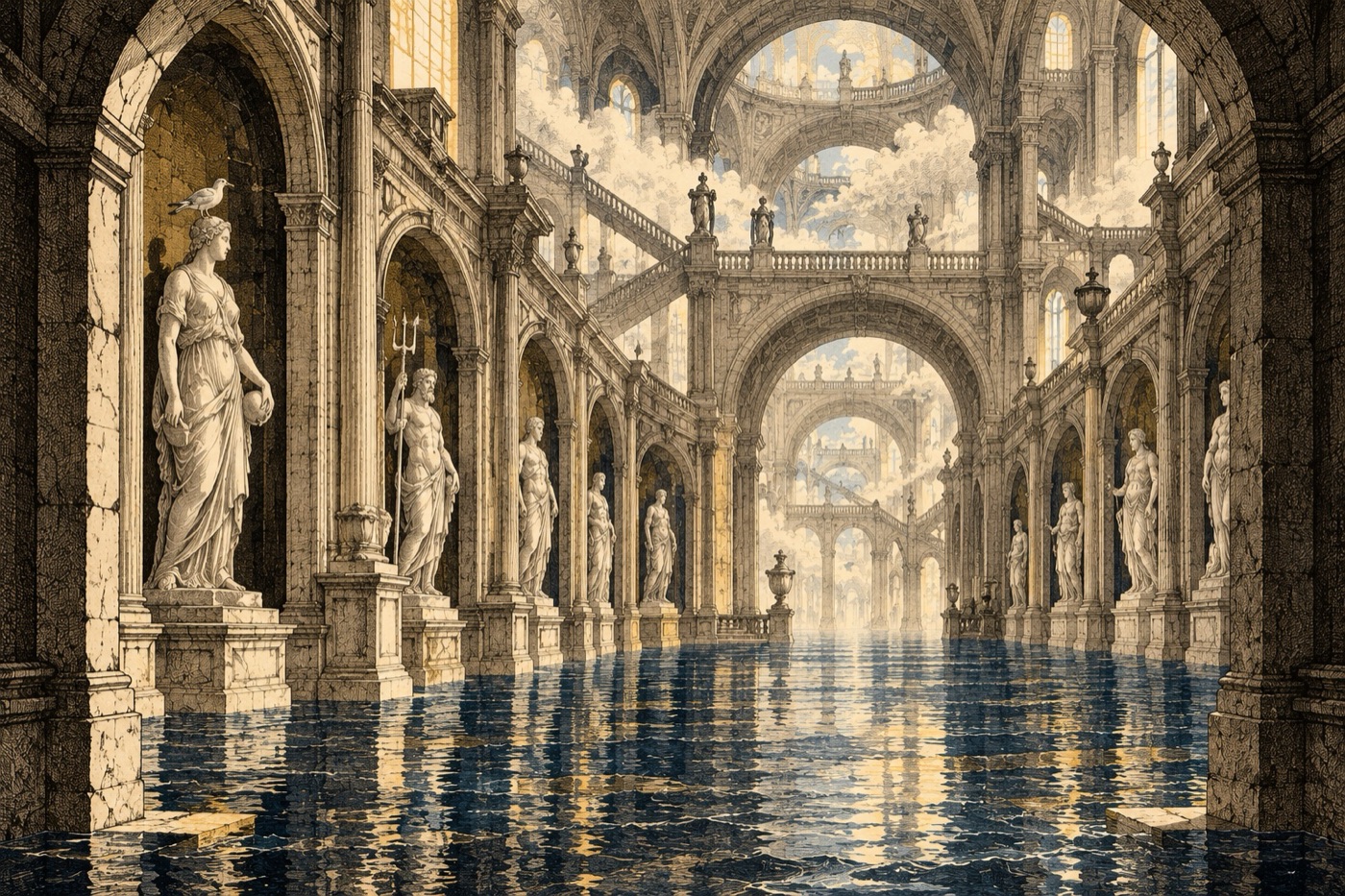
A man lives alone in an enormous building of endless halls, with the sea moving through the lower floors. He is calm, grateful and exact. How does a writer make a strange place feel like home?
The whole series · The Journals →
- Think of a place you know so well that you could describe it with your eyes closed. What would you mention first?
- Have you ever been alone somewhere for a long time? What did you start to notice that you would normally miss?
- If you could live in one enormous building for a year, what would you want it to contain?
The vocabulary of this story
Ten items. Say your answer out loud before you reveal it.
A · What do they mean here? Work it out from the context
Read the sentence, guess the meaning of the word in bold, then reveal.
B · Which term means…?
Three terms: take stock · keep track of · in awe of. Say the right one, then reveal.
C · Which word completes all three phrases?
One missing word fits every phrase in the group. Say it, then reveal.
Now use them — out loud
- When did you last take stock of your own life? What did you decide?
- What do you do to keep track of things you do not want to forget?
- What has left you in awe in the last year, a place, a person, a piece of work?
The story, in three parts
Read each part. After it, answer the quick check from memory, then discuss one question.
Part 1 — A house the size of a world
Susanna Clarke's novel Piranesi begins inside a building that seems to have no beginning and no end. There are halls opening into halls, each one lined with statues, each one different. Some are dry. In the lower halls the sea comes in, rises, fills the floor and goes out again. In the highest halls the clouds drift in and sometimes become rain.
The narrator knows no other place. As far as he is concerned, this is the world, and he calls it the House. He has explored a great deal of it, and he describes it with an extraordinary calm, naming the halls by their statues and measuring the distance between places in days of walking.
The first thing the reader notices is his voice. He is careful, grateful and curious. He treats the House as something kind that provides for him, and he never complains.
1. What is the House like?
2. What is the narrator's attitude to it?
3. How does he describe distances?
1. An enormous building of connected halls with statues in each one, tides in the lower halls and clouds in the upper ones.
2. Calm, grateful and curious. He sees it as kind and generous.
3. In days of walking, not in miles or minutes.
- A narrator who has never known anything else describes the place as a gift. What does that tell you about how we see the world we grow up in?
Part 2 — A life with a pattern
His days have a shape. He watches the tides and knows the times when certain halls are dangerous. He catches fish and collects seaweed to eat. He sleeps in a hall away from the water, and he looks after the bones of the dead who lie in some of the niches, leaving them small offerings. He is quite sure that the dead are not gone from the House, only changed.
He also writes. He keeps journals and an index of them, so that he can find any entry again. Writing is how he makes sense of a place that is too large to see. It is a quiet, orderly kind of courage.
There is one other living person, a man he calls the Other, who visits him a couple of times a week. The Other is polite, a little impatient, and always in a hurry. He wants Piranesi's help in a search that he describes only in very general terms.
1. How does he fill his days?
2. Why does he write journals?
3. Who is the Other?
1. He watches the tides, finds food, looks after the bones of the dead and writes.
2. To make sense of a place too large to see, and to find things again with the index.
3. The only other living person he knows, who visits regularly and wants his help.
- The narrator's routine is calm and repetitive. What do you find attractive about a life with that much order, and what would you find hard?
Part 3 — Why it feels strange
The reader soon senses that something is wrong. The narrator never asks where the House came from or how he arrived in it. He accepts things that would puzzle most people, and he describes some of them very precisely and understands very little of what they imply.
This is the clever part of the book's design. We see the House through a person who loves it and who cannot see its edges. We are close to him and also slightly ahead of him, and the gap between what he says and what we begin to suspect is what drives the story.
People who love the novel often say that the writing is the main pleasure: the patient lists, the names, the sense of a mind paying attention. Others find it slow at the start. Both groups usually agree that the first chapters make a very particular mood.
1. What does the narrator never ask?
2. How does the reader feel in relation to the narrator?
3. What do people usually say about the writing?
1. Where the House came from, or how he got there.
2. Close to him, but slightly ahead, so we suspect things he does not.
3. That the style and the mood are the main pleasure, though some find it slow at first.
- Do you enjoy a narrator who understands less than you do? Can you think of another book or film that works that way?
How the tool works
A good description is not a list of facts. It is the result of looking slowly. The Slow Look is a loop of four moves you can use on any place: look without hurrying, name what you see exactly, compare it with something familiar, and wonder what the place says about the people who made or use it.
Using it, step by step
- Look: stay with the place for a full minute before you speak. Notice what is large, what is small, what moves, what is still.
- Name: choose precise words. Not a big room but a long hall with a stone floor and a statue in each niche.
- Compare: link it with something your listener knows. It felt like an empty railway station at four in the morning.
- Wonder: end with a question or an idea, not a fact. I kept wondering who had put all the statues there, and why.
Try it yourself
Each sentence is part of a description of a place. Which move of the Slow Look is it?
1. Look — it shows slow attention before any description.
2. Name — it uses exact details, a number and a specific condition.
3. Compare — it links the place to a familiar memory.
4. Wonder — it ends with a question about meaning, not a fact.
5. Look — it records what the eye notices: light, direction, colour.
6. Name — it gives the material, the pose and the scale.
7. Compare — a surprising comparison that gives the feeling, not only the facts.
8. Wonder — it suggests an idea about purpose.
Where the tool breaks
Too many details. Choose the three that matter. A description that lists everything shows nothing.
Borrowed comparisons. Like a movie or like a dream tell the listener nothing. Compare with something specific from your own life.
No wondering. A description with no question or idea at the end is only a list. Finish with what the place made you think.
- Which move do you usually skip: looking slowly, naming exactly, comparing or wondering?
- Describe a place from your childhood in three sentences using only Name and Compare. Then add a Wonder.
Its cousins
Language — Describing a place precisely
A precise description depends on a few structures that add detail without making the sentence heavy: prepositions of place, participle adjectives and short relative clauses.
1. Choose the form
Put the verb in brackets into the correct participle form.
1. He walked along a (flood) corridor.
2. A (sleep) bird sat on the statue's shoulder.
3. The steps were (wear) smooth by years of use.
4. They heard the (rise) sound of water in the lower hall.
1. flooded — the corridor has been flooded (passive meaning)
2. sleeping — the bird is sleeping (active meaning)
3. worn — worn by use
4. rising — the sound is rising
2. Join the details
Combine each pair into one sentence with where, which or that.
1. There was a hall. The tide never reached it.
2. He pointed to a statue. It held a long rope.
3. She described a staircase. Nobody used it.
4. They found a room. The walls were covered in writing.
1. There was a hall where the tide never reached. (or: a hall that the tide never reached)
2. He pointed to a statue which held a long rope.
3. She described a staircase that nobody used.
4. They found a room where the walls were covered in writing.
Now describe a room you know well in four sentences. Include one participle adjective, one relative clause and two prepositions of place.
Speak
Choose a task, start the timer and talk. On your own it works as a talk; with a partner or a group, take turns and respond to each other.
Describe the House to someone who has not read the book. Use the Slow Look: what you see, the exact details, a comparison and a question.
Describe somewhere that matters to you, a room, a street or a view. Take thirty seconds to look in your mind, then speak for a minute using all four moves.
The narrator is calm, grateful and exact. Pick one thing in your day and describe it in that voice, as if it were the most important thing in the world.
To finish — the harder questions
- The narrator loves a place that other people might find frightening. What decides whether we love or fear a strange place?
- Is it a good thing to be as content as the narrator? What might he be missing?
- Does a house shape the person who lives in it? Give an example from your own life.
- From memory: describe the House in five sentences, using vast, keep track of and in awe of, and finish with a wondering.