Names and Faces
A Roman envoy who learned every senator's name in one day, and a method for the thing most people say they are worst at.
← Choosing Your System · The whole course · A Pack of Cards →
The envoy who knew everyone
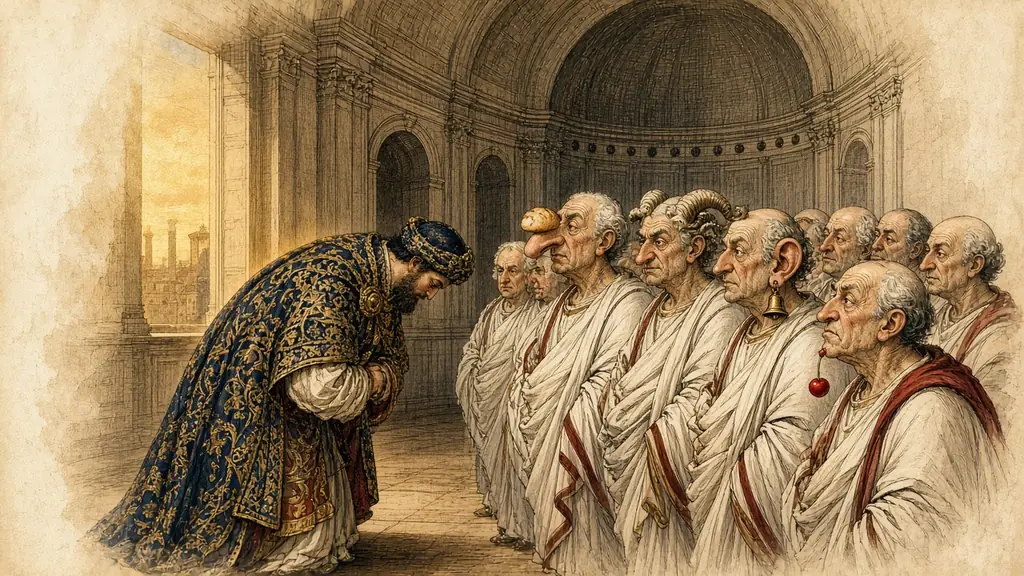
Rome, a little over two thousand years ago. A foreign ambassador, Cineas, arrives from the court of King Pyrrhus of Epirus, who is at war with Rome and wants to talk. He has a problem that anyone who has been to a big party will recognise. The Senate has hundreds of members. Everyone expects to be greeted by name. And the ambassador has never met any of them.
The Roman writer Pliny the Elder, who collected examples of great memories in his Natural History, says that Cineas managed it. On the day after he arrived in Rome, he greeted all the senators, and all the knights, by name.
Pliny gives other examples. He says King Cyrus could call every soldier in his army by name. He says a Roman, Lucius Scipio, knew the names of all the citizens of Rome. He says King Mithridates, who ruled twenty-two peoples, could give judgments in each of their languages. Whether every detail is true, the stories show what people admired: a leader who knew your name.
A name is the most personal word there is. To remember it is a way of saying you matter to me. And to forget it, people tell us, is one of the most painful social mistakes.
Why do we forget names so easily? Because when we are introduced, we are usually busy thinking about what to say, or how we look. The name comes in at one ear and goes out at the other. It is also an abstract word: Greg is not a picture, and a face with a new name on it is a bundle of unconnected facts.
The cure is to turn the name into a picture, and fasten that picture to something you notice in the face. It takes about five seconds, and it works because a name is no longer a sound but a scene.
Words worth knowing
Say what you think each one means, then open it.
Pliny the Elder, Natural History VII, lists these feats of memory (Cyrus, Lucius Scipio, Cineas, Mithridates). Retold here in our own words.
Five steps for a name
A name is a sound; a face is a picture. The method joins them in a scene.
- Hear it. Slow down. Look at the person, and ask them to repeat the name or spell it if you are not sure.
- Say it. Use it at once: 'Nice to meet you, Greg.' Then once or twice more in the conversation.
- Find one feature. Pick something about the face or hair that you notice first: ears, eyebrows, a smile, glasses. Pick a feature, not a judgement.
- Turn the name into a picture. A sound-alike or a meaning: Greg = a gremlin, Rose = a rose, Carmen = a car full of men.
- Join them, big and moving. Make the picture act on the feature, and exaggerate: a gremlin is swinging from Greg's huge ears.
Turning names into pictures
| Name | Idea | Picture |
|---|---|---|
| Rose | meaning | a red rose in the hair |
| Carmen | sound: car + men | a car full of men |
| Victor | sound: victory | a trophy, a winner's cup |
| Helen | sound: hell + hen | a hen in a fire |
| Hugh | sound: hue / who? | a spray of colour |
| Dan | sound: dam | a dam or a dancer |
Keep it kind
- Pick a feature you could praise: the colour of the eyes, the wave of the hair, the shape of a smile.
- Keep your pictures private: they are for your memory, not for saying.
- Do not choose features that make you judge the person. A neutral thing, like glasses or hair, is enough.
find a feature,
picture the name,
join them.
Reviewing
That evening, run through the faces you met, one by one, and say the name picture for each. A name you review the same day will usually stay for a week. Review it again after a few days and you will probably have it for good. You can also place the pictures at places in a palace if you must keep a large number.
Now you build
Have a go before you open any answer. A rough attempt teaches you more than a perfect model you only read.
Greg
Rose and Carmen
Victor and Helen
Name to picture
The steps
A first meeting
Drill
Flash cards
Say the answer first, then tap the card.
Quick quiz
The memory challenge
Memory challenge: six new faces
Six people you have just met. For each, make a name picture and join it to the feature. When the time is up, type the six names, in any order.
One scene per person: name picture + feature.
The list has gone. Type what you remember, one item per line.
Look back
These reach back to earlier rooms. Answer in your head or out loud, then check.
What I can do now
A thought to keep
Whose name do you most want to remember this week? What is the picture, and where in their face does it sit?