A Pack of Cards
A shuffled deck may be in an order no one has ever seen. Fifty-two cards, fifty-two pictures, and a way to hold them all.
← Names and Faces · The whole course · Speaking Without Notes →
An order no one has ever seen
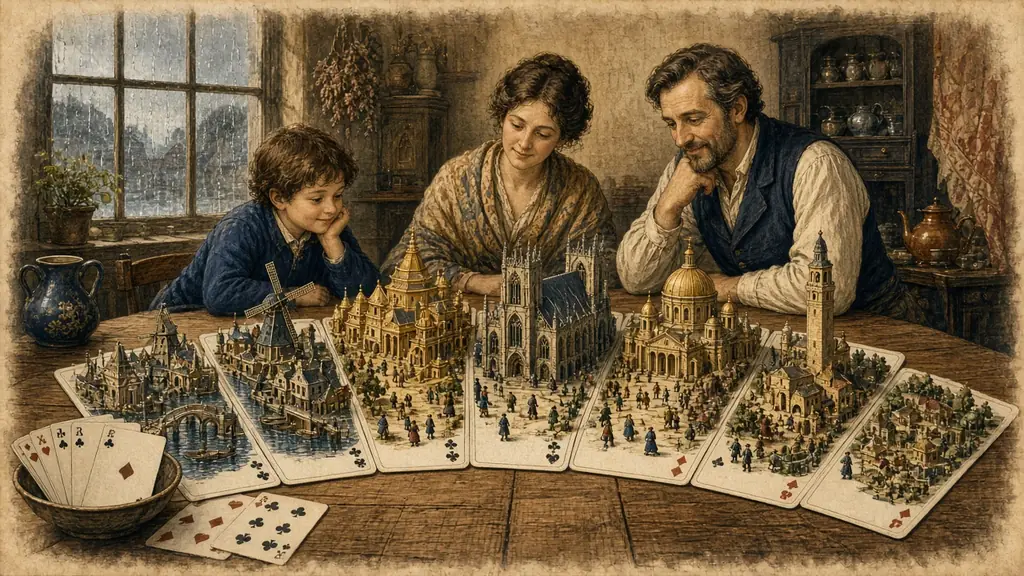
It is a rainy Sunday and a family is playing cards. Someone shuffles the deck, seven times as they were taught, and puts it in the middle of the table. The cards are no longer in any order a person could name. There is no Ace of Spades first, no King of Hearts at the end. It is a jumble.
Here is something curious. A pack has fifty-two cards, and the number of ways to arrange fifty-two things is fifty-two times fifty-one times fifty and so on all the way down to one. That number begins with eight and has sixty-eight digits. It is so large that a properly shuffled deck is almost certainly in an order that has never existed before, and will never exist again.
And yet a person can look at a shuffled deck and learn the whole order. People do it as a hobby and in competitions. They do not do it by repeating seven of hearts, queen of clubs, three of diamonds over and over. A card is a poor thing to remember: the same red and black marks, the same faces, fifty-two almost alike.
What they do is turn each card into a picture, and put the pictures in order along a route. In competitions the best of them learn a pack in less than thirteen seconds. The method is the one you already have.
To do this you need a fixed list of fifty-two pictures, one for each card, so that you never have to decide. The seven of hearts is always the same scene. In this lesson you will learn a simple system, and see how champions make it faster.
Fifty-two pictures sounds like a lot. But there is a pattern. Each suit is a family of thirteen, so you learn four families, not fifty-two separate things. You will build this system one suit at a time, and by the end of the room you will be able to run through a short hand.
Words worth knowing
Say what you think each one means, then open it.
The number of orders of a 52-card pack is 52! (about 8 × 1067).
Fifty-two pictures in four families
Give each suit a category and each rank a member of that category. One easy category is capital cities: each suit is a region, each rank is a city.
| Rank | Clubs (Europe) | Hearts (Asia) | Diamonds (the Americas) | Spades (Africa and Oceania) |
|---|---|---|---|---|
| Ace | London | Tokyo | Washington | Cairo |
| 2 | Paris | Bangkok | Mexico City | Abuja |
| 3 | Berlin | New Delhi | Ottawa | Pretoria |
| 4 | Rome | Beijing | Brasília | Nairobi |
| 5 | Madrid | Seoul | Lima | Rabat |
| 6 | Athens | Singapore | Bogotá | Canberra |
| 7 | Vienna | Ankara | Buenos Aires | Wellington |
| 8 | Prague | Manila | Santiago | Accra |
| 9 | Budapest | Hanoi | Caracas | Addis Ababa |
| 10 | Warsaw | Kuala Lumpur | Havana | Dakar |
| Jack | Lisbon | Kathmandu | Quito | Tunis |
| Queen | Brussels | Riyadh | Montevideo | Kampala |
| King | Amsterdam | Tehran | San José | Lusaka |
Each city then becomes a vivid scene you can see: London is Big Ben and a red bus; Tokyo is neon and Mount Fuji; Cairo is the pyramids and a camel.
- See the card. Say its suit and rank in your head: seven of hearts.
- Look up its picture. Hearts is Asia; 7 is Ankara.
- Make the scene big and moving. You stand in a crowded Ankara market, with the smell of bread and the call to prayer.
- Place it. Put the scene at the next place on your route.
- Go on. One picture per card, one place per picture, in order.
How champions go faster
Champions do not use one picture per card. They give every card a person (or a person with an action and an object, like PAO), and then take two or three cards at a time: the first card gives the person, the second the action, the third the object. A pack of 52 then needs only about 17 scenes, and a scene takes a couple of seconds to build. This is how a whole pack can be learned in under a minute.
rank = a city.
a fixed picture for
each of the 52.
Start small. Learn the clubs this week, then the other suits. The system only works through repetition; once it is automatic you will see the picture the moment you see the card.
Now you build
Have a go before you open any answer. A rough attempt teaches you more than a perfect model you only read.
Which city?
Seven of hearts
Three cards in a row
The pattern
Run the clubs
Drill
Flash cards
Say the answer first, then tap the card.
Quick quiz
The memory challenge
Memory challenge: eight cards
Eight cards drawn at random. Turn each into its city scene and place it at your palace. Type the cards back in order, like 'King of Clubs'.
King of Clubs = Amsterdam. 2 of Hearts = Bangkok. 9 of Spades = Addis Ababa...
The list has gone. Type what you remember, one item per line.
Look back
These reach back to earlier rooms. Answer in your head or out loud, then check.
What I can do now
A thought to keep
Which suit would you like to learn first, and what is your first picture for it?