Formulas as Characters
A clerk in a patent office changed physics in one year. You will turn five famous formulas into short scenes you can read like a sentence.
← Twenty-Six Pegs · The whole course · The Night Before the Exam →
The clerk who changed the world in a year
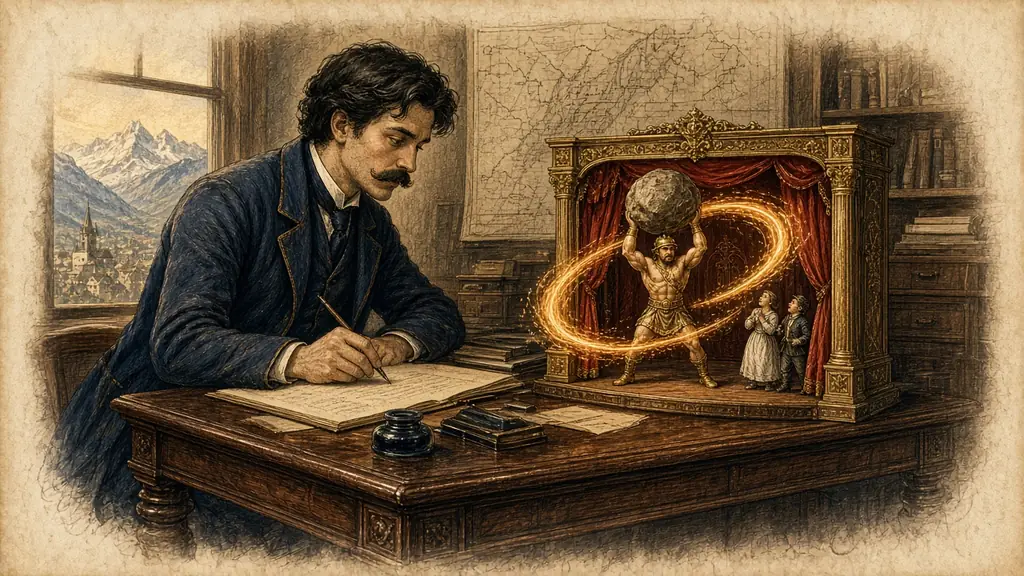
Bern, Switzerland, 1905. A young man in his twenties sits at a high desk in the patent office, reading other people's ideas for new machines. He is a clerk, and nobody thinks of him as a scientist. At home, in his spare time, he is thinking about the nature of light, time and space.
In that one year he sent four papers to a leading German journal. Any one of them would have made his name. They explained how light carries energy in small packets, how tiny particles in water jiggle, how time and space change at high speed, and, in a short paper at the end of the year, how mass and energy are connected. His name was Albert Einstein.
The last paper gave the world the most famous formula ever written: E = mc². Energy equals mass times the speed of light, squared. Five characters, and yet they say that a tiny amount of matter holds an enormous amount of energy.
Millions of people know this formula without knowing what it means. And that is a clue to something about memory. You can remember a formula as a picture of symbols, but if you do not understand it, it will not last, and you will not know when to use it. A formula is a sentence. First understand what it says.
Once you understand a formula, the problem is the symbols. E, m, c, a little 2: they look like nothing. They are abstract, and we found in the last lessons what the mind does with abstract things: it lets go.
So we give them life. Each symbol becomes a character, each operation an action, and the whole formula becomes a short scene. It sounds silly, and it is: that is what makes it work.
Words worth knowing
Say what you think each one means, then open it.
Einstein's 1905 papers: the mass-energy paper appeared in the same year as the other three. Told here in our own words.
A character for every symbol
Understand the formula first. Then make it a scene.
- Say what it means. In words, in one sentence. 'Force equals mass times acceleration.'
- Give each symbol a character. Use the first letter or the meaning: E = eagle (energy), m = mouse (mass).
- Give each operation an action. '=' is a balance or a table; '×' is a crossing; '²' is a twin or a square box; '+' is a joining.
- Join them in one scene. The characters, in the same order as the formula, doing the actions.
- Test it with a number. Put in simple numbers and check the result. If it works, the formula is yours.
| Formula | Meaning | The scene |
|---|---|---|
| E = mc² | Energy equals mass times the speed of light squared | An Eagle is carried by a Mouse riding a Cheetah, twice round the track. |
| F = ma | Force equals mass times acceleration | A Fist hits a Mouse and he flies away like an Arrow. |
| a² + b² = c² | In a right-angled triangle, the squares on the two shorter sides add up to the square on the longest side | A ladder (c) leans against a wall (a) and a floor (b): two small gardens plus a medium one fill one big garden. |
| C = 2πr | Circumference equals two times pi times the radius | A Cheetah runs twice round a giant Pie (π) with a Rabbit in the middle. |
| A = πr² | Area equals pi times the radius squared | A pie cut into a perfect circle: a Rabbit, twice, sits on top of the pie (π): that is the Area. |
Meaning before pictures
- Understand first. A picture of a formula you do not understand will fade; a picture of one you do will stay.
- Check with numbers. If the sides of a triangle are 3 and 4, the longest side is 5: 9 + 16 = 25.
- Say it in words. If you can say it, you can build the scene.
- Review formulas the way you review any list: soon, then at longer gaps.
then picture,
then test with numbers.
Now you build
Have a go before you open any answer. A rough attempt teaches you more than a perfect model you only read.
Symbols and characters
Read the formulas
Build F = ma
Build the Pythagorean theorem
Two circle formulas
Teach it
Drill
Flash cards
Say the answer first, then tap the card.
Quick quiz
The memory challenge
Memory challenge: five formulas
Learn the five scenes in order. Type the five formulas, one per line, like 'E = mc2'.
An eagle on a mouse on a cheetah; a fist, a mouse and an arrow; a ladder; a cheetah round a pie; a rabbit on a pie.
The list has gone. Type what you remember, one item per line.
Look back
These reach back to earlier rooms. Answer in your head or out loud, then check.
What I can do now
A thought to keep
Which formula or rule do you most often forget? What would its characters be?