Close reading · a graphic memoir · B2/C1

Persepolis

A girl grows up in Tehran through a revolution and a war, and draws her life in black ink. Four lessons on how a memoir makes meaning.

Marjane Satrapi's Persepolis is one of the best-known graphic memoirs ever written. It is short on words and rich in meaning, which makes it ideal for learning how to read closely: how a page works, who is telling the story, what identity costs, and how far a true story can be trusted.

Each lesson teaches one tool you can use on any text, practises the language you need to write and talk about it, and ends with plenty of speaking. They build on each other, so take them in order. You do not need the book open, but reading it alongside will make everything stronger.

The map — click a lesson
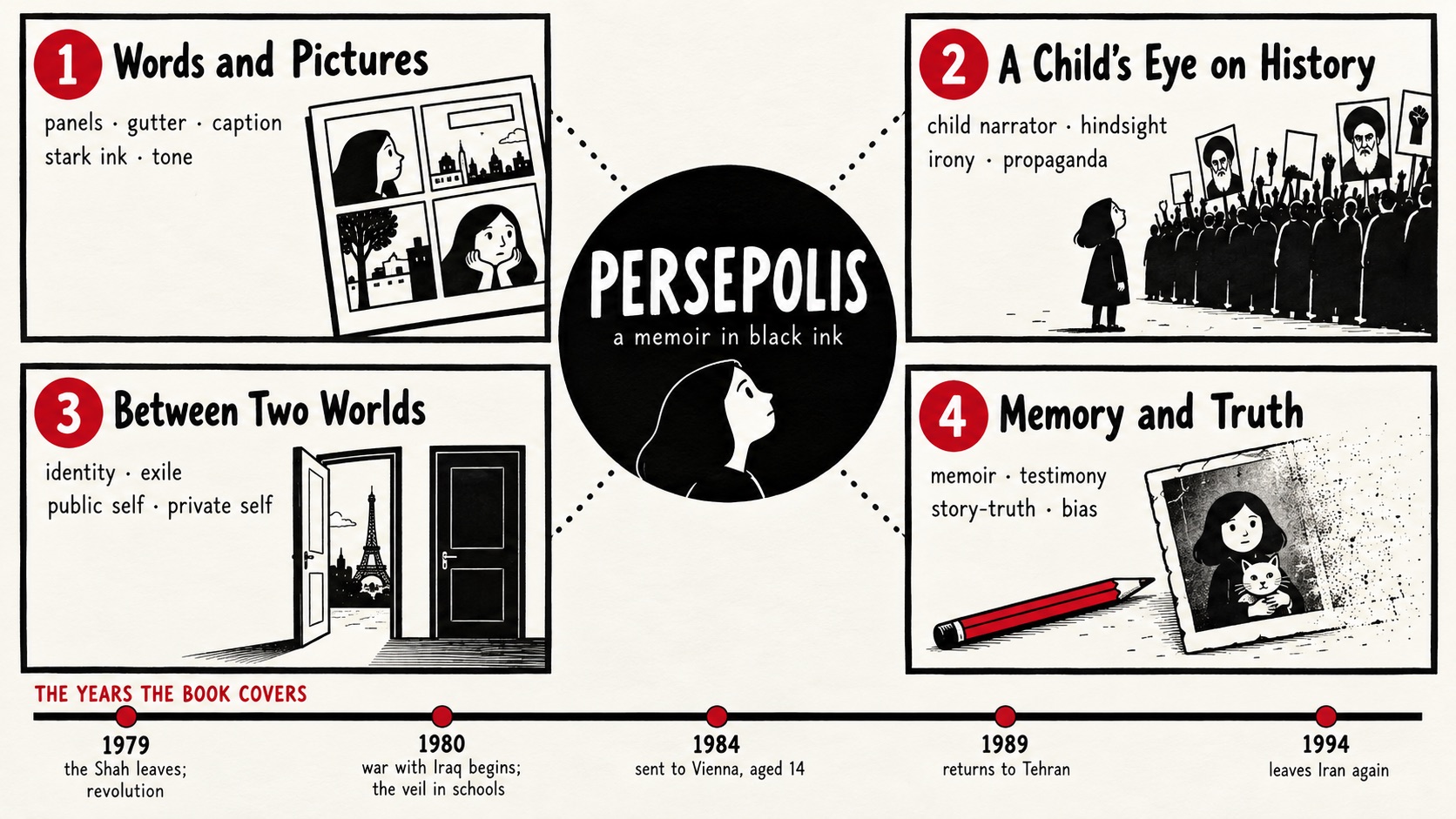
Four lessons, one book, and the years it covers. Reading for pleasure rather than for an exam? See Persepolis: Book Club.

Who it is for

Anyone who wants to read a text closely and write or speak about it with precision: students of literature and anyone who wants an analytical, essay-ready approach to a book. (Reading for pleasure? Try the Book Club edition.) The language level is B2 to C1. No special knowledge of Iran or comics is needed — each lesson explains what you need.

The series

Read the pagewords · image · gap
→
Find the voicewho is telling, and how much do they know
→
Trace the selfpublic, private, between two worlds
→
Test the truthmemory, testimony, bias

The four lessons

LESSON 1 · CYCLE
Words and Pictures
Marjane Satrapi · Persepolis · 2000–2003
A memoir drawn in stark black and white. How to read a panel — the words, the picture and the gap between them — and why the simplest drawings can carry the heaviest subjects.
The tool: The Panel Cycle
Writing about a text in the presentOpen →
LESSON 2 · GRID
A Child's Eye on History
Iran · 1979 → 1980s · the child narrator and the adult author
How a story about huge events can be told through one small, curious voice — and what happens in the space between what the child knows and what we know.
The tool: Two Levels of Knowing
Hedging an interpretationOpen →
LESSON 3 · GRID
Between Two Worlds
Tehran · Vienna · Tehran · and away again, 1984 → 1994
What it costs to be one person in public and another in private, and what it feels like to belong to two places at once and neither entirely.
The tool: The Two Selves
Contrast and concessionOpen →
LESSON 4 · PYRAMID
Memory and Truth
Marjane Satrapi · and a war story that admits it was partly invented
What a memoir can promise and what it cannot, why a story can feel truer than a list of facts, and how to read a personal account with both trust and care.
The tool: The Truth Ladder
Reporting verbs and attributionOpen →

How each lesson works

1 · Key Words

Ten words, worked out before you read.

2 · The Story

The book and its context, in three parts, with a check and a talking point after each.

3 · The Tool

A simple method, a chance to try it, and where it breaks.

4 · Language

The grammar and phrases you need to write and talk about it.

5 · Speak

Timed speaking tasks, then harder questions.