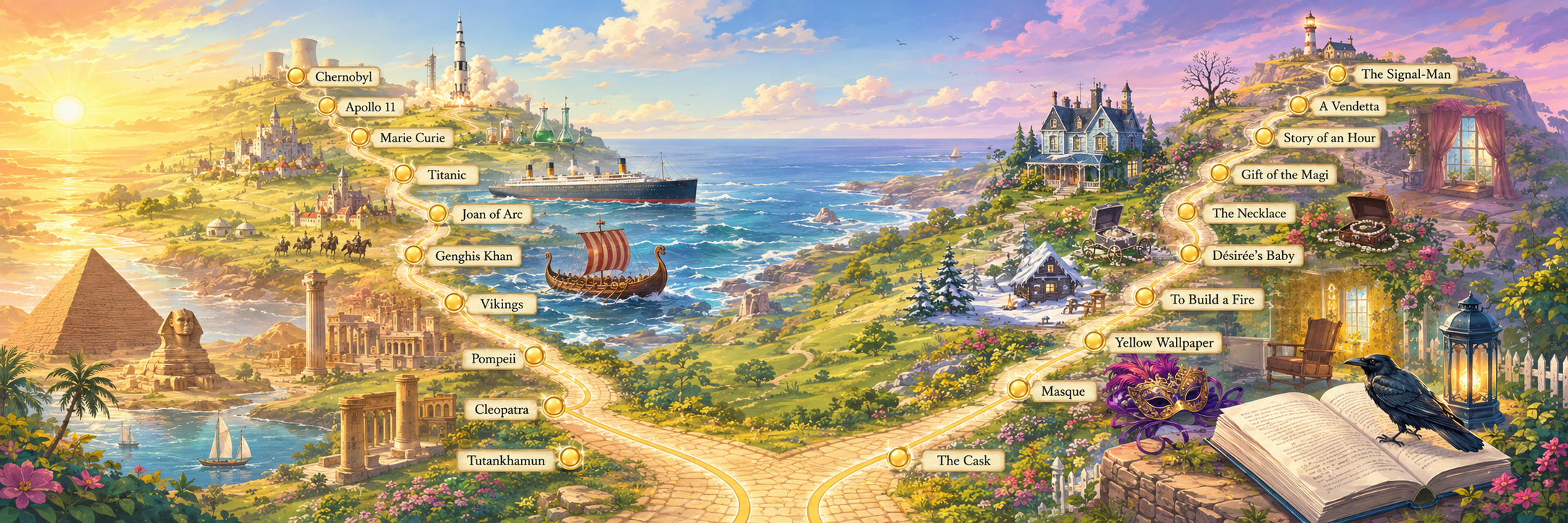
An illustrated map with two winding roads — one through history, one through short stories.
Short History, Long Echoes · read, speak, remember

Short History, Long Echoes

A hundred and thirty of history's most dramatic true stories — retold for English learners, at two levels, with the real podcast as your homework.

Real history makes the best language lessons: a gripping story to read, rich vocabulary to learn, and endless things to argue about. Each lesson here takes one extraordinary true story — a sinking ship, a queen's downfall, a city buried in a day — and turns it into a complete speaking lesson.

Most stories come at two levels (B2/C1 and a simpler A2/B1 twin), the newest are B2/C1 only, and every one teaches one grammar focus — the hundred and thirty are arranged below by that focus, so they build into a full course. The lessons stand completely on their own; the brilliant "Short History Of…" podcast sits at the end of each as optional listening — listen before for a head start, or after to stretch your ears.

🎭 Now go and speak it — Everyday Echoes Thirty B2/C1 conversation role plays — a museum, a market, a doctor's room — each carrying a small echo of one of these histories. →

Telling the past — narrative time & aspect

The Kray Twins
Two brothers who ruled London's underworld in the 1960s — and made themselves famous for it.
Narrative tensesOpen →
The Titanic
The "unsinkable" ship, and the night in 1912 that proved otherwise.
Past perfect & sequencingOpen →
Blackbeard
The most feared pirate of the age — and the canny showman behind the smoke and the legend.
Past simple vs continuousOpen →
Pompeii
The Roman city that vanished in a single day — and was found again seventeen centuries later.
used to / would (past habits)Open →
The Great Fire of London
Four days in 1666 that burned the medieval city to the ground.
Time & sequence clausesOpen →
The Terracotta Army
Eight thousand clay soldiers, buried for a first emperor who feared death.
Past perfect continuousOpen →
Agatha Christie
The best-selling novelist in history — and the eleven days she vanished without explanation.
Past perfect & narrative tensesOpen →
Dorando and the Olympic Marathon
London, 1908: the exhausted runner who entered the stadium first — and lost the gold medal at the line.
Narrative tensesOpen →
Dorando and the Olympic Marathon (A2/B1)
The same race, told more simply: the runner who came in first, collapsed, and was disqualified.
Past simple vs continuousOpen →

The future & the unreal — future forms · conditionals · wishes

Shackleton and the Endurance
The Antarctic expedition that failed at everything it set out to do — except survival.
Future-in-the-pastOpen →
The Moon Landing
How a promise made in 1961 put two men on the Moon before the decade was out.
Future perfect & continuousOpen →
The Wright Brothers
Two bicycle-makers from Ohio who taught the world to fly.
Future forms (will / going to)Open →
Cleopatra
The last pharaoh of Egypt — far shrewder than the legend allows.
Second conditionalOpen →
The Cuban Missile Crisis
Thirteen days in 1962 when the world came closest to ending.
Third conditionalOpen →
The Romanovs
The fall of Russia's last royal family — and the mystery that haunted the century after.
Mixed conditionalsOpen →
Marie Antoinette
The teenage queen who became the face of a doomed monarchy.
wish / if only (regret)Open →
The Spanish Armada
The vast fleet Philip II sent to crush England in 1588 — and the wind that wrecked it.
Conditional linkersOpen →
The Gunpowder Plot
1605: a cellar full of gunpowder beneath Parliament, and the plan to light it.
First conditional & future timeOpen →
The Tudors
Henry VIII broke with Rome and remade England — all for want of a son.
would rather / it's time / had betterOpen →
Harry Houdini
The penniless immigrant who became the world's greatest escape artist.
be about to / be on the verge ofOpen →

Stance, emphasis & certainty — modals · emphasis · the perfect

The Iliad & The Odyssey
The world's oldest adventure — from a blind bard's song to Christopher Nolan's 2026 film.
Hedging & tentative languageOpen →
Joan of Arc
A teenage peasant who heard voices, crowned a king, and turned a war.
Past modals of speculationOpen →
Nikola Tesla
The visionary who dreamed up the modern electric world — and died forgotten.
Cleft sentences (emphasis)Open →
Emperor Nero
Rome's most notorious emperor — and how much of the legend his enemies invented.
Inversion for emphasisOpen →
Marco Polo
A Venetian boy's journey to the court of the Khan — and the tales no one quite believed.
Distancing (apparently / allegedly)Open →
Amelia Earhart
The aviator who set record after record — then vanished over the Pacific, and was never found.
Present perfect vs past simpleOpen →
The Great Wall of China
Two thousand years, thousands of miles, and the myths that grew along with it.
Present perfect: for / sinceOpen →
Genghis Khan
An abandoned boy who forged the largest land empire the world has ever seen.
Modals of abilityOpen →
Hiroshima
August 1945, and the two bombs that ended a war and opened the nuclear age.
Modal perfects of regretOpen →
Rasputin
The Siberian holy man whose grip on the Russian court helped doom a dynasty.
Emphasis: do + so / such / tooOpen →
Easter Island
Nearly a thousand giant stone faces — and a mystery that still divides scholars.
Reporting verbs (suggest / claim)Open →

Building richer sentences — clauses & connectors

The Taj Mahal
The most beautiful building in the world — and the grief that built it.
Relative clausesOpen →
The Colosseum
Rome's giant arena — built to thrill a city, and to control it.
Purpose & result clausesOpen →
Marie Curie
The only person to win a Nobel Prize in two different sciences — at a terrible price.
Participle clausesOpen →
The Rosetta Stone
One broken slab of rock that unlocked an entire lost language.
Cause & result connectorsOpen →
Vincent van Gogh
A painter who sold almost nothing in life — and became immortal in death.
Concession & contrastOpen →
The Forbidden City
Five centuries of emperors behind walls no commoner could enter.
Gerunds & infinitivesOpen →
The Maya
Astronomers and city-builders of the rainforest, whose cities the jungle swallowed.
Advanced relative clausesOpen →
The Roman Republic
How Rome ruled itself for five centuries — and slid into one man's hands.
Discourse markers & linkingOpen →
Angkor
The vast temple-city of the Khmer, lost for centuries to the Cambodian jungle.
Nominalisation & formal registerOpen →
The Trojan War
Helen, the wooden horse, and the war between myth and history.
make / let / help / getOpen →
The Black Death
The plague that killed a third of Europe — and changed the world that survived.
Dependent prepositionsOpen →
The Wild West
Outlaws, lawmen and legend on the American frontier.
Phrasal verbsOpen →
The Scramble for Africa
How the European powers carved up a whole continent between them in barely thirty years.
Balancing ideas (both…and / neither…nor)Open →

Describing & quantifying — articles · quantity · description

The Vikings
Raiders, traders and explorers who reached America 500 years before Columbus.
Articles & determinersOpen →
The Great Depression
The boom everyone was sure would last forever — and the crash that followed.
Quantifiers & quantityOpen →
Alexander the Great
The young king who conquered the known world by thirty — and never lost a battle.
Comparatives & superlativesOpen →
The Gladiators
The fighters of the arena — and the truth behind the spectacle.
Adjective orderOpen →
The Conquistadors
A few hundred Spaniards, and the fall of two great American empires.
Comparison: every bit as / nowhere nearOpen →
The Spanish Flu
The 1918 pandemic that infected a third of the planet and spared almost no one.
Determiners (all / every / each)Open →
The World Cup
How a modest tournament of thirteen teams became the most-watched spectacle on Earth.
Intensifiers & extreme adjectivesOpen →

Voice, report & obligation — passive · causative · reporting · modals

Stonehenge
Five thousand years old, and still keeping its secret.
The passive & deductionOpen →
Tutankhamun
A forgotten boy king who became the most famous pharaoh of all.
The causativeOpen →
The Salem Witch Trials
How fear and rumour sent twenty innocent people to the gallows.
Reported speechOpen →
Machu Picchu
The Inca city in the clouds that the Spanish never found.
Passive reportingOpen →
The Samurai
Japan's warrior class — the sword, the code, and the long fall from power.
Obligation & permissionOpen →
The Aztecs
The island capital of Tenochtitlan, the tribute empire, and the gods who demanded blood.
The subjunctiveOpen →
Pearl Harbor
The surprise attack of December 1941 that pulled America into the war.
Reported questions & commandsOpen →
Chernobyl
April 1986: the reactor that exploded, and the secret the Soviet state tried to keep.
Get-passive & passive reportingOpen →

Style, precision & interaction — description · emphasis · word-building

The Berlin Wall
A city split overnight in 1961 — and the night in 1989 the barrier finally came down.
be used to / get used toOpen →
Nelson Mandela
Twenty-seven years in a cell, then the choice of reconciliation over revenge.
-ever words (no matter)Open →
The Suffragettes
"Deeds not words" — the women who broke the law to win the vote.
Question tags & responsesOpen →
The Knights Templar
Warrior-monks and Europe's first bankers — arrested and destroyed in a single day.
Approximation & vague languageOpen →
The Mary Celeste
A ship found sailing the Atlantic in 1872 with not a soul aboard.
-ed vs -ing adjectivesOpen →
Alcatraz
"The Rock" — the escape-proof prison, and the 1962 breakout never solved.
Adverbs & adverbialsOpen →
Muhammad Ali
The Greatest — in the ring, and in refusing to fight a war he didn't believe in.
Ellipsis & substitutionOpen →
Boudica
The queen who united Britain's tribes and burned Roman London to the ground.
Reflexive & reciprocal pronounsOpen →
Petra
The rose-red city carved into desert rock, lost to the West for centuries.
Compound & possessive nounsOpen →
Vlad the Impaler
The real prince — and the fearsome legend that became Dracula.
Word formation (affixes)Open →

Ten more journeys through time — passives, perfects, relatives, reporting & more

The Pyramids of Giza
How — and why — the world's greatest tombs were raised from the desert.
The passive voiceOpen →
Napoleon
From a Corsican boy to Emperor of Europe — and his long, cold fall.
Past perfect & sequencingOpen →
The French Revolution
1789: bread, anger, and the day the people stormed the Bastille.
Cause & effect connectorsOpen →
The Crusades
Two centuries of holy war for Jerusalem — Saladin and the Lionheart.
used to / wouldOpen →
The Olympic Games
From sacred ancient Olympia to the modern revival of 1896.
Comparatives & superlativesOpen →
The Library of Alexandria
The dream of holding every book in the world — and how it was lost.
Relative clausesOpen →
The California Gold Rush
1849: gold in the hills, and a wild rush that remade the West.
QuantifiersOpen →
Leonardo da Vinci
Painter, inventor, scientist — the mind that still amazes the world.
Present perfectOpen →
The Battle of Hastings
1066: one day that changed England's crown, its land and its language.
Narrative tenses & time clausesOpen →
Mutiny on the Bounty
Paradise, rebellion, and an impossible voyage across the Pacific.
Reported speechOpen →

From the ancient world to the modern age — rulers, empires, wonders & disasters

Julius Caesar
Rome's most famous man — the Rubicon, absolute power, and the Ides of March.
Participle clausesOpen →
Hannibal
Elephants over the Alps, and the one general Rome feared above all others.
Third conditionalOpen →
The Fall of Constantinople
1453: the giant cannon, the great walls, and the end of the Byzantine Empire.
Concession linkersOpen →
The Space Race
Sputnik to the Moon — the Cold-War rivalry that reached the stars.
Future-in-the-pastOpen →
Queen Victoria
The teenage queen who gave her name to an age of empire and industry.
Adjective orderOpen →
Hadrian's Wall
Why Rome drew a line across Britain — and the soldiers who lived on it.
Prepositions of place & movementOpen →
The Boston Tea Party
The night a tax on tea lit the fuse of the American Revolution.
Expressing purposeOpen →
The Hindenburg
The golden age of the airship, and the 37 seconds that ended it.
Past continuous (scene-setting)Open →
The Seven Wonders of the Ancient World
The Hanging Gardens, the Colossus, the Lighthouse — and what became of them.
Reported passiveOpen →
Catherine the Great
A minor German princess who seized a throne and ruled Russia for 34 years.
Past modals of obligationOpen →

Ten more true stories — from Sparta and the Medici to Waterloo, the Alamo and the bomb

Sparta
The Greek city-state that raised its sons for war — and made its unforgettable last stand at Thermopylae.
Comparatives & superlativesOpen →
King Arthur
The once and future king: the tangled history and legend behind Camelot, the sword and the Round Table.
Narrative tensesOpen →
The Medici
The Florentine bankers who turned a fortune into beauty by the acre — and funded the Renaissance itself.
Present perfect vs past simpleOpen →
Anne Boleyn
The queen who reshaped a country, gave England Elizabeth I, and then fell faster than anyone at court thought possible.
Past modals of speculationOpen →
The Battle of Waterloo
One long, muddy day in 1815 that turned hour by hour — and ended the Napoleonic Wars for good.
Linkers: time & contrastOpen →
The Alamo
Thirteen days, a walled mission and a doomed garrison — and three words that outlived them all.
Reported speechOpen →
Al Capone
How Prohibition turned a Brooklyn boy into America's most famous gangster — undone at last by his tax returns.
Gerunds & infinitivesOpen →
The Manhattan Project
The secret wartime race to build the atomic bomb — and the scientists who had to live with what they made.
The passive voiceOpen →
Pablo Escobar
The poor boy from Medellín who built the world's largest cocaine empire — and held a whole nation hostage.
used to & wouldOpen →
The Bermuda Triangle
Vanished ships and planes, a legend that grew in the telling — and the science that quietly explains it.
Relative clausesOpen →

Seven more true stories — the passive voice & past habits

The Silk Road
Not one road but a web of routes — the network that carried silk, faith, invention and plague between East and West.
The passive voiceOpen →
The Dancing Plague of 1518
A real event so strange it sounds invented: a plague not of illness but of dancing, in the streets of Strasbourg.
The passive voiceOpen →
Krakatoa
The 1883 eruption heard three thousand miles away, and the tsunami that followed it.
The passive voiceOpen →
Mansa Musa
The emperor of Mali whose pilgrimage to Mecca was so lavish it unsettled the economies he passed through.
The passive (past)Open →
The Antikythera Mechanism
A corroded lump from a Greek shipwreck that turned out to be a two-thousand-year-old astronomical computer.
The passive voiceOpen →
The Christmas Truce of 1914
The night the guns stopped and men climbed out of the trenches to meet the enemy in no man's land.
used to / would (past habits)Open →
Ching Shih
The Cantonese pirate commander who led tens of thousands of men — and negotiated her own retirement.
The passive voiceOpen →

Telling the past, timing the story — narrative time · the historic present · conditionals

Nellie Bly
The reporter who had herself committed to a madhouse to expose it — then raced around the world in seventy-two days.
Time & duration expressionsOpen →
Ned Kelly
The Australian bushranger who made himself armour out of plough steel, and became a national argument that has never ended.
Narrative time clausesOpen →
Anne Frank
A girl who kept a diary in a hidden annexe for two years, and whose voice became the way the world learned to hear six million.
The historic presentOpen →
Charlemagne
The Frankish king who conquered half of Europe, revived learning, and was crowned emperor on Christmas Day 800.
Superlatives & ordinalsOpen →
Mary Queen of Scots
A queen at six days old, a widow at eighteen, a prisoner for nineteen years, and the only anointed monarch her cousin ever put to death.
Inverted conditionalsOpen →
Apollo 13
The moon landing that failed, and became the finest thing NASA ever did.
Conditionals of contingencyOpen →

Cause, consequence & scale — passives · linkers · data & proportion

The Great Smog of London
Five days of windless December air in 1952 that killed thousands of Londoners, and forced a country to stop burning its cities.
Cause-and-effect verbsOpen →
The Haitian Revolution
The only slave revolt in history that founded a nation — and the price its people were made to pay for winning.
Cause, consequence & concessionOpen →
The Irish Potato Famine
A crop disease, a political theory, and the years that halved a country.
Agentless passives & responsibilityOpen →
The East India Company
A private company with its own army that came to trade in spices and ended up ruling a subcontinent.
Expressing scale & proportionOpen →
Florence Nightingale
The lady with the lamp who was, far more importantly, a statistician who used data to force a government to change.
Describing change & dataOpen →
The Printing Press
A goldsmith's machine that broke the Church's grip on the written word and made the modern world possible.
The passive for processesOpen →
The Partition of India
A line drawn across a subcontinent in five weeks, and the largest forced migration in human history.
Verbs of change & transitionOpen →

Argument, evidence & doubt — clefts · reporting · certainty · relative clauses

Christopher Columbus
The navigator who was wrong about almost everything, reached a continent he never accepted he had found, and is still argued about.
Corrective cleft sentencesOpen →
The Watergate Scandal
A third-rate burglary, a tape recorder in the Oval Office, and the only American president ever to resign.
Reporting verbs & their patternsOpen →
D.B. Cooper
The polite man in the dark suit who jumped out of a Boeing 727 with two hundred thousand dollars and was never found.
Degrees of certainty about the pastOpen →
Bletchley Park
Ten thousand people in wooden huts who read the enemy's mail, told no one for thirty years, and may have shortened the war by two.
Relative clauses with quantifiersOpen →
Magna Carta
A failed peace treaty between a broke king and his angry barons, which became the most famous document in the English-speaking world.
Legal modals (shall / must / may)Open →
The Panama Canal
The fifty-mile ditch that joined two oceans, killed tens of thousands, and created a country in order to be built.
Attempt & achievement patternsOpen →
The Conquest of Everest
Thirty years of failure, one morning in 1953, and two men who agreed never to say which of them stepped up first.
Phrasal verbs of journey & enduranceOpen →

Three more true stories — attribution · historical periods · means & instrument

Michelangelo
The sculptor who insisted he was not a painter, and spent four years proving otherwise on a chapel ceiling.
Passive with by-agents & attributionOpen →
The Renaissance
Not a sudden rebirth but three centuries of argument about what a human being is for.
Historical periods & approximate timeOpen →
The Industrial Revolution
Coal, steam and cotton remade the world in a century — and nobody agrees yet whether it was worth the cost.
Means & instrumentOpen →

Two more true stories — past habits · so & such for drama

The Real Robinson Crusoe
A hot-tempered sailor demanded to be left on an empty island — and spent four years alone finding out what a person really needs.
Past habits: used to & wouldOpen →
The Great Serum Run
Twenty drivers and 150 dogs raced medicine across frozen Alaska to save a town — and history cheered the wrong dog.
Result clauses: so … that / such … thatOpen →

How each lesson works

1 · Key Words

Learn the words you'll need — before you read.

2 · The Story

The true story, read in parts, with checks and discussion.

3 · Grammar

One structure the story teaches, with practice.

4 · Listen

The real podcast — optional, for before or after.

5 · Speak

Retell it, discuss it, make the language your own.

Happening right now — reason & precaution: in view of · for fear of

The Gold That Came Home
Europe sent its gold to New York when it feared Soviet tanks — and is quietly shipping it back now, for reasons nobody will quite name.
Reason & precaution: in view of / for fear ofOpen →