TOOL 01 · GRID
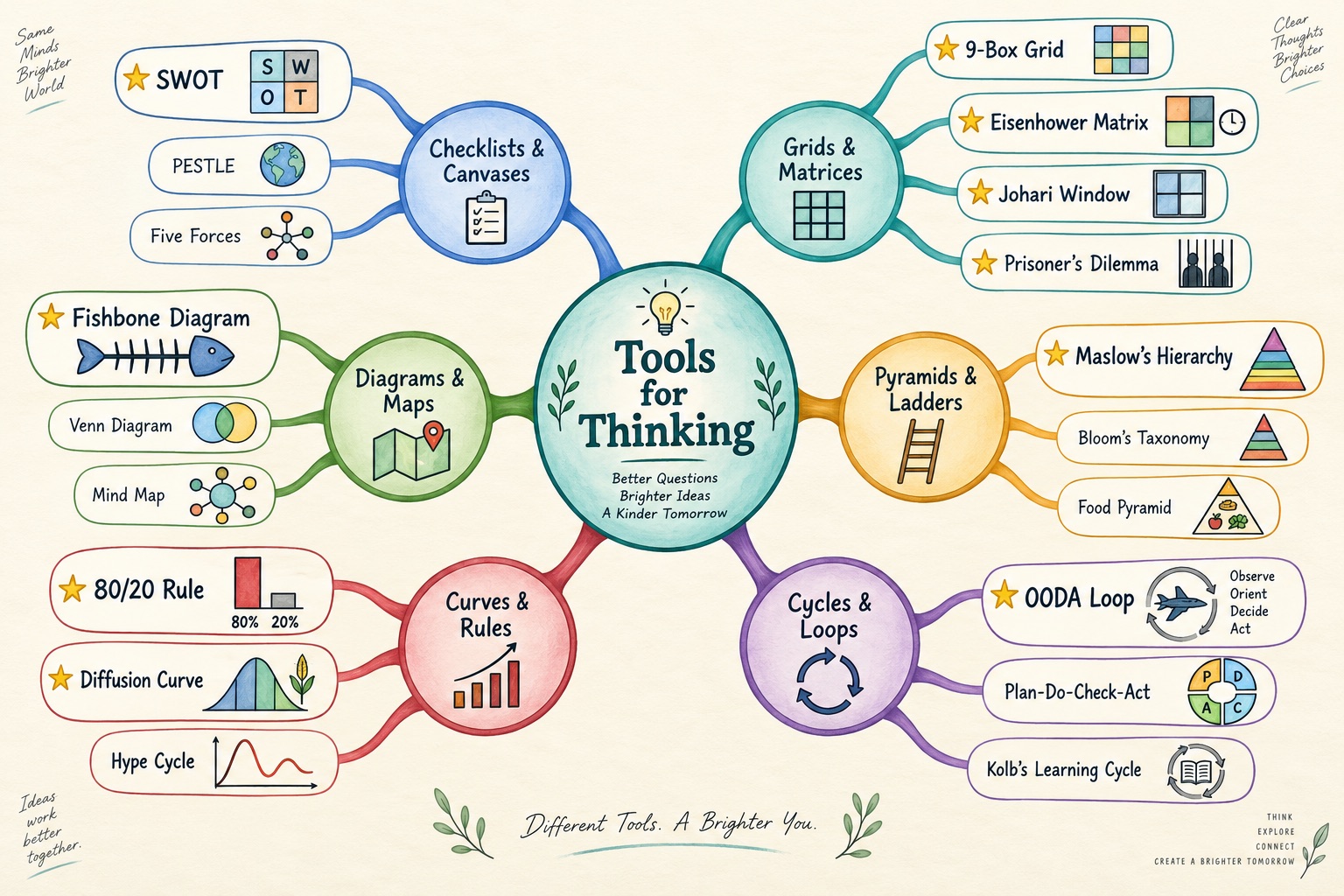
The 9-Box Grid
General Electric & McKinsey · 1970s → today
A giant company had too many businesses to understand. Its answer was a grid of nine boxes — and a generation later, HR teams were putting their own staff into the same boxes.
The story: Nine Boxes for Every Employee
TOOL 02 · GRID
The Eisenhower Matrix
Dwight D. Eisenhower · 1954 → Stephen Covey · 1989
He commanded the largest sea invasion in history and then ran the United States. His secret was not doing more — it was knowing what could wait.
The story: The General Who Ran Out of Time
TOOL 03 · GRID
The Johari Window
Joseph Luft & Harrington Ingham · 1955
Other people can see things about you that you have never noticed. Two Californian psychologists turned that uncomfortable truth into a window with four panes — and named it after themselves.
The story: Joe, Harry and the Window
TOOL 04 · GRID
The Prisoner's Dilemma
Flood, Dresher & Tucker · 1950 → Axelrod · 1980
Nuclear strategists built a game in which betraying your partner always looks smart — yet both players end up worse off. Thirty years later, a tiny computer program showed the way out.
The story: The Game That Explained the Cold War
TOOL 05 · PYRAMID
Maslow's Hierarchy of Needs
Abraham Maslow · 1943 → Charles McDermid · 1960
Every business student knows Maslow's pyramid. Almost nobody knows that Maslow never drew it — or that he warned against reading his ideas as a neat staircase.
The story: The Pyramid Maslow Never Drew
TOOL 06 · CURVE & RULE
The Pareto Principle
Vilfredo Pareto · 1896 → Joseph Juran · 1940s
Twenty per cent of the causes, eighty per cent of the results. The world's favourite rule of thumb began with tax records — and the man who named it later confessed he had given Pareto too much credit.
The story: The Rule of the Vital Few
TOOL 07 · DIAGRAM
The Fishbone Diagram
Kaoru Ishikawa · 1943 → Japan's quality revolution
After the war, “Made in Japan” meant cheap and badly made. A generation later it meant the opposite. One of the simplest tools behind that change looks like the skeleton of a fish.
The story: The Fish That Rebuilt Japan
TOOL 08 · CYCLE
The OODA Loop
John Boyd · US Air Force · 1950s–1990s
A difficult, brilliant pilot turned a dogfight into four words — observe, orient, decide, act — and changed how armies, companies and even emergency doctors think about speed.
The story: Forty-Second Boyd
TOOL 09 · CURVE
The Diffusion of Innovations
Ryan & Gross · 1943 → Everett Rogers · 1962
The new seed grew more corn. Farmers still waited years to try it — until they saw it working on a neighbour's farm. That discovery explains how smartphones, vaccines and ideas spread today.
The story: The Seed Nobody Wanted
TOOL 10 · CHECKLIST
SWOT Analysis
Stanford Research Institute · 1960s → the 2023 detectives
Strengths, weaknesses, opportunities, threats: every business student learns it. But who invented it? For fifty years, the answer everyone repeated had almost no evidence behind it.
The story: The Tool Nobody Invented
TOOL 11 · GRID
The Risk Matrix
Engineering & safety practice · 20th century → today
You cannot prevent everything. So safety experts score every danger twice — how likely, and how serious — and act on the red corner first. It is the most-used grid in the working world.
The story: The Grid That Keeps People Alive
TOOL 12 · STAGES
Tuckman's Team Stages
Bruce Tuckman · 1965 (fifth stage 1977)
Every new team goes through a polite beginning, a difficult argument, an agreement and then real work. The argument is not a sign of failure — it is stage two.
The story: Forming, Storming, Norming, Performing
TOOL 13 · GRID
Berry's Acculturation Model
John Berry · Canada · 1970s–80s
People argue as if keeping your culture and joining a new one were a single dial. One grid shows they are two separate questions — and that changes the whole conversation about migration.
The story: Two Questions for Anyone Living Abroad
TOOL 14 · QUESTIONS
The Five Whys
Sakichi Toyoda & Toyota · 20th century
The first answer to “why did that happen?” is almost never the real reason. Toyota's habit was to keep asking until the answer stopped being a person and started being a system.
The story: The Man Who Kept Asking Why
TOOL 15 · PYRAMID
Bloom's Taxonomy
Benjamin Bloom & colleagues · 1956, revised 2001
Not all thinking is the same. Remembering a fact is one thing; using it, judging it or creating something new with it is harder — and a good lesson or test asks for all of them.
The story: The Examiners' Ladder
TOOL 16 · PYRAMID
The Food Pyramid
Anna-Britt Agnsäter, KF · Sweden, 1974
Eat a lot of what's at the bottom, less of what's in the middle, and only a little of what's at the top. A whole diet at a glance — and a picture governments have argued about ever since.
The story: The Pyramid Made of Prices
TOOL 17 · CYCLE
Plan–Do–Check–Act
Shewhart, Deming & Japanese managers · 1939–1993
Don't make a big change in one go. Plan a small change, try it, check what happened, then act on what you learnt — and go round again.
The story: The Circle Deming Disowned
TOOL 18 · CYCLE
Kolb's Learning Cycle
David Kolb · 1970s–1984
An experience on its own may teach you very little. You learn when you look back at it, make sense of it and try out what you've understood — which gives you a new experience to learn from.
The story: The Doers and the Watchers
TOOL 19 · CURVE
The Hype Cycle
Jackie Fenn, Gartner · 1995
Excitement about a new technology rises far faster than the technology itself. After the peak comes a fall — and only those that survive the fall become part of everyday life.
The story: When to Leap
TOOL 20 · DIAGRAM
The Venn Diagram
John Venn · 1880
Draw a circle for each group. Where the circles overlap, things belong to both; outside them, things belong to neither. Every possible combination gets its own space.
The story: Circles and a Cricket Machine
TOOL 21 · DIAGRAM
The Mind Map
Tony Buzan · BBC, 1970s (roots far older)
Put the topic in the middle of the page and let the ideas branch out from it — one keyword per line, with colour and pictures. You see the whole subject, and how its parts connect, at a glance.
The story: The Doodles That Became a Brand
TOOL 22 · CHECKLIST
PESTLE
Francis Aguilar · 1967 → PEST → PESTLE
Before you plan, look outside: Political, Economic, Social, Technological, Legal and Environmental changes. Six headings, so that the big changes in the world don't take you by surprise.
The story: Scanning the Horizon
TOOL 23 · DIAGRAM
Porter's Five Forces
Michael Porter · Harvard Business Review, 1979
An industry's profits don't depend only on the rival down the road. Customers, suppliers, newcomers and substitutes all push on prices too — and the harder they push, the less profit there is to share.
The story: Who Takes the Profit?
 The 9-Box Grid
The Eisenhower Matrix
The Johari Window
The Prisoner's Dilemma
Maslow's Hierarchy of Needs
The Pareto Principle
The Fishbone Diagram
The OODA Loop
The Diffusion of Innovations
SWOT Analysis
Bloom's Taxonomy
The Food Pyramid
Plan–Do–Check–Act
Kolb's Learning Cycle
The Hype Cycle
The Venn Diagram
The Mind Map
PESTLE
Porter's Five Forces